


The McLaren W1 has arrived. The hypercar summer of 2026 has its headline act as the first of just 399 examples reach their owners, closing a lineage that began with the F1 and ran through the P1 — and opening a new chapter with the most powerful road car Woking has ever built. After nearly two years of development testing at circuits like Silverstone and in extreme-climate trials, the $2.1 million flagship has moved from prototype to private garage.
1,258 Horsepower, Rear Wheels Only
At the McLaren W1’s core is an almost entirely new 4.0-liter twin-turbocharged flat-plane-crank V8 — the MHP-8 — paired with McLaren’s most advanced hybrid system to date. The engine alone spins to 9,200 rpm and produces 928 PS; a radial-flux electric motor adds another 347 PS for a combined 1,258 bhp and 988 lb-ft of torque, every bit of it sent to the rear wheels through an 8-speed dual-clutch transmission with an integrated E-Differential.
In an era when its closest rivals split torque across two axles, McLaren’s decision to stay rear-driven is a philosophical statement: the W1 is meant to be managed, not merely deployed. The result is 0–62 mph in 2.7 seconds, 0–124 mph in 5.8 seconds — the fastest-accelerating road-legal McLaren in history — and a 217 mph top speed. With a dry weight of just 1,399 kg, the W1’s 911 PS-per-tonne power-to-weight ratio leads its class outright.
Downforce Over Top Speed
Where previous flagship generations chased headline velocity, the McLaren W1’s defining number is aerodynamic: up to 1,000 kg of downforce as speed builds — roughly five times what the car generates in standard road configuration. The system is anchored by the McLaren Active Long Tail, a rear wing that extends the car by 300 mm in Race mode while the suspension drops, expanding the working area of the diffuser and transforming the silhouette.
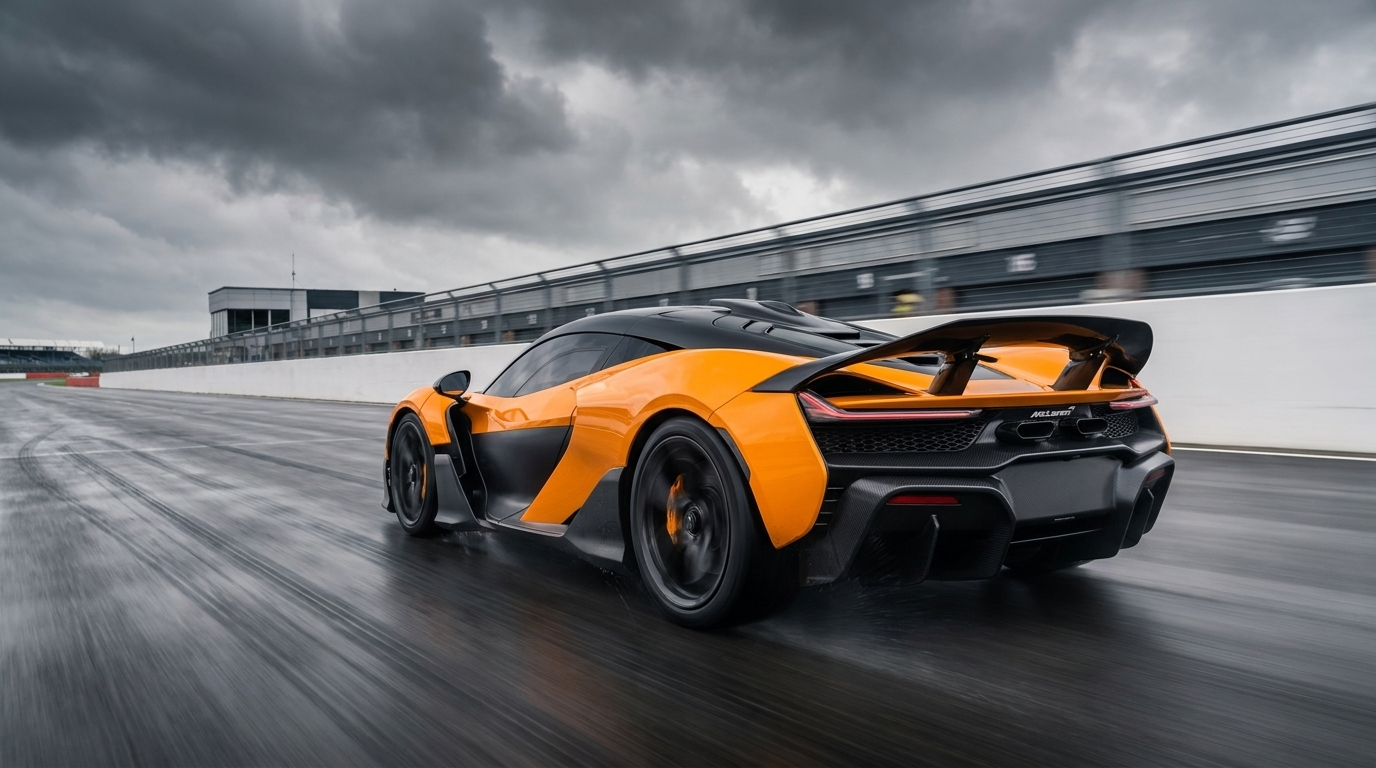
The wing itself is controlled by electric motors and can raise, lower, and rotate — working as a downforce device, an air brake, and a DRS system depending on the moment. Ground-effect underbody work does the rest. The McLaren W1 is also hundreds of kilograms lighter than the Ferrari F80, and in fast, committed corners that mass advantage is worth more than any horsepower gap.
Built Around the Driver: The Aerocell
The structural story is just as radical. The McLaren W1 sits on the Aerocell, the most advanced carbon-fiber monocoque McLaren has ever produced, with a raised footbox and a narrow front section shaped as much by airflow as by crash structure. The seats are bonded directly into the tub — the driver’s seat is fixed, with the pedal box and steering column adjusting to the driver instead — which shortens the wheelbase and drops the occupants deeper into the car.
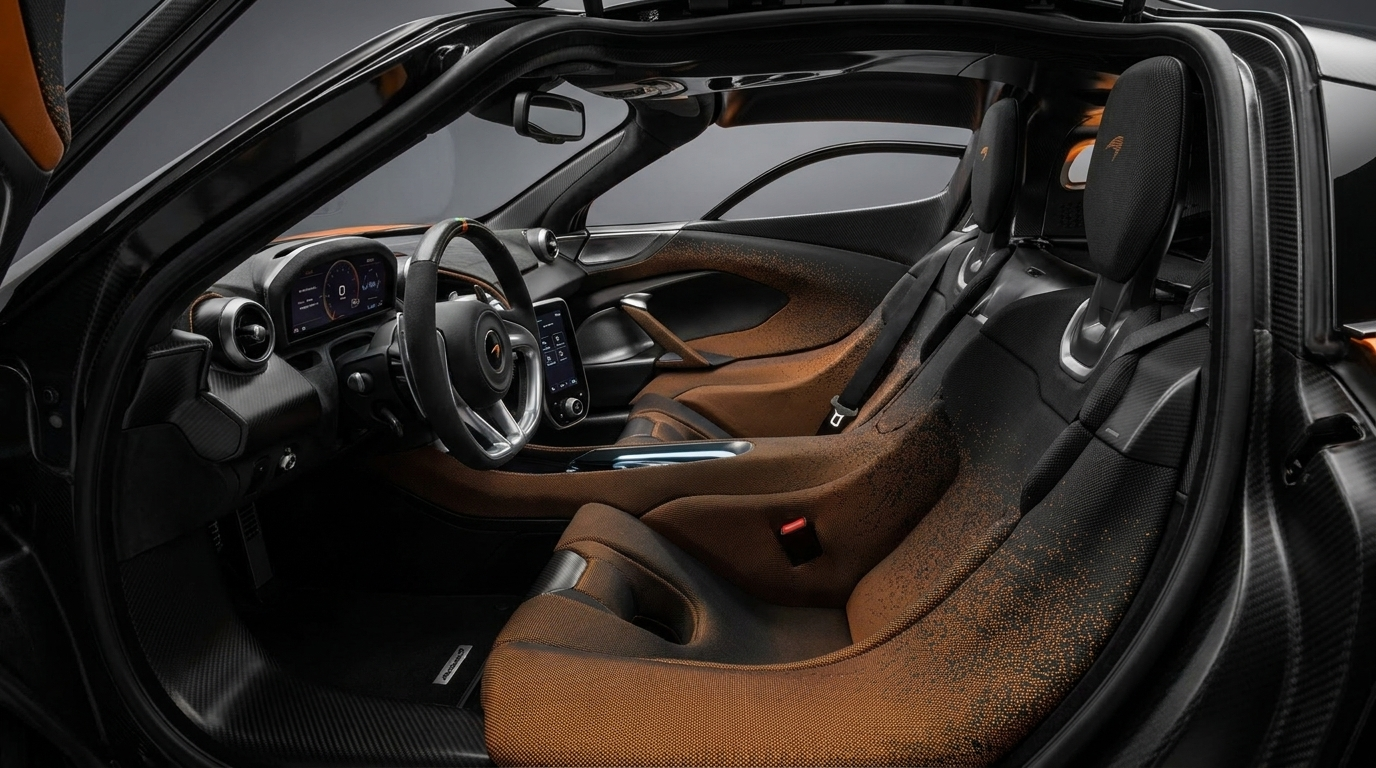
New anhedral doors replace McLaren’s familiar dihedral design, and the cabin debuts InnoKnit — a world-first 3D-knitted trim material that integrates lighting and speakers directly into its surface while cutting weight. The steering wheel is McLaren’s smallest and flattest yet, carrying integrated shift lights and dedicated Boost and Aero controls lifted straight from Formula 1 practice. It is a cockpit engineered like an instrument, not upholstered like a lounge.
The Weight of the Name
No modern McLaren has carried expectations like this one. The F1 redefined what a road car could be in the 1990s, and its naturally aspirated V12, gold-lined engine bay, and central driving position remain the reference point for the entire genre. The P1 helped invent the hybrid hypercar in 2013 alongside the LaFerrari and 918 Spyder. The W1 — named for McLaren’s “World Championship mindset” and revealed on the 50th anniversary of the team’s first Formula 1 titles — must live up to both. With Porsche notably quiet on a 918 successor, it arrives at a moment when the crown is genuinely contestable.
Sold Out Before the First Delivery
All 399 build slots were spoken for long before the first car turned a wheel, with McLaren Special Operations reporting some of the most extensive personalization commissions in its history — from bespoke paint and exposed-weave carbon bodies to fully tailored InnoKnit cabins.

The only path into a McLaren W1 now runs through the collector market, where early transactions are expected to command significant premiums over the $2.1 million list price — the standard pattern for sold-out flagship hypercars in their delivery year. The precedent is instructive: the F1 cost roughly half a million pounds in 1992 and now trades north of $20 million, while P1 values have climbed steadily past their original sticker.
McLaren W1 vs Ferrari F80
The rival matchup that will define this hypercar generation is already set. Ferrari’s F80 answers with 1,184 hp from a hybridized V6 and all-wheel drive, spreading its output across four contact patches where the W1 concentrates everything at the rear. Ferrari builds 799 cars; McLaren builds 399. One prioritizes accessibility of performance, the other purity of it. Track comparisons over the next twelve months will settle the spec-sheet debate, but the philosophical divide — and the scarcity gap — is already shaping how collectors value the two cars.
What Deliveries Mean for the Market
First deliveries are the moment a hypercar stops being a rendering and becomes an asset class. Early McLaren W1 resales over the next twelve months will set the tone for the entire 2026 hypercar cohort, much as Daytona SP3 results did for the previous cycle — and with Monterey auction week arriving in mid-August, the first public price discovery may come sooner than McLaren would like. For a deeper look at how this class trades, see our guide to exotic car market liquidity.
The McLaren W1 is a 399-unit hybrid hypercar producing 1,258 bhp from a twin-turbo V8 and electric motor, priced from about $2.1 million and sold out before launch. First customer deliveries began in 2026. It accelerates from 0 to 62 mph in 2.7 seconds, tops out at 217 mph, and generates up to 1,000 kg of downforce through its Active Long Tail aero system. It succeeds the McLaren F1 and P1 as the third chapter in the brand’s “1” car lineage.