

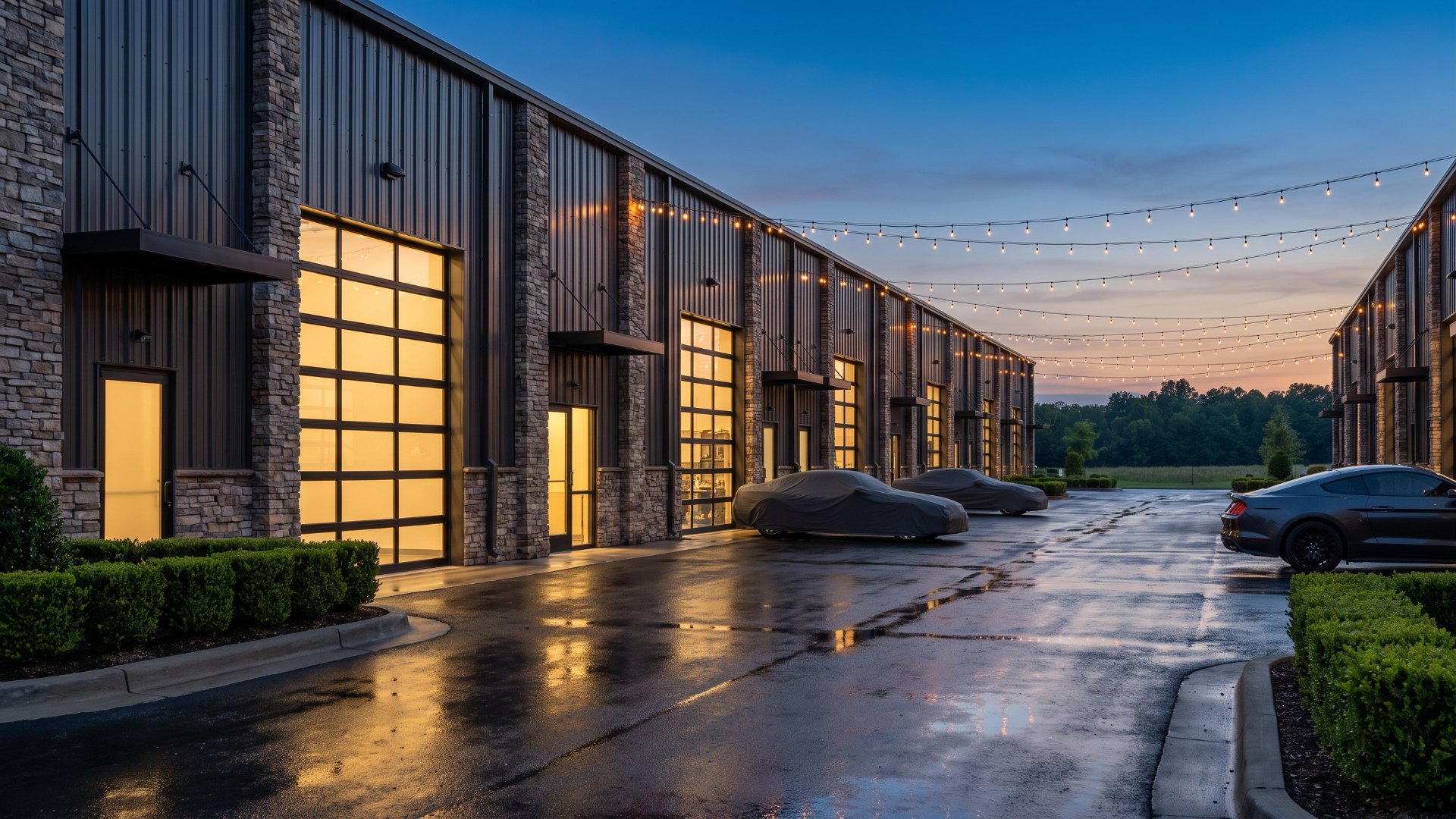
The U.S. garage condo market crossed 619 tracked developments this year, pre-sales are clearing before concrete cures, and what the phrase covers now runs from an $84,000 storage bay to a trackside suite with six hours of circuit time a week.
What You Need to Know
- National tracking of the category reached 619 developments by August 2026, up from roughly 500 in March and about 540 in April. Florida (77), Minnesota (65), Texas (52), Colorado (46) and Arizona (43) hold close to half the national pipeline.
- Pricing no longer lives in one range. Texas listings alone span $95 to $480 per square foot, and the category now runs from $84,000 entry storage units in Arizona to trackside garages past $1 million.
- Absorption is the number that separates a real project from a rendering. Several 2026 launches sold 84 percent of their inventory before completion, and one Illinois building took 25 commitments on 37 units inside ten days.
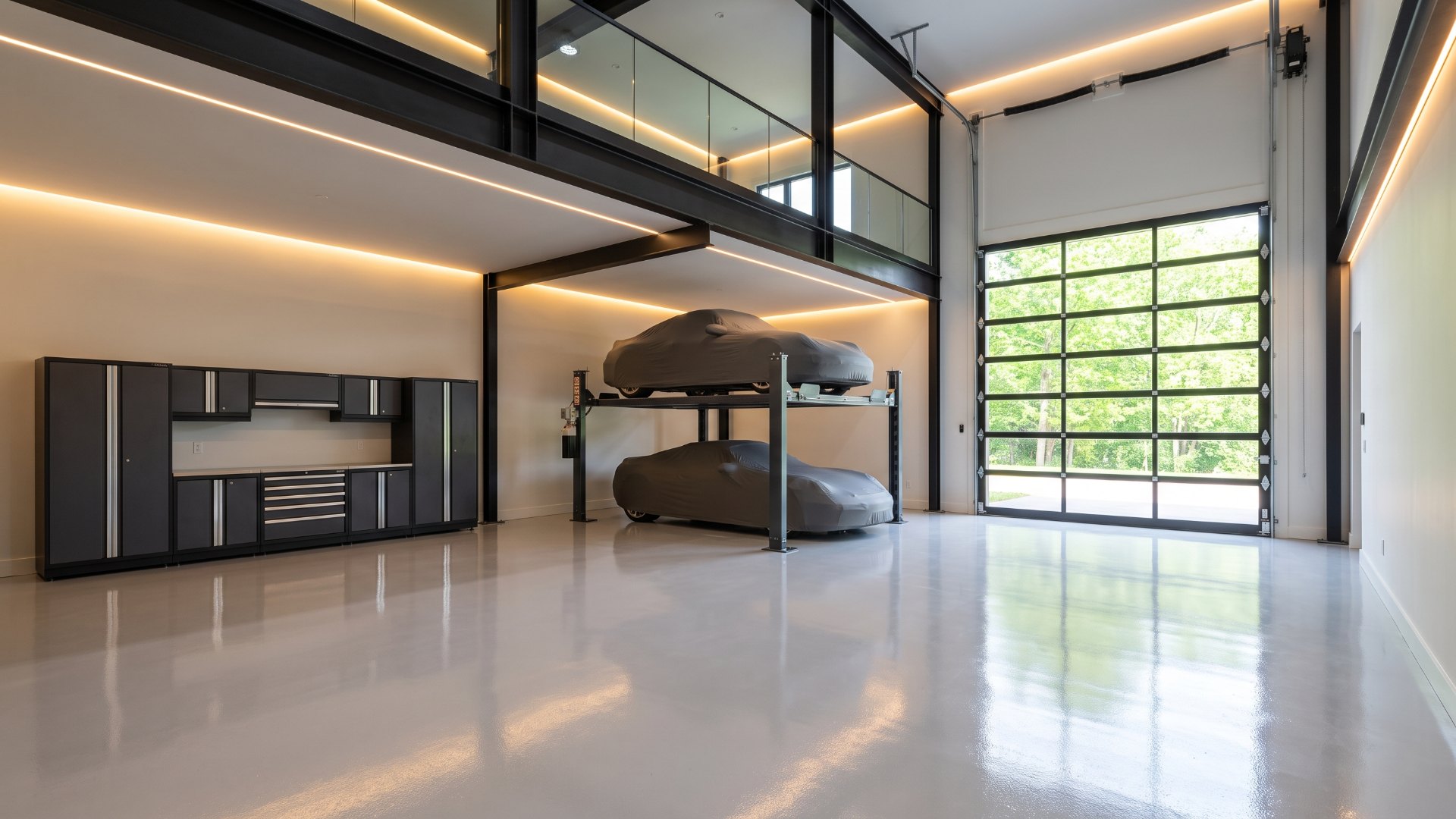
Ten years ago, telling someone you owned a garage condo required an explanation. In 2026 it requires a follow-up question, because the phrase now covers a $104,900 insulated box in Billings and a climate-controlled suite with a mezzanine lounge, a car lift and six hours of weekly track time thirty miles north of Detroit. Those are not the same asset. They are not even in the same business.
The scale of the shift is what makes this worth writing down. Industry tracking of the category counted roughly 500 projects across the country in March, about 540 in April, and 619 by August 2026. Some of that is better tracking rather than pure construction. Most of it is not. Nearly 50 developments in the database logged a genuine 2026 milestone — a groundbreaking, a phase completion, a first delivery.
Counts of the club-and-track end of the same world run to 374 unique facilities across 423 U.S. and 17 Canadian locations: 335 private car clubs, 43 private tracks, and 41 properties that combine the two. That tally ranks the states a little differently — Florida (74), California (55), Texas (50), Colorado (22), Arizona (18) — but it lands in the same place. The enthusiast has become a real estate customer, and the money behind these buildings is the same money that produced a $748 million Monterey auction week.
Three products, one word
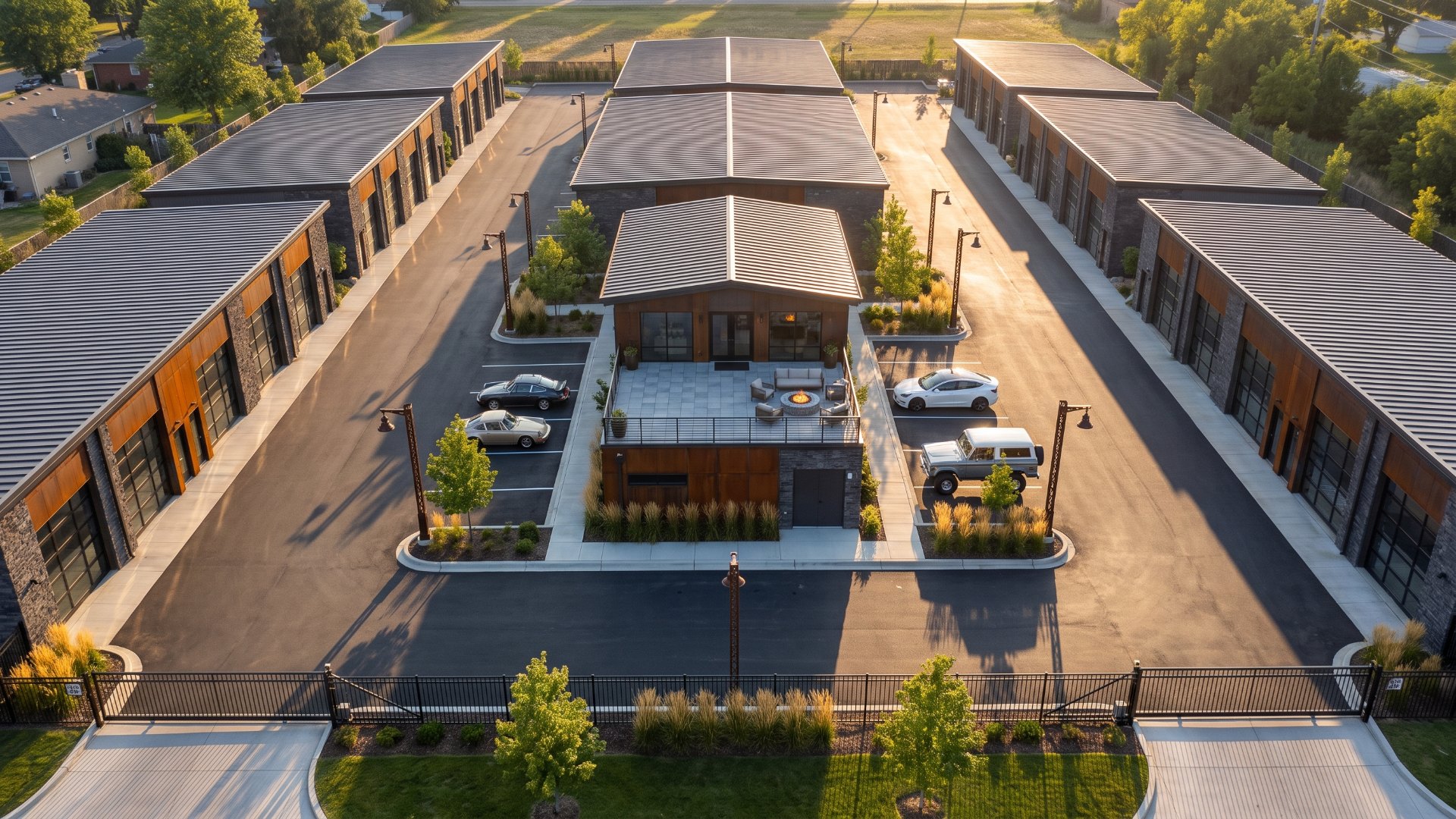
The most useful thing an experienced buyer can do right now is stop treating the garage condo market as a single category. In practice the market has separated into three tiers that share a floor plan and almost nothing else.
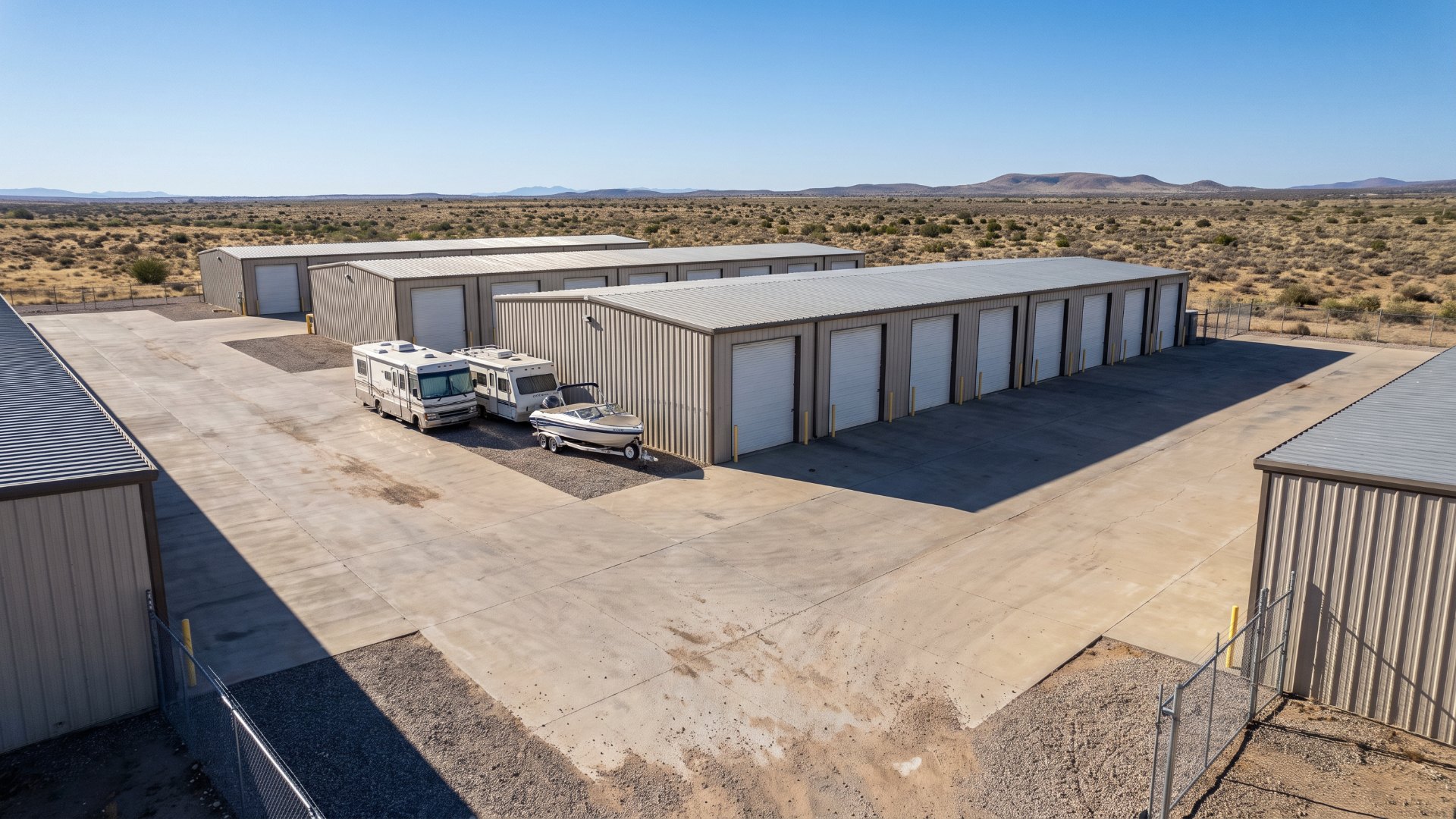
The storage condo. Metal building, insulated shell, 14- to 16-foot overhead door, maybe a bathroom, maybe three-phase power. Arizona’s entry product starts near $84,000. Billings, Montana has units at $104,900. Texas has listings at $119 and $140 per square foot in Cypress and Tomball. This is a shed you own instead of rent, and the math against a decade of self-storage invoices is the entire pitch. It is also the tier most exposed to ordinary industrial vacancy, because that is effectively what it is.
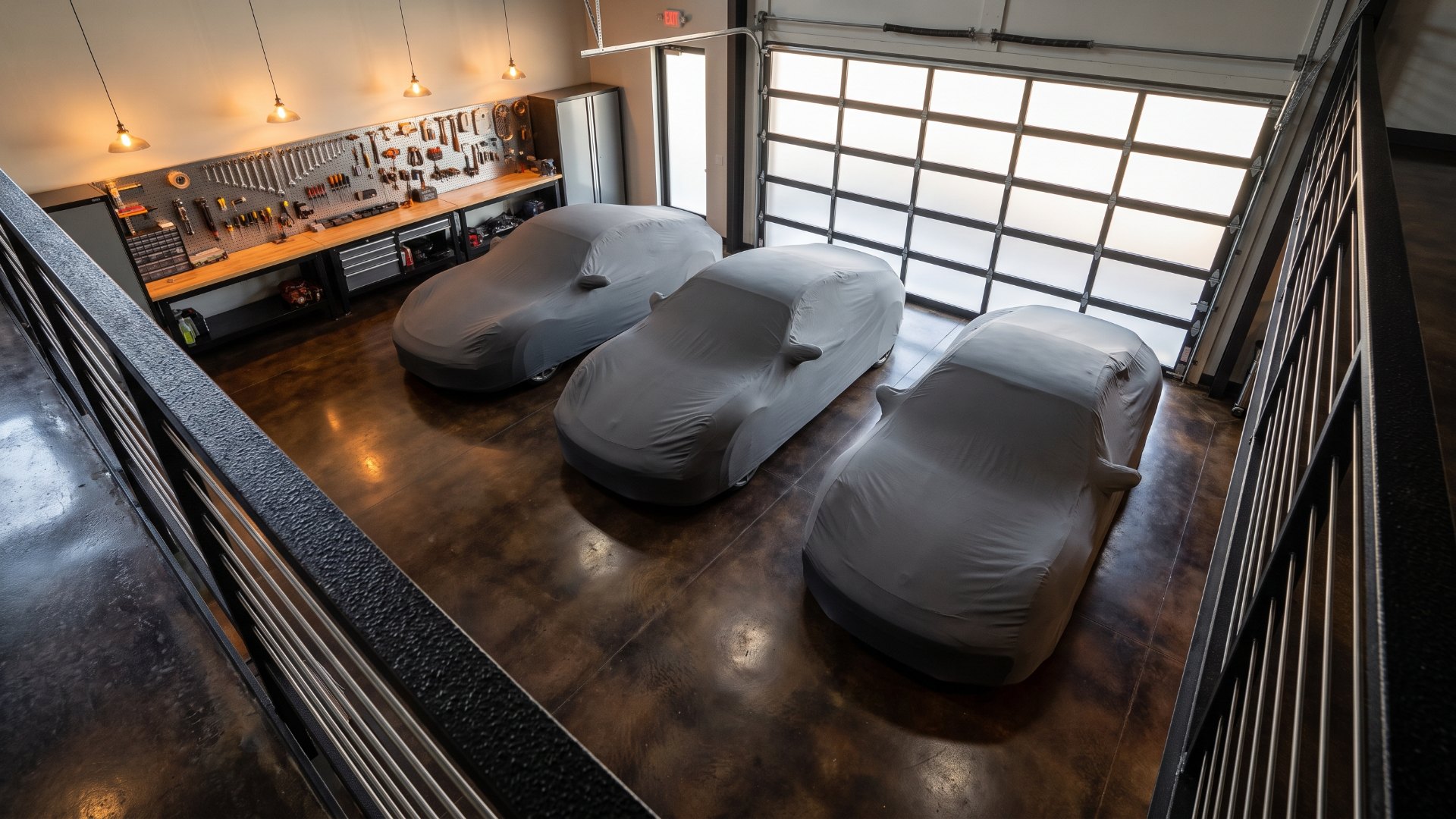
The garage condo proper. This is the fastest-growing middle. Finished floors, HVAC, mezzanines, kitchenettes, glass overhead doors, a shared clubhouse, security.
Chicago’s northwest suburbs and the Sun Belt have converged on $400,000 to $1.1 million for these. MotorCave Suites in Barrington, Illinois runs $410,000 to $1.1 million. Luxe Corsa in Lake Zurich sits at $549,000 to $699,000. Torque Motor Suites opened its Blue Ash, Ohio phase on July 29 with 30 units between $395,000 and $450,000; its Birmingham, Alabama building starts at $399,500 for interior units and $480,000 for corners.
The club with real estate attached. M1 Concourse in Pontiac, Michigan is the reference point and has been since its 1.5-mile circuit opened in June 2016. Its 87 acres hold more than 175 garages from 500 to 13,000 square feet, averaging roughly $300 per square foot.
The purchase price is only part of the entry cost: membership runs a one-time $20,000 initiation per garage plus $3,950 annually per member, and members get six guaranteed hours of track time a week. Spring Mountain, The Thermal Club and The Motor Enclave operate variations on the same idea.
Confusing tier one with tier three is how people overpay. A storage condo that borrows the marketing language of a motorsports club is still a storage condo, and the exit price will eventually say so.
The split is easy enough to see in practice. Our sister marketplace Motor Stables lists the tiers as separate categories — storage, garage condos and motor clubs — which is a quick way to sanity-check which of the three a given building is actually selling before you read the brochure.
The money, honestly
Per-square-foot pricing is the only figure that lets you compare a Scottsdale suite to a Killeen warehouse bay, and the spread is startling. Thirteen Texas listings surveyed this year ran from $95 per square foot in Lubbock to $480 in San Antonio. In between: Dripping Springs at $221 for a 3,220-square-foot unit with a mezzanine and Hill Country views, Schertz at $246, Lewisville at $300, Southlake at $320 with a Fall 2026 completion, Katy at $386 for 23-foot ceilings, McKinney at $475.
Florida is the volume leader and prices accordingly. Motocave St. Petersburg’s 43 units transacted between $275 and $375 per square foot, with remaining inventory above $350,000. Collection 674 in Oviedo is bringing 36 units in four sizes — 709, 949, 1,227 and 1,658 square feet — priced from the $300,000s into the upper $400,000s, with an October groundbreaking.
Auto ClubHouse Palm Beach in Jupiter has three of nineteen 1,400-square-foot units left and is already replicating the format in Cornelius, North Carolina, where a 42-unit, $15 million building is under construction.
Per-square-foot comparison only works if you can see markets next to each other, which is what browsing by state is for. Two things fall out of those numbers. First, the ceiling and the floor are moving apart, not together. Second, the cheapest square footage is almost always the least differentiated square footage, which matters enormously on resale.
Pre-sale velocity is the metric that matters
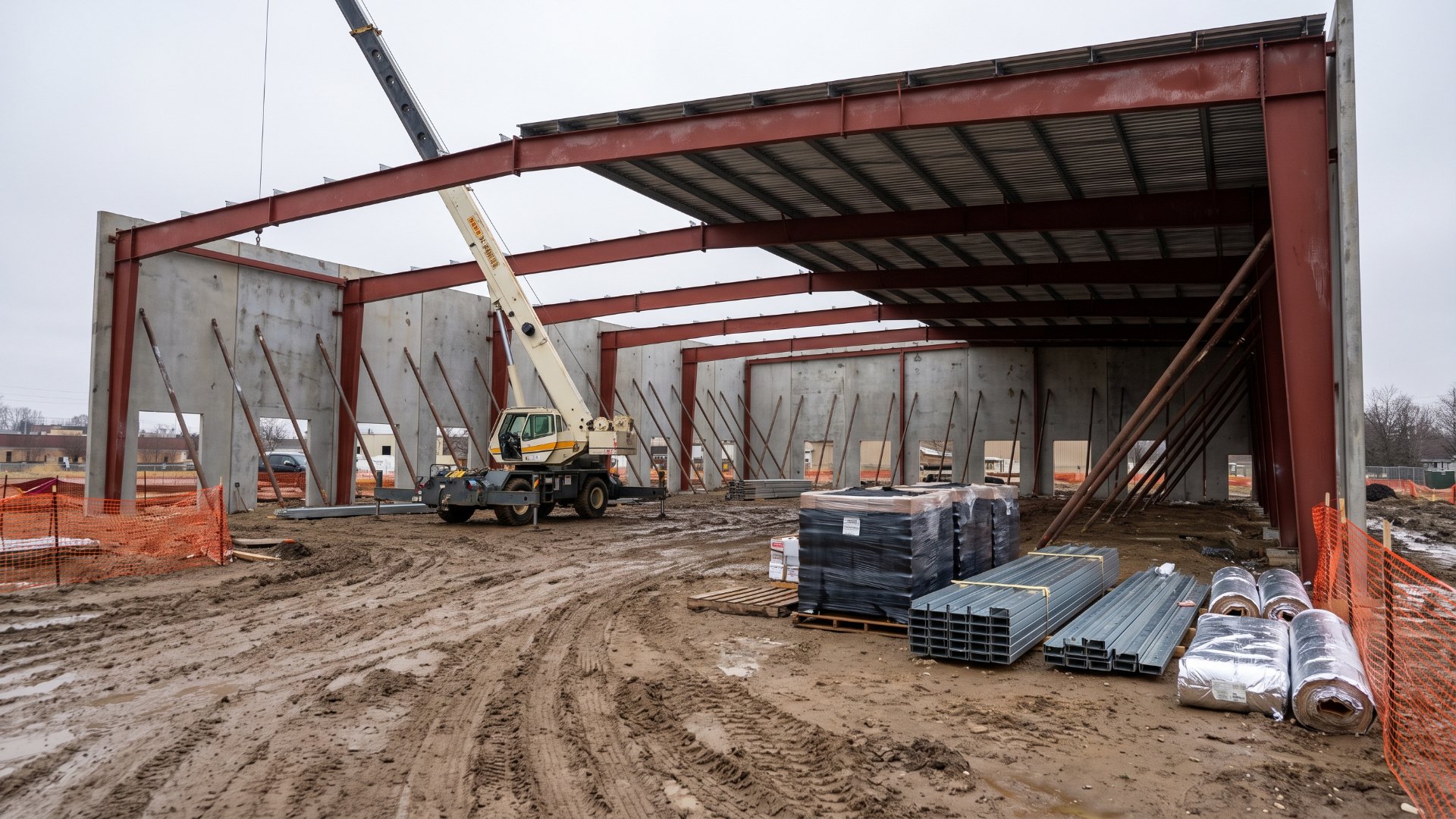
Renderings are free. Deposits are not. The most reliable 2026 signal of a project’s health is how fast it sold before anyone could park in it.
MotorCave Suites in Barrington took 25 pre-commitments on 37 units within ten days. Auto ClubHouse Palm Beach cleared 16 of 19. Motocave St. Petersburg moved 36 of 43. Luxe Corsa in Lake Zurich, a 121-unit development on 20 acres led by former racing driver Romeo Kapudija, had 40-plus pre-sold. BeSpoke Motor Union in Gilberts, Illinois broke ground on the first 26 of a planned 156 units across 19 acres, with deposits opening at $350,000.
That last pairing — Luxe Corsa at roughly a third pre-sold, BeSpoke phasing 156 units in 26-unit bites — is the sane version of this business. Phased delivery against confirmed demand is how a developer avoids handing a half-empty building to an HOA. Buyers should read a phasing plan as a feature, not as hesitation.
The motorsports-credibility play is now standard practice. Torque Motor Suites brought in four-time Indianapolis 500 winner Hélio Castroneves as a partner. Luxe Corsa’s principal raced professionally. It works because it signals to a skeptical buyer that someone in the room understands why a 16-foot door and a properly graded drive aisle matter. It is also, unavoidably, marketing.
The 2026 U.S. garage condo market at a glance
| Tracked developments (Aug 2026) | 619 |
| Tracked developments (Mar 2026) | about 500 |
| Leading states | FL 77, MN 65, TX 52, CO 46, AZ 43 |
| Share held by top five states | roughly half the national pipeline |
| Documented club and track facilities (North America) | 374 unique facilities |
| Entry price, storage tier | about $84,000 (Arizona) |
| Typical mid-luxury range | $400,000 to $1.1 million |
| Observed price per square foot (Texas sample) | $95 to $480 |
| Common unit sizes | about 700 to 1,700 sq ft |
| Strong 2026 absorption examples | 84 percent sell-through before completion |
| Ownership structure | commercial condominium, HOA-governed |
| Residential occupancy | prohibited in standard CC&Rs |
What the paperwork says you cannot do
This is where enthusiasm meets a recorded document, and it is the part most first-time buyers skim.
A garage condo is a commercial condominium interest. That single word governs almost everything downstream. Standard CC&Rs permit vehicle storage, RV and boat parking, workshops, hobby space, and — within HOA limits and local code — small business operations. They prohibit residential occupancy outright. No sleeping quarters, no primary residence, no matter how comfortable the mezzanine gets.
Noise and fumes are constrained to reasonable hours. Drive aisles must stay clear, and long-term outdoor storage is usually barred unless the site designates space for it. Mezzanines and electrical upgrades typically require both code compliance and association approval, which is worth confirming before you buy the lift.
Insurance splits along the same seam: the association insures the building shell, and the owner insures interior improvements, tools, equipment and, critically, the cars. A collector policy on the vehicles is not the same as coverage on a $60,000 build-out.
Financing deserves its own conversation with a lender before you fall in love with a floor plan. Because these units are commercial condominiums rather than dwellings, conventional residential mortgage products generally do not apply, and buyers are usually looking at commercial or portfolio lending with larger down payments and shorter terms than a house.
SBA 504 financing comes up constantly in sales offices, and it is worth understanding what it actually requires: the program is designed for owner-occupied commercial real estate used by an operating business, with an occupancy threshold the business itself must meet. A personal car collection is not an operating business. Many developer-affiliated lenders have workable programs; the point is to get the structure in writing early rather than assume a 30-year fixed exists on the other side of the deposit.
Where the risk actually sits
Nothing in the 2026 garage condo market data suggests a bubble. It does suggest concentration.
The 2026 numbers describe densification inside corridors that are already hot — Chicago’s northwest suburbs, Dallas–Fort Worth, Scottsdale — rather than meaningful expansion into new geography. Arizona alone has roughly 2,500 units across 39 tracked developments, with twelve more under construction or in planning and much of the premium product stacked into Scottsdale.
Southwest Florida absorption is the obvious watch item. When six similar buildings open within twenty minutes of each other, the differentiated ones hold value and the generic ones compete on price.
The second risk is governance. An HOA at a 156-unit campus with a clubhouse, fitness center and event lawn has a real operating budget and a real reserve obligation. Ask for the reserve study. Ask what happens to dues when the developer’s subsidy ends and control transfers to owners. That transition, not the purchase, is where garage condo communities historically get expensive.
The third is the exit. Secondary-market data in this category is thin, which cuts both ways — sold-out communities in the strongest Arizona markets have traded at meaningful appreciation, but there is no index, no comp service, and in most metros no depth of buyers. A specialist resale market has begun to form around mature communities like M1 Concourse. Elsewhere, you are selling to the same narrow pool the developer sold to, and you should underwrite the purchase as a lifestyle asset that may appreciate, not as an investment that happens to hold cars.

Why it matters
The garage condo boom is the physical expression of something the collector market figured out years ago: the storage problem was never really about storage. It was about not having anywhere to go. A rented unit across town with a roll-up door and a padlock solves square footage and nothing else. A campus with a clubhouse, a lift, decent lighting and forty neighbors who understand why you drove forty minutes to change your own oil solves the actual problem.
That is also why the amenity arms race — bonfire pavilions, racing simulators, track-day partnerships, adventure clubs — reads as inevitable rather than absurd. Developers are not selling concrete. They are selling a place to be a car person, and the buildings that understand that are the ones clearing 84 percent before completion.
For dealers and marketplaces, the second-order effect is quieter but real: a national inventory of climate-controlled, secured, individually owned automotive space changes what people are willing to buy, at a moment when where a rare car sits is increasingly trackable in public. Cars that need somewhere to live now have somewhere to live. Our sister site Motor Stables, which catalogs automotive real estate and private garage communities across the U.S., exists because the search behavior changed — buyers stopped asking whether these places exist and started asking which one is twenty minutes from the office with a mezzanine and a functioning HOA.
For buyers, the practical takeaway from the 2026 data is narrow and useful. Compare on price per square foot, not sticker. Read the CC&Rs before the brochure. Ask for pre-sale numbers and a reserve study, and treat a phased delivery plan as a good sign. And be honest about which of the three products you are actually buying, because the market is going to be honest about it eventually.
Frequently asked questions
What is a garage condo?
A garage condo is an individually owned unit inside a commercial condominium development, purchased with a deed and governed by an HOA, typically used for vehicle storage, workshop space or hobby use. Units commonly run 700 to 1,700 square feet with tall overhead doors, and many developments add shared clubhouses, security and event space.
How much does a garage condo cost in 2026?
Entry-level storage condos start near $84,000 in Arizona, mid-luxury units in the Chicago suburbs and Sun Belt run $400,000 to $1.1 million, and trackside garages at established motorsports clubs can exceed $1 million. A Texas sample this year spanned $95 to $480 per square foot.
Which states have the most garage condos?
As of August 2026: Florida (77 developments), Minnesota (65), Texas (52), Colorado (46) and Arizona (43). Those five states account for roughly half the tracked national pipeline.
Can you live in a garage condo?
No. Standard CC&Rs prohibit residential occupancy and overnight sleeping. Units may be used for storage, workshop activity and, within HOA and municipal limits, some small business use, but they are not dwellings and are not zoned as such.
Can you finance a garage condo like a house?
Generally not. These are commercial condominium interests, so conventional residential mortgage products typically do not apply. Buyers usually use commercial or portfolio lending, often with a larger down payment and a shorter term. SBA 504 financing is aimed at owner-occupied property used by an operating business, so a personal collection does not qualify on its own.
Do garage condos appreciate?
Some have, particularly in sold-out communities in supply-constrained markets, and a specialist resale niche has formed around mature developments. But the category has no pricing index, limited comparable-sales data and a narrow buyer pool in most metros. Treat appreciation as possible, not as the reason to buy.
What should I ask before signing?
Request the CC&Rs, the reserve study, current and projected HOA dues, the developer pre-sale figures, the phasing schedule, and written confirmation of what interior build-outs require association approval. Confirm your financing structure before the deposit, not after.