
The short answer: Flock Safety’s automated license plate readers photograph every passing vehicle, then use machine learning to build a searchable “Vehicle Fingerprint” — make, model, body style, color, roof racks, decals, damage — that works even when the plate is unreadable. More than 100,000 Flock cameras now cover American roads. For owners of rare, loud, brightly finished cars that changes the math: a Verde Mantis supercar is a far more searchable object than a silver Camry, and the system was built to find exactly that kind of outlier.
In November 2025, San Diego police arrested three people for an attempted carjacking. The evidence that put them in handcuffs was not a witness, a fingerprint, or a plate number. It was a vehicle signature — an automated match on a red Alfa Romeo. The car turned out to have been five miles from the scene. One of the passengers spent close to a month in jail before it unwound.
Read that again, because there is a lesson in it that most coverage of license plate cameras misses entirely. The system did not fail because it could not read a plate. It failed because it was confident about a car. And the reason it was confident is that a red Alfa Romeo is unusual — which is precisely the quality that makes the machine reach for it.
If you drive something interesting, you have been quietly promoted from noise to signal.
Flock cameras at a glance
| Question | Answer |
|---|---|
| What Flock cameras are | Fixed, solar-powered roadside cameras that photograph every passing vehicle and read its plate |
| Network size | 100,000+ Flock cameras nationwide; roughly 119,000 ALPRs mapped by DeFlock, about 83% of them Flock |
| What is captured | Plate text plus a “Vehicle Fingerprint”: make, model, body style, color, decals, roof racks, visible damage |
| Default retention | 7 days, cut from 30 during 2026 — but state law overrides it (Virginia 21 days, Arkansas up to 150) |
| Stated accuracy | About 93%, against more than 20 billion scans a month |
| Facial recognition | Flock states that it does not run facial recognition |
| Legal status | Unsettled — Schmidt v. City of Norfolk is pending before the Fourth Circuit |
How Flock cameras actually work
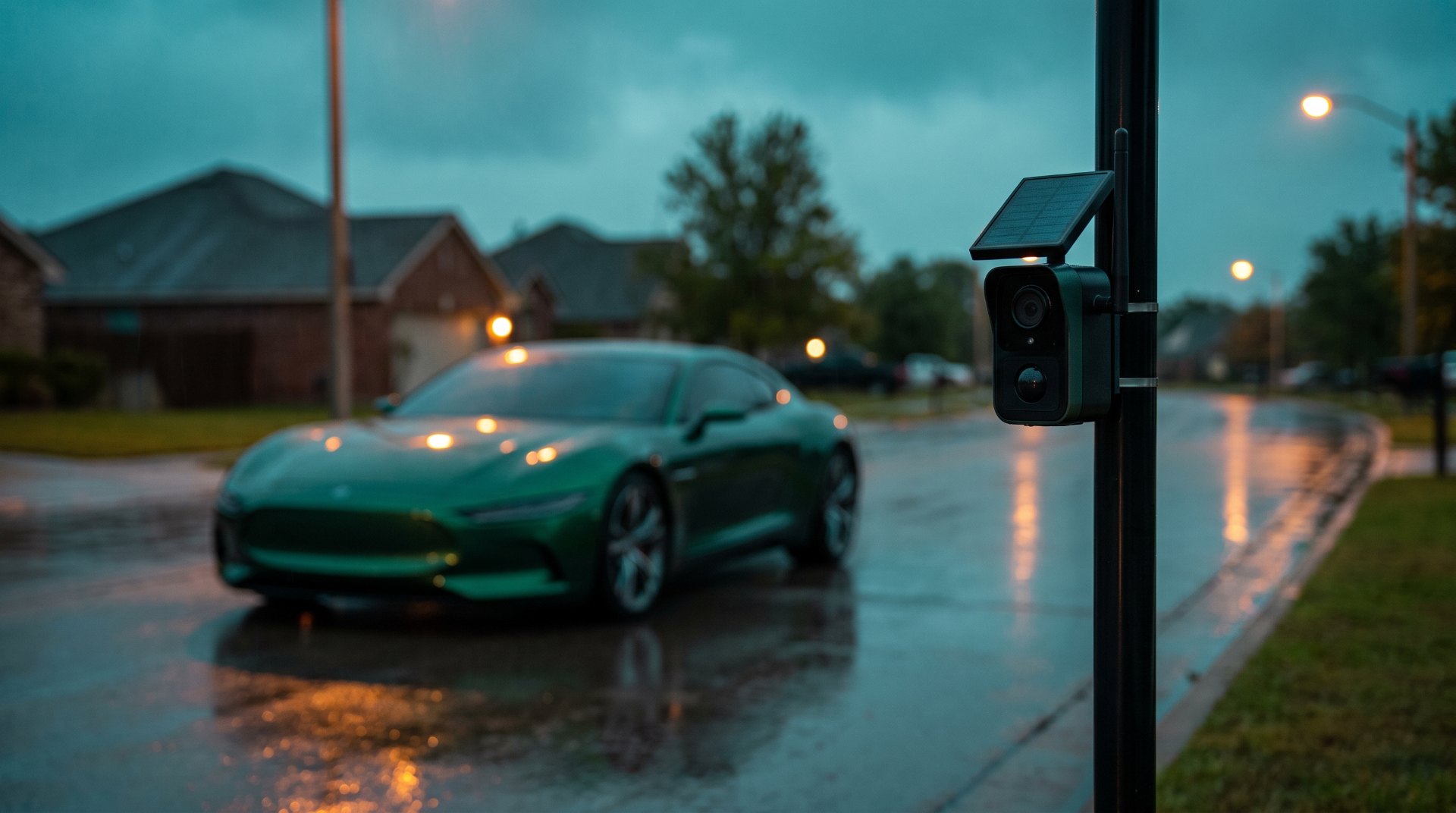
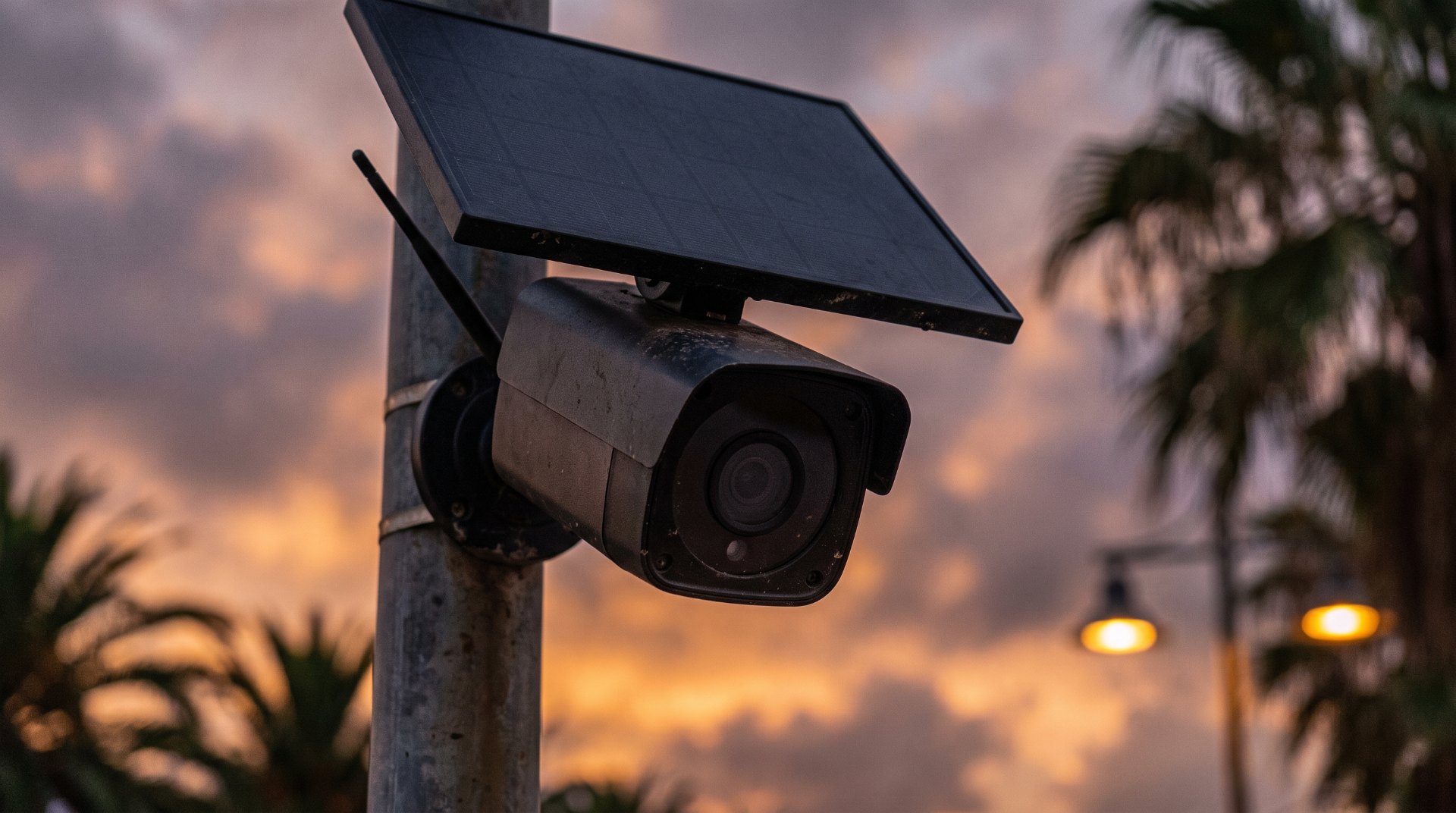
Strip away the branding and a Flock camera is a fairly humble piece of hardware: a small weatherproof housing on a slim pole, an infrared illuminator, a solar panel, and an LTE modem. That last combination is the entire business model. No trenching, no conduit, no power drop, no fiber. A crew can plant one at the mouth of a subdivision in an afternoon, and it starts working before the truck leaves.
The camera does not stream video. It sits on a motion trigger and takes stills — a frame of the vehicle, a frame of the plate. Flock’s Falcon units are specified to catch traffic across multiple lanes at speeds north of 60 mph, which is more demanding than it sounds when you consider that the exposure has to be short enough to freeze a moving car and bright enough, via infrared flash, to burn a retroreflective plate out of a dark background.
Those frames go to the cloud, where machine-learning models trained on plate formats from all fifty states convert pixels to characters and attach a confidence score. That score matters enormously later, and we will come back to it.
The Vehicle Fingerprint, or why your car is easier to find than a Camry
Here is where it gets genuinely interesting for anyone who cares about cars.
Reading plates is the easy part and, increasingly, the least important part. Flock’s system also extracts what the company calls a Vehicle Fingerprint: make, model, body style, color, and a growing catalogue of distinguishing marks — roof racks, ladder racks, bumper stickers, decals, visible damage. As one technical breakdown of the system put it, the fingerprint makes “the plate almost optional.”
Think about what that means as a search problem. On a typical American arterial, a white mid-size crossover is close to information-free. Thousands of them pass a given camera in a week. A query for one returns a haystack.
Now query for a low, wide, two-door, non-metallic-green coupe with aftermarket centerlock wheels and a visible wing. In most cities, on most days, that is a set with one member. You do not need the plate. You do not need to know the plate. You need a dropdown menu and a date range.
The enthusiast community has spent forty years making cars distinguishable — the wrap, the stance, the wheel choice, the exhaust cut-out, the sticker on the quarter glass. Every one of those decisions is, to a computer-vision pipeline, a feature. Individuality and searchability turn out to be the same property viewed from two directions.
This is also why the false-positive risk lands harder on us. When the system generalizes from “red Italian sedan” to a specific red Italian sedan, there is no crowd of near-identical vehicles to dilute the match. The rarity that gets you a thumbs-up at a light is the same rarity that makes an algorithm sure.

The AI layer nobody voted on
Cameras alone are a records problem. The wider push to put machine learning into everything automotive shows up here too, just pointed outward at the car rather than inward at the driver. The software on top is what turned a records problem into a search engine.
FreeForm lets an officer type a plain-language description instead of structured criteria. Multi Geo Search takes a single vehicle’s appearances across many cameras and stitches them into a movement trail — times, places, direction, sequence. Not a snapshot. A route.
Nova goes further, aggregating public records, dispatch logs and open-source intelligence into one interface — a search engine built for police rather than for the public. After sustained criticism, Flock said it would not incorporate breached or dark-web data into the product.
And in August 2026, Gizmodo reported on OS Investigate, an experimental tool in limited testing that ships with 69 pre-written, editable natural-language search prompts. Two details stand out. First, it deliberately filters out buses, semi-trucks, business vans and trailers in order to concentrate on privately owned vehicles. Second, it links plates to drivers and to those drivers’ social networks by pulling in 911 dispatch logs, arrest records and commercial databases.
Flock’s position is that OS Investigate is a separate product from the plate readers, designed to help investigators work across data their agencies already hold. That is a fair description of the architecture and an incomplete description of the effect. The company also states that it does not run facial recognition. Both things can be true while the practical outcome is a system that starts from a car and ends at a person.
For a car owner, the mental model to carry is this: the camera is not the product. The camera is the sensor. The product is the index.
The 93 percent problem
Flock has cited an accuracy figure of roughly 93 percent. That sounds like an A-minus until you multiply it by the volume. With more than 20 billion scans a month nationwide, the Institute for Justice calculated that even Flock’s own number implies well over a billion inaccurate readings every month.
The Institute has documented at least 27 cases since 2018 in which innocent motorists were pulled over, held at gunpoint, or jailed on the strength of a plate-reader error — the majority of them since 2023. Roughly a third trace to machine error. The rest are human: an officer fat-fingering a plate into a hotlist, misreading an alert, or failing to remove a recovered vehicle from a watchlist so that it keeps triggering for its rightful owner.
The machine errors are almost comically mundane. Road grime. A dealer plate frame cropping a character. The letter O read as the numeral 0 — which is what put a pair of grandparents in Morristown, Tennessee at the wrong end of drawn weapons in June 2024. In Sherwood, Arkansas in February 2026, a couple travelling with a six-week-old infant was stopped at gunpoint after a single misread character. In Milwaukee in August 2026, police acknowledged that a data error caused the same woman to be pulled over at gunpoint twice in connection with a homicide investigation her car had nothing to do with.
None of this requires anyone to be malicious. It requires only that a high-confidence machine output be treated by a human being as a fact rather than as a lead. That is a training and policy failure, not a physics failure — but it is the failure mode that actually reaches drivers.
Who is actually running the searches
The second category of risk is not error but access, and 2026 was a bad year for the proposition that the data stays where the contract says it stays.
Dayton, Ohio found more than 7,100 searches of its camera data run for immigration enforcement — explicitly prohibited under the city’s own policy. Officials called the violations egregious. In Mountain View, California, an audit found over 250 unauthorized agencies had run roughly 600,000 searches across twelve months, including the ATF, the Air Force and a federal Inspector General’s office. San Francisco identified 299 improper inquiries by federal and out-of-state agencies in a single year, and a class action there alleges 1.6 million queries over seven months. In Illinois, Customs and Border Protection reached cameras through an undisclosed pilot program, and 47 agencies were required to remove access.
Then there is straightforward personal abuse. The Washington Post documented 46 cases of officers allegedly using the system to track ex-partners. A Kentucky officer was arrested after running his ex-girlfriend more than 2,000 times. Six Savannah police employees were fired in August 2026 over alleged misuse. In Florida, misconduct cases in Haines City and Sarasota — officers fired and arrested for allegedly using the cameras to stalk — helped build the pressure behind the state action described below.
Flock’s guardrails have not aged well in public. When the company introduced a tool in June 2025 meant to block improper searches by requiring a stated reason, the ACLU notes officers discovered they could simply type “investigation” — or “hehehe” — and proceed. The company moved to a dropdown of acceptable purposes, which standardizes the answer without verifying it. Default retention was cut from 30 days to seven, a real improvement, though an “Evidence Mode” override can preserve data beyond that window, and roughly 90 percent of searches happen within a week of collection anyway — meaning the shorter window bites less than it appears to.
The map is being redrawn right now
This is the most volatile part of the story, and the reason a piece like this has a shelf life measured in weeks.
On August 31, 2026, the Florida Department of Transportation issued a memo revoking license plate reader permits across state rights-of-way and giving 30 days for removal, citing an “exponential increase in deployments coupled with concerning reports of misuse, data privacy concerns and surveillance schemes.” Governor Ron DeSantis, discussing the order, noted the limit of its reach: “The Flock in Florida, 98% are local.” The order clears state roads. It does not touch city and county streets, which is where the overwhelming majority of the cameras live.
Elsewhere: Texas Governor Greg Abbott paused state funding. Pennsylvania Governor Josh Shapiro signalled support for a ban. Senator Josh Hawley opened an investigation. Three House Republicans introduced legislation barring federal purchase of these systems. Meanwhile California’s most recent regulatory bill died in September 2026 — the second consecutive year a measure has failed there, despite the state hosting more mapped readers than anywhere else in the country.
At the municipal level, at least 53 cities across 20 states have cancelled or rejected contracts. Cameras have been physically vandalized in at least 36 states. The ACLU’s Jay Stanley called it the biggest grassroots privacy backlash in more than twenty years.
And yet: roughly 800 U.S. cities approved new Flock contracts in 2026. Departures are real and growth is faster. Both facts belong in the same paragraph.
If you want to know what your own commute looks like, the crowdsourced DeFlock project has plotted roughly 119,000 automated readers nationwide, of which about 83 percent are Flock units. California leads with more than 16,000 mapped; Florida follows at 7,169; Georgia at 7,046; Illinois at 5,822. Because it depends on public submissions it undercounts rural coverage and over-represents places with engaged residents — treat it as a floor, not a census.
The constitutional question is genuinely open
The legal fight to watch is Schmidt v. City of Norfolk. Two Norfolk residents, Lee Schmidt and Crystal Arrington, challenged the city’s network of roughly 200 cameras arranged in about 75 clusters with 21-day retention, arguing that comprehensive vehicle tracking is a Fourth Amendment search requiring a warrant.
Their argument runs through Carpenter v. United States (2018), in which the Supreme Court held that long-term location records give the government “an all-encompassing record of the holder’s whereabouts” and cannot simply be collected without a warrant. The city’s counter is that fixed cameras on public roads photographing what anyone could see, held only briefly, are categorically different from continuous tracking.
The district court agreed with the city and granted summary judgment on January 27, 2026. The appeal was docketed at the Fourth Circuit on February 26 and fully briefed by June 20, 2026. It is awaiting argument. Whatever that court says will shape how every network in the country is operated — and the question of where “a photograph of a public road” becomes “a record of your life” has not been answered.
The honest other side of the ledger
A piece written only from the privacy side would be a worse piece, and dishonest to boot.
Flock reports helping locate more than 10,000 missing people annually and supporting a million criminal investigations in 2025. The technology has been credited in high-profile cases including identifying the suspect vehicle in the murder of a Brown University professor. Chief executive Garrett Langley has framed the question fairly — “How do we have our safety, and how do we balance privacy?” — and has apologized directly to at least one person wrongly stopped, telling CBS News, “I apologize. It kills me that she went through that.” He has also called for states to criminalize unauthorized use of the data, which is a more serious position than critics usually credit him with. He has, separately, characterized organized opposition as “coordinated attacks” by groups seeking to “defuse the police, weaken public safety, and normalize lawlessness” — which is less serious, and worth noting for balance in the other direction.
And there is a specifically automotive case for the technology. Exotic and collector car theft is not opportunistic joyriding; it is organized, logistics-driven crime involving transport fraud, VIN laundering and rapid interstate movement. A network that can flag a stolen vehicle crossing three states in a night is genuinely useful to the people it was stolen from. Plenty of owners who got a car back will tell you so, and they are not wrong.
The uncomfortable truth is that the same capability serves both outcomes. A system precise enough to find your stolen car in Georgia is precise enough to reconstruct where you were last Tuesday night. There is no version that does one and not the other.

What this actually means if you own something rare
Practical, non-paranoid, and legal. In that order.
Assume the drive is logged, not the destination. These are fixed cameras at chokepoints, not continuous GPS. What exists is a set of timestamped sightings. That distinction matters both for what you should worry about and for what you should not.
Know that your car is a strong identifier. If your build is unusual — and if you are reading this, it probably is — assume it can be located by description alone, without anyone ever typing your plate. Wraps and wheel changes alter the fingerprint; they do not remove you from the index.
Keep your plate legible, ironically. Tinted covers, aggressive frames and rake angles that crop characters do not make you invisible. They make you misread, which is the specific failure that lands innocent drivers at gunpoint. A clean, unobstructed, correctly mounted plate is your best protection against being mistaken for someone else’s problem. Obscuring a plate is also illegal in every state, which rather settles the question.
Clear your own records. If a car of yours was ever reported stolen and later recovered, confirm in writing with the reporting agency that it has been removed from the hotlist. Stale hotlist entries are a documented cause of repeat gunpoint stops on legally owned vehicles. This is a fifteen-minute phone call that is worth making.
Ask your HOA what it bought. Private deployments are the fastest-growing segment and the least examined. In September 2026, residents of Central Florida communities including Winter Springs’ Parkstone subdivision petitioned for removal of HOA-installed readers, with one homeowner putting the concern plainly: “The community overall is concerned that someone, somewhere knows when a homeowner is at or not at their residence.” The same questions apply to purpose-built garage condos and collector storage, which are being instrumented just as fast. If your community has cameras at the gate, the questions for the board are: who owns the data, how long is it kept, is it shared with any outside network, and who is permitted to query it. If nobody on the board can answer, that is your answer.
Know your state’s rules. They vary wildly and are moving fast. Virginia caps retention at 21 days and enumerates permitted uses. Arkansas allows up to 150 days and extended access to private landowners and businesses. Idaho restricts use to law enforcement purposes and requires training. California’s attempt to impose a 60-day cap failed again this month. Your local ordinance may be stricter than the vendor default — or nonexistent.
Glossary for the non-technical
- ALPR / LPR — Automated (or Automatic) License Plate Reader. The camera and the software that turns a picture of a plate into text.
- Vehicle Fingerprint — The non-plate description of a car: make, model, body style, color, decals, racks, damage. Searchable on its own.
- Hotlist — The watchlist of plates that trigger an alert, populated from stolen-vehicle databases, warrants, and manual entry by officers. Manual entry is where a lot of errors originate.
- Confidence score — The model’s own estimate of how likely its plate read is correct. Meant to be a lead. Frequently treated as a fact.
- Evidence Mode — A setting that preserves data past the default retention window when it is tied to an investigation.
- Multi Geo Search — Assembling one vehicle’s sightings across many cameras into a movement trail.
- Carpenter standard — The 2018 Supreme Court principle that comprehensive long-term location data is meaningfully different from a single observation, and generally needs a warrant.
Frequently asked questions
Do Flock cameras record video of drivers?
No. They capture still images triggered by motion — typically a vehicle frame and a plate frame. Flock states that it does not run facial recognition on them.
Can a Flock camera identify my car without reading the plate?
Yes. That is the explicit purpose of the Vehicle Fingerprint, which indexes make, model, body style, color, decals, racks and visible damage. Distinctive vehicles are easier to isolate this way than common ones.
How long is Flock camera data kept?
Flock’s default is now seven days, reduced from 30 during 2026, but agencies can extend it through Evidence Mode and state law overrides the default in both directions — Virginia caps it at 21 days, Arkansas permits up to 150.
Are license plate reader cameras legal?
Photographing plates on public roads has generally been held lawful. Whether a dense, networked, searchable system crosses into a Fourth Amendment search is unsettled and currently before the Fourth Circuit in Schmidt v. City of Norfolk.
Can I find out where the cameras are near me?
The crowdsourced DeFlock project maps roughly 119,000 readers nationwide. It is community-submitted and incomplete, particularly in rural areas, so read it as a minimum rather than a complete census.
Does a wrap or a plate cover defeat the system?
A wrap changes the fingerprint but does not remove the vehicle from the index. Plate covers and obstructions are illegal everywhere in the U.S. and increase the chance of a misread — the exact error that leads to innocent drivers being stopped at gunpoint.
What should I do if I am wrongly stopped because of a camera alert?
Comply at the scene and argue later. Afterward, request the alert record and the agency’s audit log, and if the trigger was a stale hotlist entry on your own vehicle, insist in writing that it be cleared. Repeat stops on the same car are a documented pattern.
Where this lands
There is a version of this article that ends with an exhortation to tear the things down, and another that ends with a reminder that they find missing children. Neither is quite honest.
What is honest is this: a surveillance layer of this density arrived on American roads in under a decade without most drivers noticing, and the rules governing it are being written now — in city council chambers, in a federal appeals court in Richmond, in a transportation department memo in Tallahassee. The people with the strongest incentive to pay attention are the ones whose cars stand out, because a system built to find the unusual will always find us first.
That is not a reason to panic. It is a reason to know how it works, to keep your own paperwork clean, to ask your HOA an uncomfortable question at the next meeting, and to read your state legislature’s docket with something other than indifference.
The cars we love are conspicuous by design. We should at least be deliberate about what that now costs.