
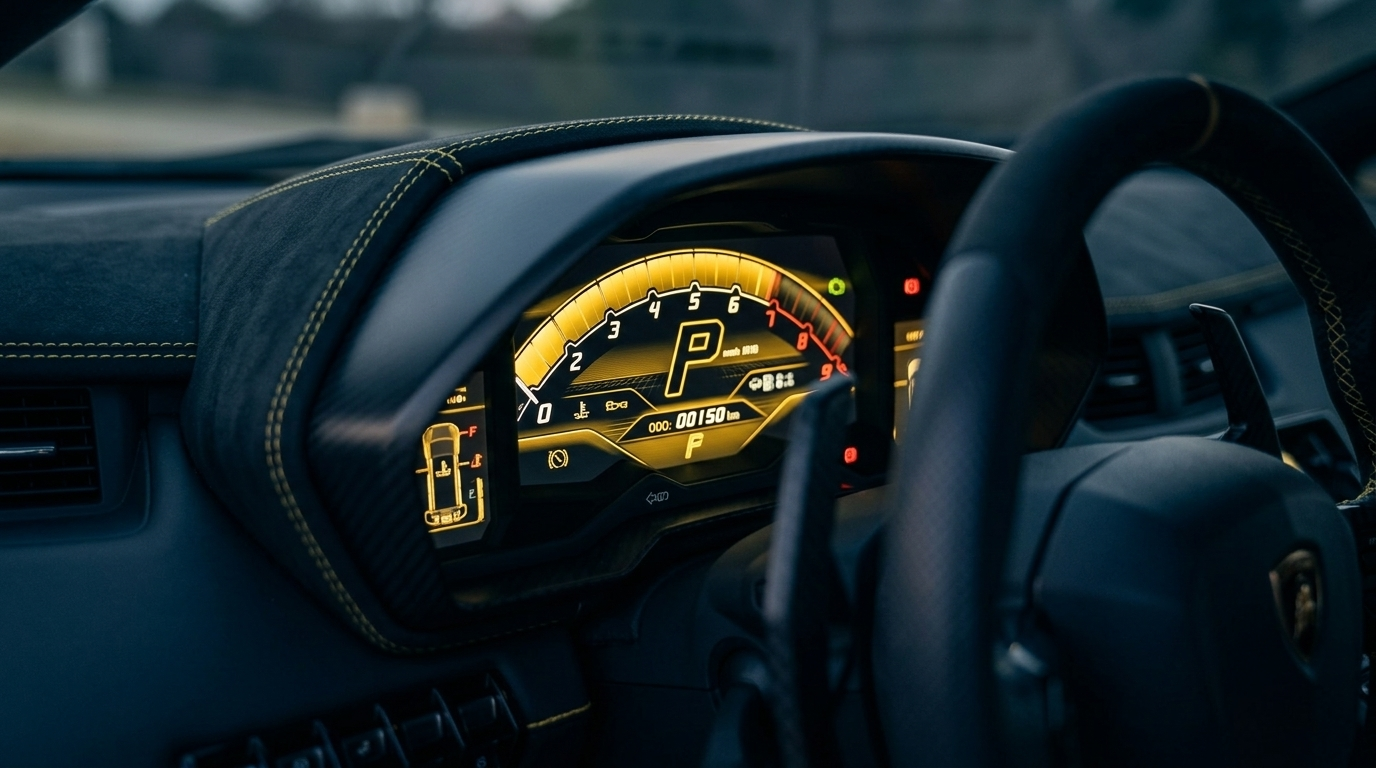
The odometer used to be the closest thing the used car market had to an honest witness. On an exotic car, it is far more than that — it is the single number that can swing a sale price by six figures. A 2,000-mile Aventador SVJ and an 18,000-mile Aventador SVJ are, in the eyes of the market, two different cars with two very different values.
That is exactly why a new generation of electronic devices known as mileage blockers has found its most profitable home in the exotic and luxury segment. And unlike the odometer rollbacks of decades past, mileage blockers are engineered to be nearly invisible.
What Mileage Blockers Actually Do
A mileage blocker does not roll an odometer back. It stops mileage from being recorded in the first place. The device intercepts the vehicle’s internal data network so that miles driven while it is active simply never exist — no rollback, no altered memory, no obvious tampering signature.
The sellers of these devices market them with a wink: “for testing purposes only, not for use on public roads.” In practice, the use case is obvious. The most sophisticated mileage blockers are engineered for specific high-end vehicles and suppress mileage data across multiple control modules simultaneously, without triggering warning lights or diagnostic errors. Cheaper units cover fewer systems and can leave detectable inconsistencies — but by the time a car reaches the used market, a buyer has no way of knowing which grade of deception they are up against.
To be clear about the legal picture: using one of these devices to misrepresent a vehicle’s mileage in a sale is fraud. In the United States, federal odometer law enforced by the NHTSA carries criminal penalties of up to three years in prison, and victims can pursue civil damages at triple their actual losses. The device itself may be sold under a “off-road use only” label, but the moment its output is used to deceive a buyer, that disclaimer is worth nothing.

Why Exotic Cars Are the Prime Target for Mileage Blockers
Odometer fraud is not new, and it is not confined to supercars. Regulators estimate that mileage tampering costs consumers well over a billion dollars every year across the whole market. But the economics are what make the exotic segment uniquely attractive to bad actors.
On a mass-market sedan, shaving 40,000 miles off the clock might add a couple thousand dollars to the asking price. On a low-production hypercar, the mileage number is one of the primary levers of value. Collector-grade cars are priced on a curve where delivery-mileage examples command enormous premiums, and every thousand miles below a psychological threshold — 1,000, 5,000, 10,000 — can be worth tens of thousands of dollars. Our breakdown of why some exotics sell in days and others sit for a year shows just how sharply mileage bands move real-world prices.
That asymmetry changes the risk calculation entirely. A device that costs a few hundred to a few thousand dollars can, in theory, manufacture a six-figure swing in a car’s apparent value. When the potential upside is that large, the incentive to cheat scales with it.
The Damage Mileage Blockers Cause Runs Deeper Than the Purchase Price
An inflated purchase price is only the first cost. The bigger problem is everything a false mileage reading hides.
Service intervals on exotic cars are brutal and non-negotiable. Many require major service on a fixed time-or-mileage schedule, and some of the most expensive items — clutches, gearbox fluids, cambelts, suspension components — are tied directly to distance traveled. A car showing 6,000 miles that has actually covered 40,000 has almost certainly blown past service intervals that a diligent owner would have honored. The buyer inherits deferred maintenance they don’t know exists, on components that can cost tens of thousands to put right.
There is also the safety dimension. Tires, brakes, and other wear items degrade with use. A car presented as barely driven invites a new owner to skip inspections they would otherwise insist on — right up until a failure at speed reveals the truth.

How Buyers Can Protect Themselves From Mileage Blockers
The good news is that a frozen odometer is a lie that gets harder to maintain over time. The number on the dash may be clean, but a car leaves a trail everywhere else — and a disciplined buyer can cross-check it.
Demand the full service history. Franchised dealers and specialist independents stamp mileage at every visit. A coherent, rising sequence of readings across years of service records is the single strongest defense. Our guide to why window stickers, build sheets and factory records matter covers exactly what a clean paper trail should look like. Gaps, or readings that plateau suspiciously, are a red flag worth walking away over.
Cross-reference every data point that carries a mileage figure. Inspection records, warranty claims, tire and brake replacement invoices, even toll and telematics data on connected cars — each is an independent witness. A blocker can freeze the cluster, but it rarely rewrites all of these at once. The FTC’s consumer guidance is a useful primer on documenting a purchase.
Match the mileage to the wear. A genuinely low-mileage exotic looks it: unmarked pedal rubber, crisp seat bolsters, fresh-looking steering wheel, minimal stone chips. Pedal wear, seat sag, and a polished gear selector on a car claiming delivery mileage should stop a sale cold.
Use a marque specialist for the pre-purchase inspection. A technician who knows the specific car can read module data, look for mileage inconsistencies between control units, and spot the physical signs a spreadsheet can’t. On a six-figure purchase, the cost of a proper PPI is trivial insurance.
Where the Mileage Blockers Market Goes From Here
The uncomfortable truth is that detection technology and evasion technology are locked in the same arms race that plays out in every kind of fraud. As manufacturers distribute mileage data across more modules and lean on connected-car telematics, the crude blockers get easier to catch. In response, the sophisticated end of the market moves to suppress more systems at once.
For the exotic world specifically, the long-term answer is provenance that doesn’t live on the dashboard at all. Comprehensive documentation, verifiable service trails, and — increasingly — tamper-resistant digital vehicle records are what separate a car you can trust from a car you’re gambling on. In a segment where a single number can move a price by the cost of a house, the mileage on the cluster is no longer something a serious buyer takes on faith.
The odometer may have started as the market’s honest witness. Today, on an exotic car, it is only as honest as the paper trail standing behind it.