

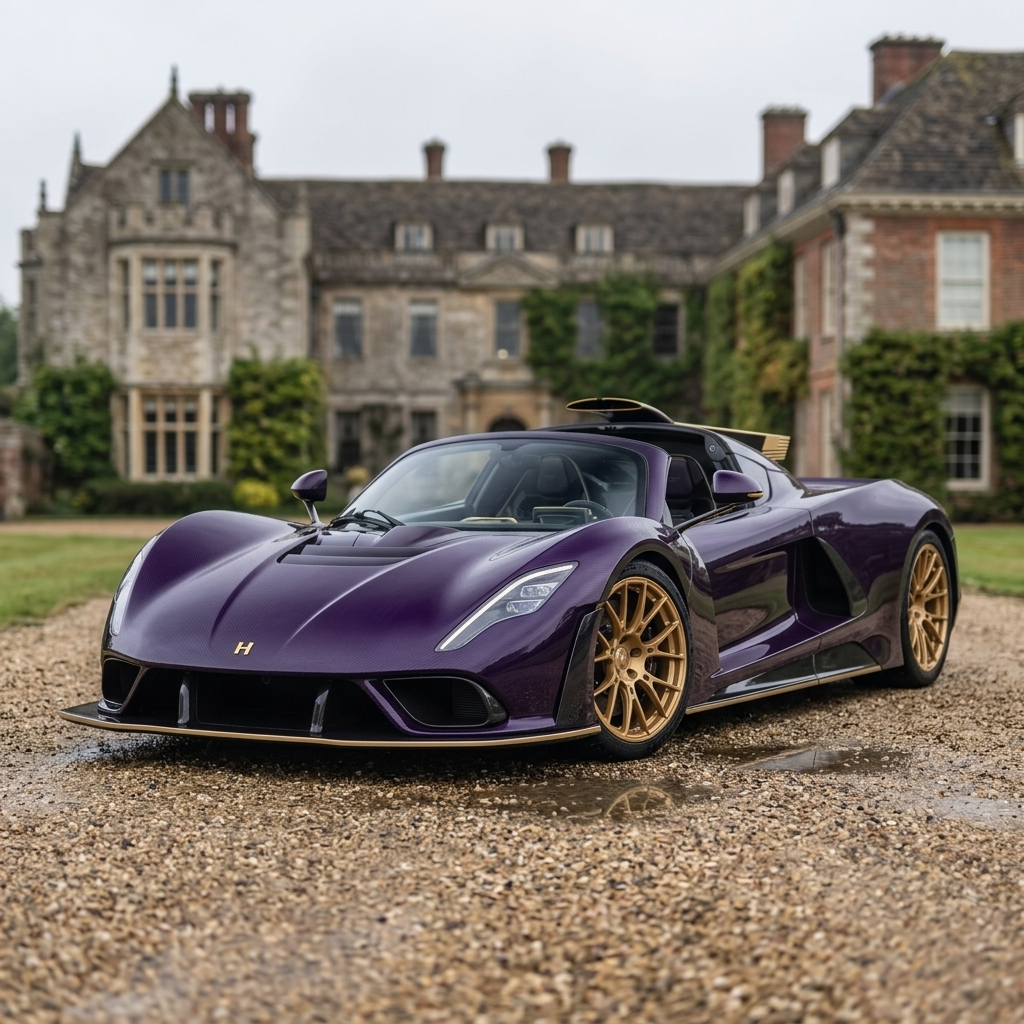
The Hennessey Venom F5-M arrived this month with 2,031 horsepower, a gated six-speed manual, a $2.65 million price, and a production run of twelve cars. That was the story at Goodwood. The detail that has surfaced since is the more interesting one to anyone who knows American engines: the Venom F5-M’s twin-turbo V8 is reported to trace its architecture back to GM’s LS platform.
The engine is Hennessey’s own 6.6-liter “Fury” unit, built in-house in Sealy, Texas, and heavily re-engineered for hypercar duty. But according to reporting in the American performance press, the bones are LS-derived. The most swapped engine architecture in the world — the one sitting in half the project cars in America — underpinning a machine that outguns every manual production car ever built.
What the Hennessey Venom F5-M actually is
The F5-M is the manual, open-top expression of the Venom F5 Evolution package — the update that brought revised aerodynamics, active suspension, and the 2,031-horsepower tune.
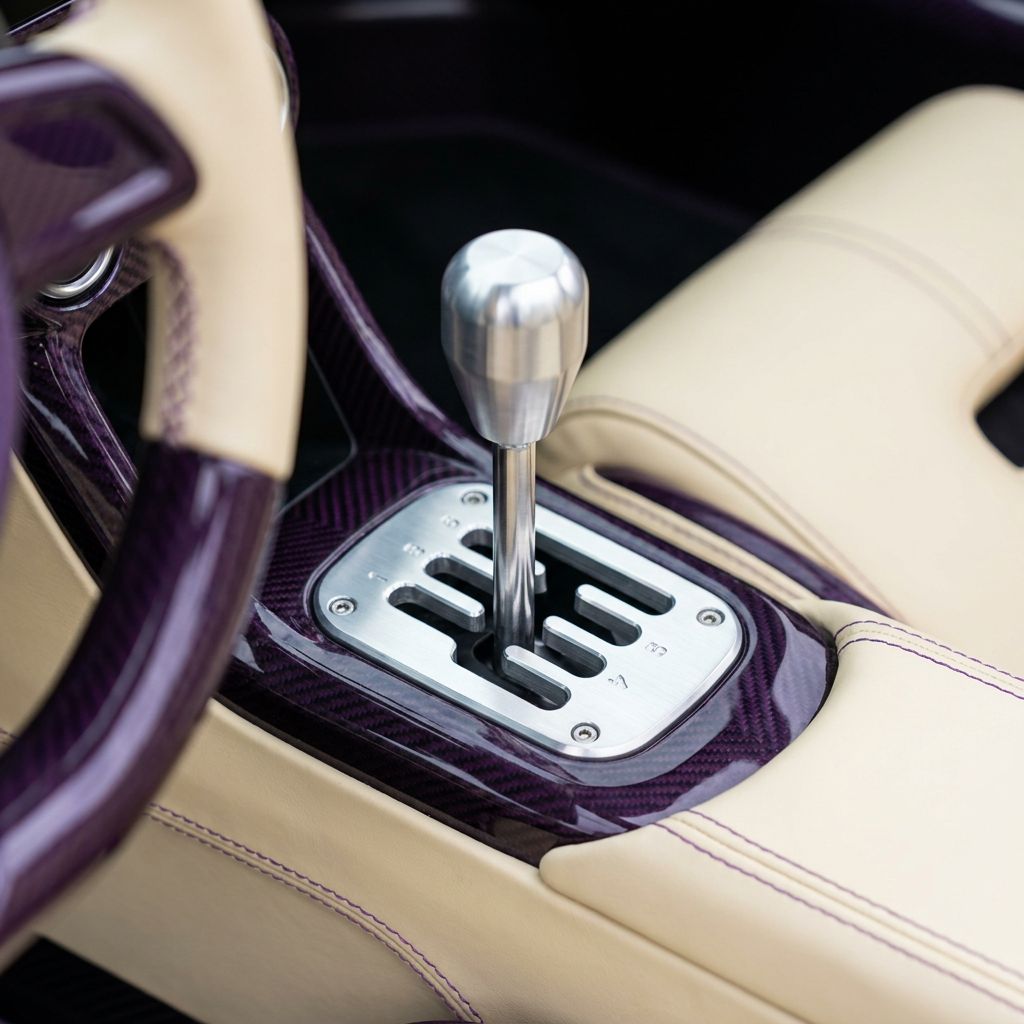
Where every other hypercar at this power level routes output through a dual-clutch gearbox, the F5-M uses a six-speed gated manual. That decision was not a bolt-on. Hennessey reworked the carbon fiber tub to accept both the transmission and a third pedal assembly, then rebuilt the interior around the shifter — a short-throw billet aluminum lever in a precision-milled gate, positioned close to the steering wheel so the driver’s hand travels the shortest possible distance. At 2,031 horsepower, that is not a styling decision.
The result is a car that requires three pedals and a deliberate hand to access performance that sells out before most buyers ever see the car, in a segment that spent fifteen years engineering that requirement out of existence.
Hennessey Venom F5-M specifications
| Engine | 6.6L twin-turbo “Fury” V8 |
| Power | 2,031 bhp |
| Transmission | Six-speed gated manual |
| Drive | Rear-wheel drive |
| Body | Roadster, open top, integrated roof scoop |
| Chassis | New carbon fiber tub, revised for the manual gearbox |
| Suspension | Adaptive by drive mode |
| Aerodynamics | Bespoke, with 55-inch dorsal fin |
| Production | 12 units worldwide |
| Price | From $2.65 million before taxes |
The details that separate it from a standard F5
Two things stand out beyond the drivetrain.
The first is a 55-inch (1,400 mm) dorsal fin running from the roof-mounted air intake to the trailing edge of the rear deck, added to keep an open car stable beyond 200 mph. The integrated roof scoop feeds cool air into the engine bay, and air spilling around its sides gets channeled rearward by the fin. It is the single most identifiable visual cue on the F5-M.
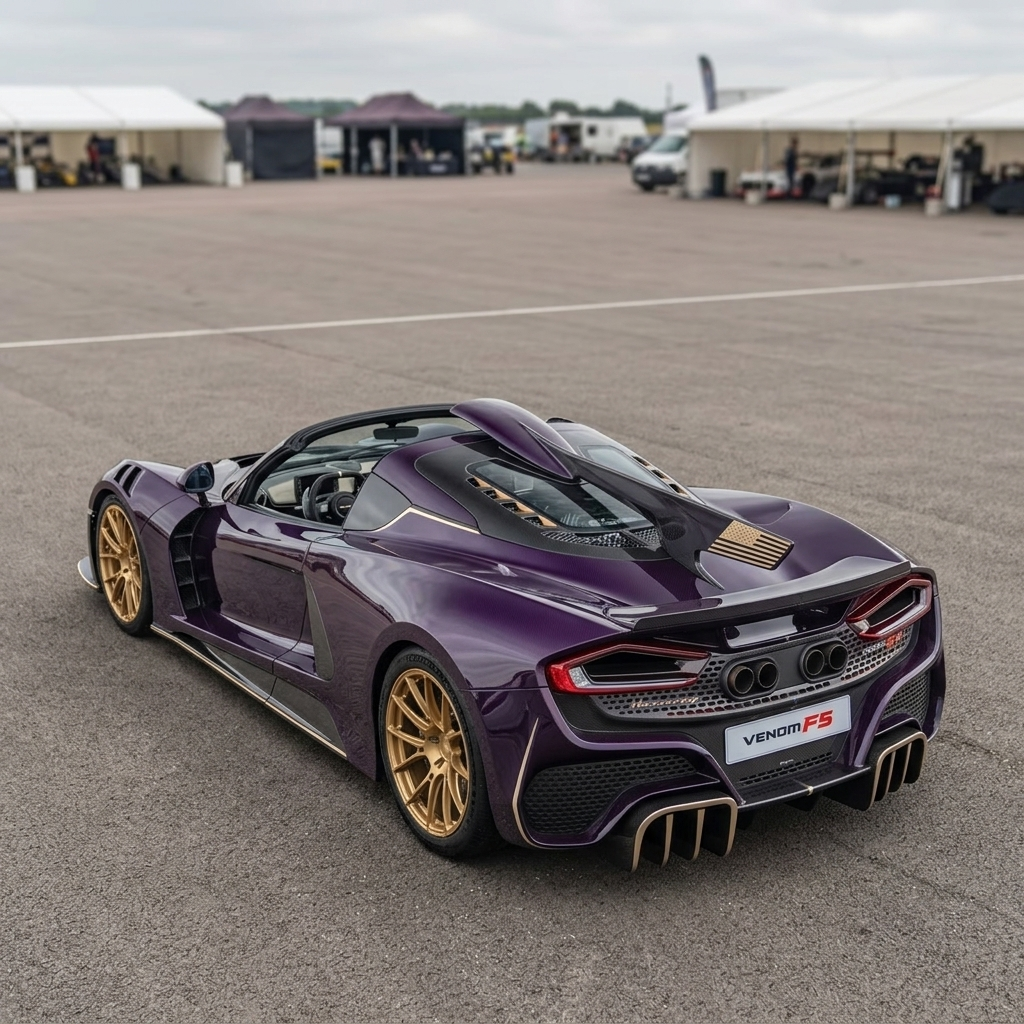
The second is the wheel package: custom one-piece forged monoblock wheels from Forgeline, machined from single forgings of aerospace-grade 6061-T6 aluminum, 19×10 inches front and 20×12 rear, built to order around the Venom’s suspension geometry and carbon-ceramic brakes.
That supplier choice says something about how Hennessey positions itself. Bugatti — whose Tourbillon takes the opposite, everything-in-house approach — and Koenigsegg develop nearly all major components internally. Hennessey builds a hypercar the way the American performance industry has always built fast cars: pick the best available specialist for each component and integrate them properly. The reported LS-derived block is the same philosophy applied to the engine.
Goodwood debut and chassis one
The Venom F5-M made its global public debut at the Goodwood Festival of Speed in July, based in the Supercar Paddock and running the hill climb twice daily with racer Alex Brundle at the wheel. A gated manual and a twin-turbo V8 at full throttle up a narrow English driveway is a specific kind of spectacle, and it was the right venue to make the point.
The car shown was chassis one, belonging to a UK customer who specified it through Hennessey’s Maverick division: exposed purple carbon with anodized gold accents, a 24-karat gold nose badge, and the owner’s family name on the tail and stitched into the knee pads. The trailing end of the dorsal fin carries hand-painted Union Flag and Stars and Stripes emblems in the same gold as the rest of the livery. The remaining eleven cars are allocated worldwide, with US owners making up the largest share.
Why twelve cars at $2.65 million works
Hennessey is asking hypercar money for a car with a manual transmission, which on paper is a harder sell than a faster automatic. In practice it is the easier sell, because scarcity in this segment is now about experience rather than output.
Two thousand horsepower is no longer rare. A buyer who wants the quickest possible lap has options — the McLaren W1 and Ferrari F80 among them, and this year’s delivery calendar is full of them. What almost nobody offers is a modern hypercar you shift yourself. Pagani found willing buyers for the manual Huayra. Hennessey went straight at it with the most extreme version anyone has attempted.
At twelve units, the F5-M does not need broad appeal. It needs twelve people who would rather work for the performance than have it delivered. Those people exist, and they have been underserved for a decade.
The more consequential part is what happens after those twelve. Hennessey has said both the manual gearbox and the updated chassis architecture will be offered across the rest of the F5 range, meaning Coupe, Roadster, and track-focused Revolution buyers will be able to specify three pedals. Twelve cars is the statement. The rollout is the actual product decision, and it makes Hennessey the only hypercar manufacturer offering a manual across a full model line.
The Hennessey Venom F5-M matters less for its horsepower figure than for what it proves: there is still a market at the very top of the performance world for a car that asks something of the person driving it. Hennessey got there by trusting proven American engine architecture and a gated manual instead of chasing the next tenth of a second. Twelve buyers will find out whether that trade was worth $2.65 million. Everyone else gets to argue about it.