
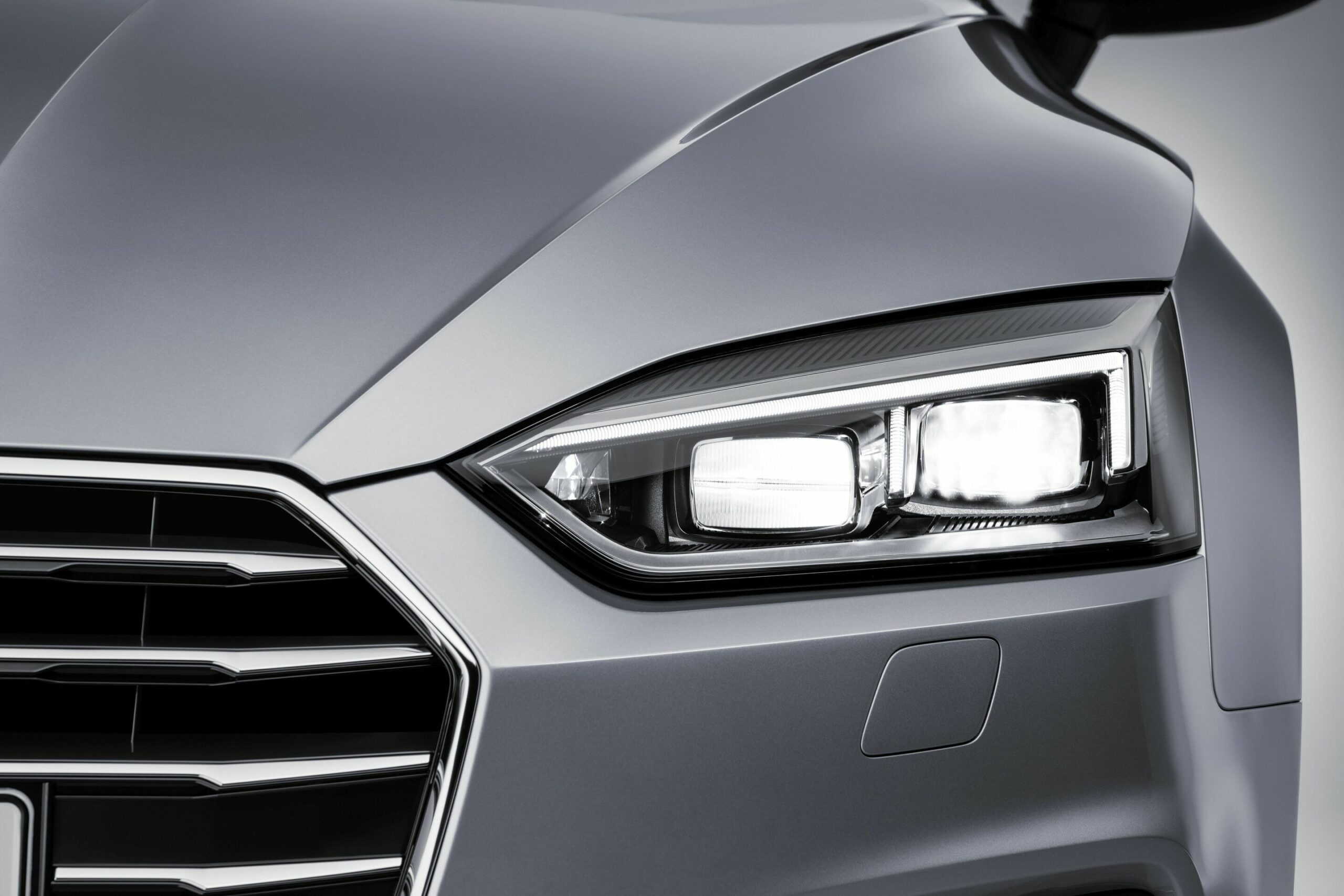
When it comes to supercar headlights, a multimillion-dollar hypercar and a luxury sedan can carry very different kinds of light. Inside the race from filament to micro-LED, and why price, pixels and “600 metres” don’t tell you which car actually sees farther at night.
Picture two cars parked nose-out at the top of a dark mountain road: a Ferrari Purosangue and the latest Mercedes-Benz S-Class.
Look closely at the Ferrari and its headlights aren’t headlights at all. Ferrari says those slim openings are air intakes wrapped around the daytime running lights; the real lamps sit low in the grille. The S-Class, meanwhile, can be ordered with about 25,000 individually controlled micro-LEDs in each headlamp, enough to project a snowflake onto the road when it turns icy.
One of these cars is far more exotic. Yet it’s the Mercedes that carries the more elaborate lighting technology, which, on its own, says nothing about which car actually sees the road better.
That gap between price and lighting technology runs through modern car design. The most advanced headlamps on sale were developed largely for luxury sedans and SUVs built in numbers large enough to justify custom chips, cameras and software. Supercar makers often choose differently, because their headlamps must also cool brakes, feed radiators and give the car a face you can recognise across a parking lot.
Neither approach is wrong. But if you assume the most expensive car on the road must have the most advanced headlights, the engineering, and the law, tell a more complicated story.
What You Need to Know
- Headlights have become computers. The newest use thousands of individually switched micro-LED pixels, steered by cameras and software.
- “600 metres” is a claim, not a test. Several brands advertise it from very different hardware, with no common method.
- Supercars trade light for air and identity. Ferrari, Bugatti and others shape their lamps around cooling and design.
- America is catching up. Adaptive high beams were legal in Europe for years before the U.S. allowed them in 2022.
- Independent tests don’t reward technology for its own sake. IIHS has rated a fancier lighting package below the standard lamps on one Mercedes, and above them on another.
From Filament to Pixel
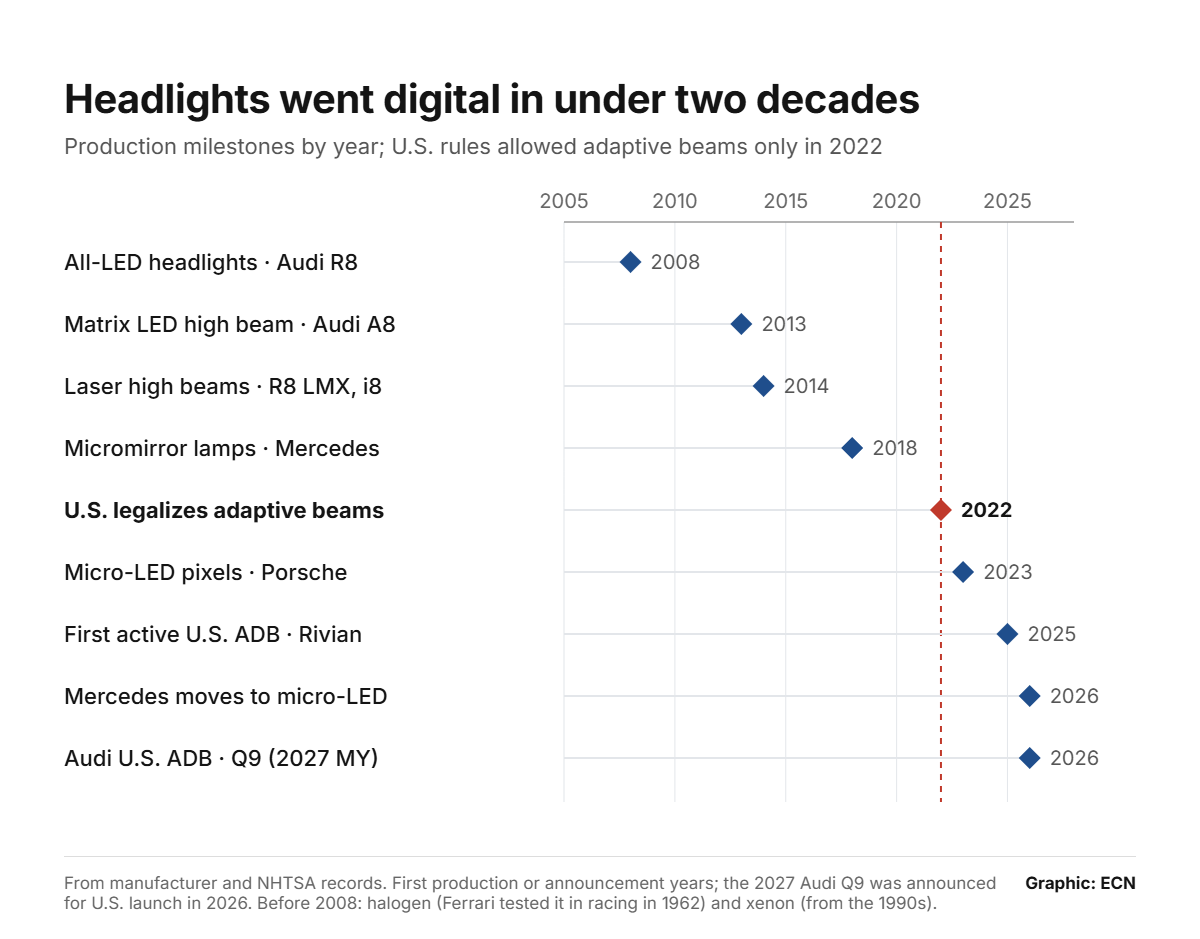
For most of motoring history, a headlight was a bulb behind a reflector. Halogen, which Ferrari first tried in racing in 1962, and xenon, which arrived in the 1990s, made that bulb brighter, but the beam stayed fixed: low or high, switched by the driver.
LEDs broke the light into pieces. Audi says its 2008 R8 was the first production car with all-LED headlights, and once light came from many small emitters, engineers could switch parts of the beam on and off. In 2013, Audi’s A8 used a camera to do exactly that, dimming slices of the high beam around oncoming cars while keeping the rest of the road lit. The industry calls it an adaptive driving beam, or ADB.
Then the paths diverged. In 2014, Audi’s limited R8 LMX and BMW’s i8 brought laser high beams to production, each claiming a first; blue laser diodes make a phosphor glow intensely white, adding a long, narrow spot to the LED beam. In 2018, Mercedes launched DIGITAL LIGHT, bouncing LED light off a chip with roughly 1.3 million microscopic tilting mirrors, the principle inside cinema projectors.
Today’s answer is simpler: put the pixels in the light source itself. Micro-LED chips such as ams OSRAM’s EVIYOS 2.0, in volume production since July 2023, carry 25,600 individually controlled LEDs. No mirrors, no moving parts. Porsche, Mercedes and Audi have all gone that way.
The 600-Metre Club
Read enough luxury-car press kits and one number keeps appearing. BMW said its Laserlight reached up to 600 metres. Porsche says the same of its HD Matrix high beam, and Mercedes of the 2026 S-Class. Rolls-Royce was widely reported to claim about 600 metres at the Phantom VIII’s 2017 launch.
Four brands, four technologies, one number. That should make you curious, not impressed.
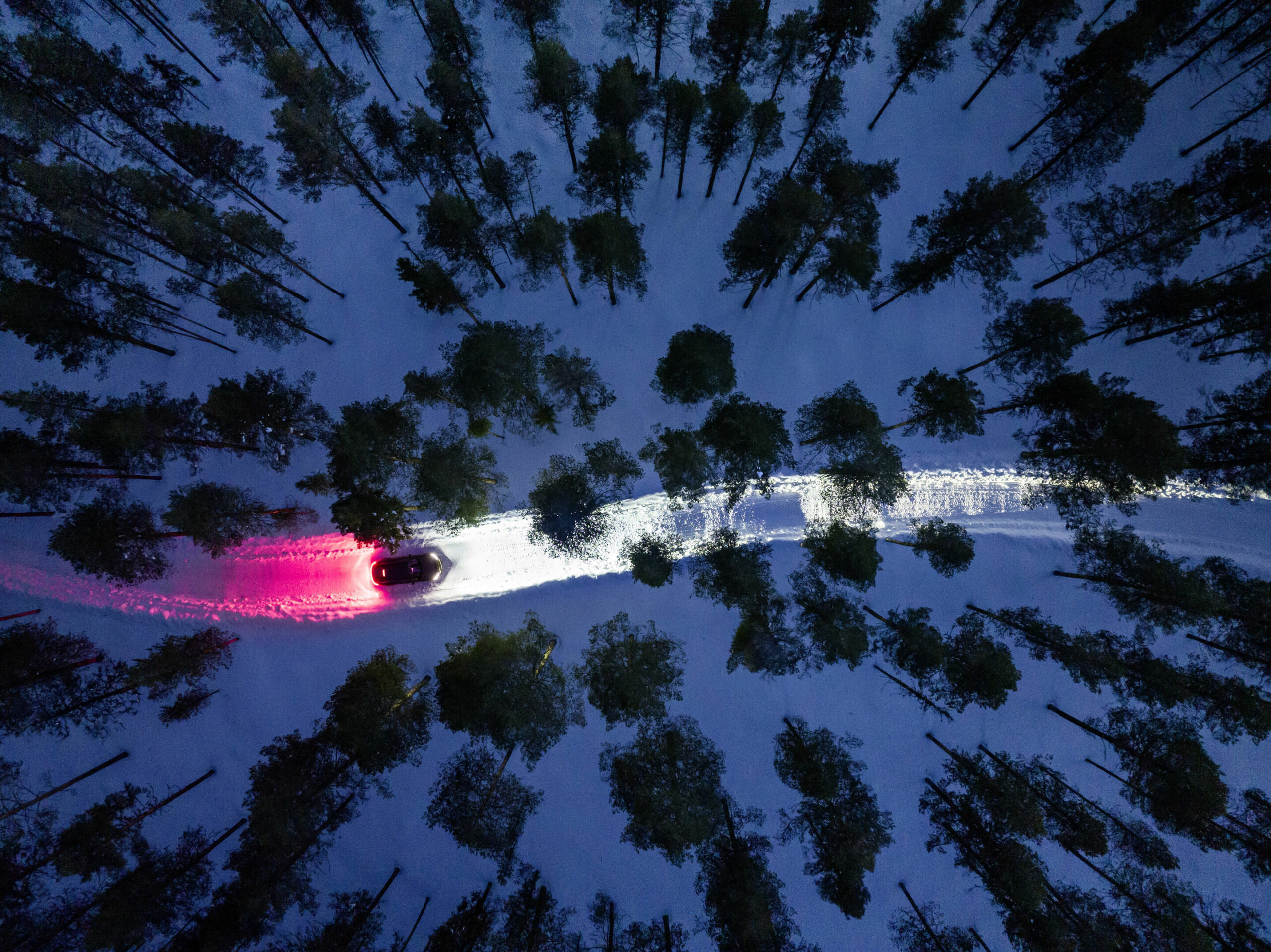
The likely reason is regulation. In Europe and other markets that follow United Nations rules, the combined peak brightness of a car’s high beams is capped. Peak brightness, more than the type of light source, decides how far a beam can usefully reach, so different hardware tuned to the same ceiling ends up making similar claims. None of these companies says how it measures its figure, so the claims can’t be ranked against one another, and a bigger advertised number doesn’t necessarily mean you will see a deer sooner on a dark country road.
The real contest has moved from how far to how well.
Mercedes-Benz rebuilt DIGITAL LIGHT around micro-LEDs for the 2026 S-Class, sold in the U.S. as a 2027 model. Each lamp carries about 25,000 of them; Mercedes claims a roughly 40 percent larger high-resolution field than the mirror-based system it replaces, up to half the energy use and lamps more than a quarter lighter. The high-beam spot now swivels using camera and map data, and the lighting software runs inside the car’s central MB.OS operating system. Mercedes has also switched some lens parts from glue to screws, which should help when a headlamp needs repair.
BMW is the cautionary tale. Its laser lights were a genuine engineering statement, but in 2024 product manager Andreas Suhrer told Australia’s carsales that the latest matrix LEDs distribute light better, and BMW has shifted its focus accordingly. It told Axios in August 2026 that it is still developing an adaptive system that meets U.S. rules.
Audi, which put matrix LED on the road first, has also swapped micromirrors for micro-LEDs about 40 micrometres across, roughly half the width of a human hair. In May 2026, Audi of America said the 2027 Q9 and SQ9 would be its first U.S. models with the adaptive beam switched on.
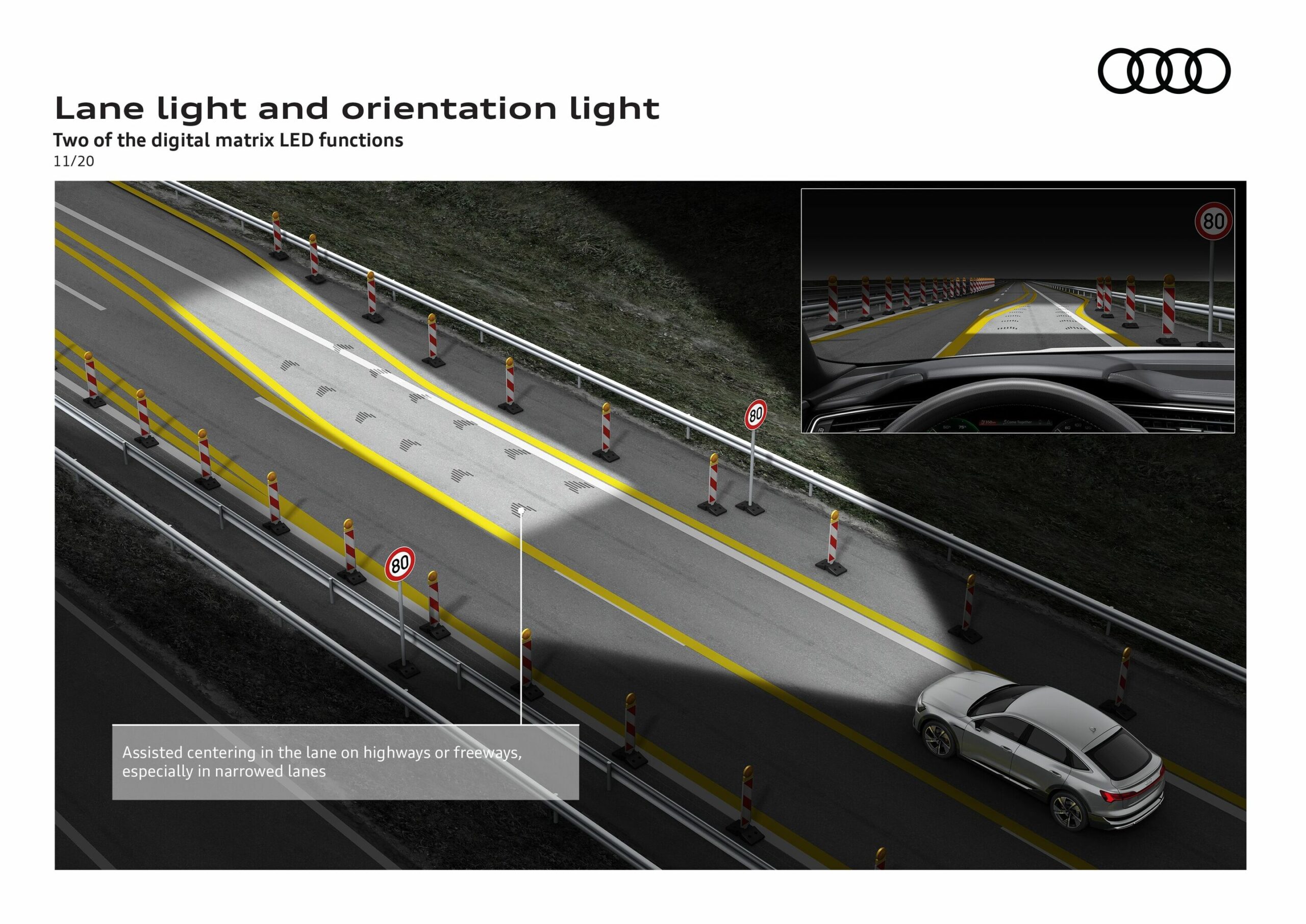
Porsche splits the work between a wide-angle pixel module and a long-throw one, with 32,768 pixels per lamp, and adds an auxiliary high beam on empty highways. It filed more than 25 patents on the design, though the pixel technology comes from FORVIA HELLA. Even Porsche’s standard matrix lamp on the latest Taycan divides the high beam into 11 segments.
All four are impressive engineering. The differences that matter to a driver, how evenly the road is lit, how precisely an oncoming car is masked, how quickly the beam follows a bend, are exactly the things a range figure doesn’t capture.
Rolls-Royce and Bentley: Light as Jewellery
If the German brands treat headlights as sensors, Britain’s great luxury houses treat them as jewellery that also happens to see.
Rolls-Royce adopted laser high beams on the 2017 Phantom; it is owned by the BMW Group, which pioneered them, though neither company details shared parts. What it does next is entirely its own. The 2022 Phantom Series II added Starlight Headlights, 580 laser-cut stars in the bezels echoing the famous Starlight Headliner, beside an illuminated Pantheon grille. The Cullinan Series II uses tall running-light graphics so the SUV is identifiable at night, and the electric Spectre revives the split-lamp face of the old Phantom Coupé, slim running lights above and the main lamps set lower in darkened housings.
None of this makes the road brighter. All of it makes a Rolls-Royce unmistakable after dark, which, for a brand that sells presence, is an engineering brief in its own right.
Bentley pushed the idea into craft. The 2017 Continental GT’s matrix LED lamps had internal surfaces cut like crystal glass, designed, Bentley said, to catch the light like a gemstone. When that car reached America, early reports noted its matrix function couldn’t be used here. The fourth-generation car of 2024 dropped the brand’s twin-lamp face for single headlamps, its first mainstream model with them since the 1950s, according to launch reports. Each carries 120 digitally controlled LEDs with jobs from low-beam foreground to high-beam boost, beneath a horizontal “eyebrow.”
Bentley shares a parent company with Audi and Porsche but publishes no pixel counts or range figures. What it sells is visible from the kerb: the lamp as an object, finished with the care of a cufflink.
Do Hypercars Have Better Headlights?
At the top of the price ladder, the front of a car is its most contested real estate. Every square centimetre must cool something, steer air or carry the brand’s face, and headlights compete for all three.
Ferrari is unusually candid about this. In its own history of Ferrari lighting, it says the F8 Tributo’s designers wanted the smallest possible lamps, using LEDs to free space for brake-cooling intakes. On the Purosangue, the real lamps hide in the grille; the 12Cilindri and F80 wrap theirs in a black visor, which design chief Flavio Manzoni has said avoids the familiar face of headlight eyes and grille mouth.
Ferrari hasn’t ignored the technology. It introduced LED elements on the 599 GTB Fiorano in 2006 and steering-linked adaptive lamps on the 2008 California, and it credits the SF90 Stradale as its first car with matrix LED, masking oncoming drivers and even reflective road signs. Dealer specifications list separate U.S. versions of its Active Matrix LED option.
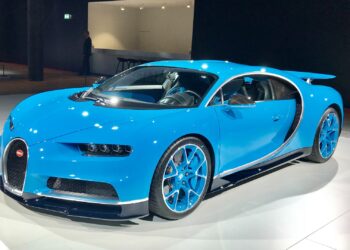
Bugatti made the trade literal. The Chiron’s eight-eye headlamps include ducts that feed cooling air to the front brakes, which then-design director Achim Anscheidt said are often the first thing to overheat when the car is driven hard. On the Tourbillon, Bugatti says the slim lamps hang from a “flying fender” that channels air to the side radiators and intakes. Bugatti noted the car had not yet received type approval when it described that design in October 2025. In a hypercar, even the headlamp is part of the cooling system.
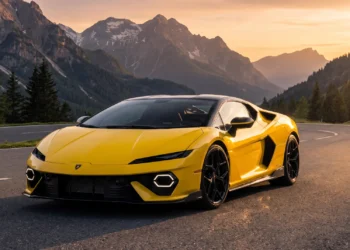
Lamborghini‘s Revuelto, launched in 2023, was the first Lamborghini with a full driver-assistance suite, adaptive headlights included. Its compact lamps sit beneath the bonnet’s overhang, framed by the Y-shaped signature lights, and UK dealer specifications list an optional package with matrix beam and a boosted high beam.
McLaren treats lighting as part of the aerodynamic sculpture: on the W1, the LED lamps sit in deep scoops shaped by air flowing over the nose, and the 750S is sold with adaptive LED headlamps. Aston Martin etches its wordmark inside the Vanquish’s matrix LED lamps, and its U.S. specification lists matrix high-beam control as “market dependent”, a frank admission that American buyers may not get everything the hardware can do.
Koenigsegg is famous for building its own engines and gearboxes in-house, so its restraint on lighting is telling. The Jesko wears narrow, swept-back full-LED lamps, with the running lights tracing their upper edges, and the company has said little more about them. For a maker that publicises its engines, gearboxes and carbon wheels in fine detail, the silence says where it thinks the engineering story lies.
Rimac‘s Nevera, built in a run of 150 cars, uses LED headlights with high-beam assist. Its most distinctive lights are elsewhere: three LED dots on each flank, which buyers can personalise and which change appearance with the driving mode, according to reviews of the car. Rimac’s storytelling is about batteries, motors and software, and its headlamps are restrained to match.
Notice the pattern. Mercedes, Audi and Porsche publish pixel counts and range claims. The supercar and hypercar makers mostly publish design stories, and no independent body has tested their headlights against a luxury sedan’s. Nobody can honestly say which sees farther.
What ECN can say is that their priorities differ, and the economics help explain why. A micro-LED headlamp is really a camera, a control unit and software that must be validated market by market. For a company building a few hundred cars a year, that is hard to justify for lighting alone when the same space could cool a brake disc. Spending the budget on air, weight and a face you recognise from a hundred metres away is a choice, not an oversight.
Headlights at a Glance: 13 Manufacturers
Mercedes-Benz
S-Class (2026; 2027 MY in U.S.)
- System
- DIGITAL LIGHT, micro-LED (~25,000 per lamp)
- What stands out
- Swivelling high-beam spot, road projections, lighting software in MB.OS
- Published claim
- Up to 600 m · U.S.: partial high beam now offered
Audi
Q9/SQ9 (2027 MY), Q3, A8
- System
- Digital Matrix LED, now micro-LED (earlier 1.3m-mirror DMD)
- What stands out
- Audi’s first U.S. adaptive driving beam; projected signals
- Published claim
- None for range
Porsche
Cayenne (2023 on), Taycan, Panamera
- System
- HD Matrix LED, 32,768 pixels per lamp (FORVIA HELLA SSL | HD)
- What stands out
- Wide and long-throw modules plus auxiliary high beam
- Published claim
- Up to 600 m
BMW
i8 (2014) and later models
- System
- Laserlight; adaptive LED with glare-free high beam
- What stands out
- Laser spot added to LED high beam; now refocusing on matrix LED
- Published claim
- Up to ~600 m (laser, 2015)
Rolls-Royce
Phantom VIII (2017), Phantom Series II (2022), Cullinan, Spectre
- System
- Laser high beam (Phantom)
- What stands out
- Starlight Headlights with 580 laser-cut bezel stars
- Published claim
- ~600 m (reported at 2017 launch)
Bentley
Continental GT (2017; fourth generation 2024)
- System
- Matrix LED, 120 LEDs per lamp on current car
- What stands out
- Cut-crystal internals; single-lamp face
- Published claim
- None
Ferrari
SF90, Purosangue, 12Cilindri, F80
- System
- Matrix LED (first on SF90); “Active Matrix LED” option
- What stands out
- Lamps shaped around brake cooling, hidden or visored
- Published claim
- None
Lamborghini
Revuelto (2023 on)
- System
- LED with optional matrix beam and boosted high beam (dealer spec)
- What stands out
- Compact lamps under the bonnet overhang; Y-shaped signature
- Published claim
- None
McLaren
750S, W1
- System
- Adaptive LED (dealer spec)
- What stands out
- Lamps set into aerodynamic scoops
- Published claim
- None
Aston Martin
Vanquish (2024 on), DB12
- System
- Matrix LED with auto high beam
- What stands out
- Etched wordmark; matrix control “market dependent” in U.S.
- Published claim
- None
Bugatti
Chiron (2016), Tourbillon
- System
- Eight-element LED (Chiron); compact LED (Tourbillon)
- What stands out
- Lamps double as air paths to brakes and radiators
- Published claim
- None
Koenigsegg
Jesko
- System
- Full LED
- What stands out
- Slim, swept lamps; minimal public detail
- Published claim
- None
Rimac
Nevera, Nevera R
- System
- LED with high-beam assist (published specs)
- What stands out
- Lighting secondary to battery and software story
- Published claim
- None
“Published claim” means a manufacturer figure, not an independent measurement.
Who Really Makes the Light
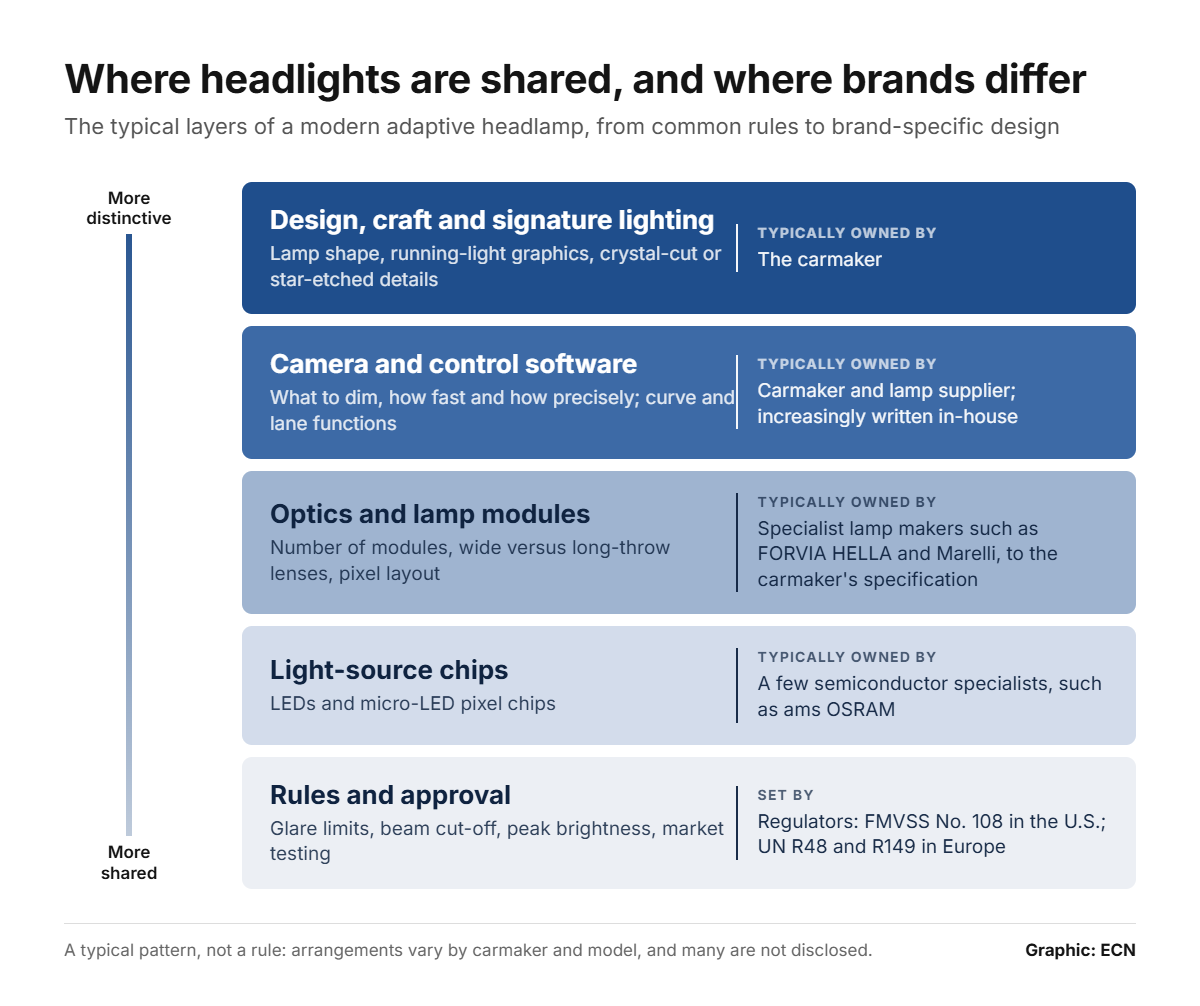
Marketing names suggest each brand invents its own headlights. In reality, the light usually comes from a handful of specialists. ams OSRAM sells its 25,600-pixel EVIYOS chip to lamp makers rather than to a single carmaker; Marelli builds a headlamp module around it, with roughly 20,000 pixels per lamp, and has not publicly named the carmakers using it. FORVIA HELLA says its SSL | HD pixel technology lights the Porsche Cayenne and has won orders from other premium brands it doesn’t name. When two carmakers both quote about 25,000 pixels, they may be using similar chips, though neither Mercedes nor Audi has said whose.
| Shared by almost everyone | Where brands genuinely differ |
|---|---|
| Legal limits on glare, beam cut-off and peak brightness | Optics: how many modules, wide versus long-throw lenses |
| Light-source chips from a few specialists | Camera and software that decide what to dim |
| Low beam, high beam, automatic dipping | Speed and precision of masking; curve and lane functions |
| Market approval testing | Integration with the car’s central computer and maps |
| Design, craft and signature lighting |
Increasingly, ownership lives in software. Mercedes runs DIGITAL LIGHT inside its MB.OS operating system, and Rivian sources the lighting system on its R1 from OPmobility but wrote its own adaptive-beam software for the R2. For luxury and supercar brands, the craft layer matters just as much: Bentley’s crystal-cut internals, Rolls-Royce’s starlit bezels, Ferrari’s intake-wrapped lamps. Those are proprietary in the most visible sense, even when the LEDs inside are not.
Why Your American Car May Be Dimmer Than Its European Twin
For American buyers, the biggest factor in headlight performance is often not the badge but the border.
The U.S. lighting rule, FMVSS No. 108, long allowed only two states: low beam and high beam. Toyota petitioned for change in 2013, but NHTSA permitted adaptive driving beams only in February 2022, after Congress ordered an update, and in 2024 rejected all twelve petitions asking it to revise the rule. The sticking point is testing: U.S. systems must pass on-track tests against stand-in vehicles, while European approval happens in the lab. That is why European hardware couldn’t simply be switched on here, and why Audi said everyone had to redesign their systems.
| United States | Europe and UN-rule markets | |
|---|---|---|
| Rulebook | FMVSS No. 108; carmaker self-certifies | UN R48 and R149; type approval by authorities |
| Adaptive high beam | Allowed since February 2022 | Allowed for well over a decade |
| How it’s approved | On-track tests plus lab measurement | Lab measurement |
| High-beam brightness cap | 150,000 candela per vehicle | 430,000 candela, all high beams combined |
| Road-projected symbols | Not provided for | Allowed within adaptive beams |
As of October 2026, factory-active adaptive beams remain rare in the U.S. Rivian says its system, launched in 2025, was the first activated here. Mercedes says its partial high-beam function is now offered to U.S. buyers on the 2027 S-Class, and Audi’s 2027 Q9 is its first U.S. model with Digital Matrix active. IIHS says the U.S. rule limits what these systems can do. Some owners re-code European functions into U.S. cars; ECN doesn’t recommend it, as NHTSA says it acts against non-compliant headlamps.
Change may be coming. On October 6, 2026, NHTSA opened a negotiated rulemaking to modernize FMVSS 108, covering glare, headlamp aim and alignment with international standards. Comments close November 9, 2026; no requirements have changed yet.
What Independent Testing Actually Shows
The one large, independent U.S. headlight test measures something different from the brochures. The Insurance Institute for Highway Safety drives each car toward light sensors on a straight road and four curves, records how far the beam stays bright enough to be useful (5 lux, in its terms) and penalises low beams that dazzle oncoming drivers. Its ratings are technology-neutral.
Its figures aren’t a rival to the brochure numbers; they answer a different question. IIHS reports how far a car’s beams deliver usefully bright light along the road’s edges under a defined test, not the farthest point a beam can reach, so its results shouldn’t be lined up against manufacturer range claims.
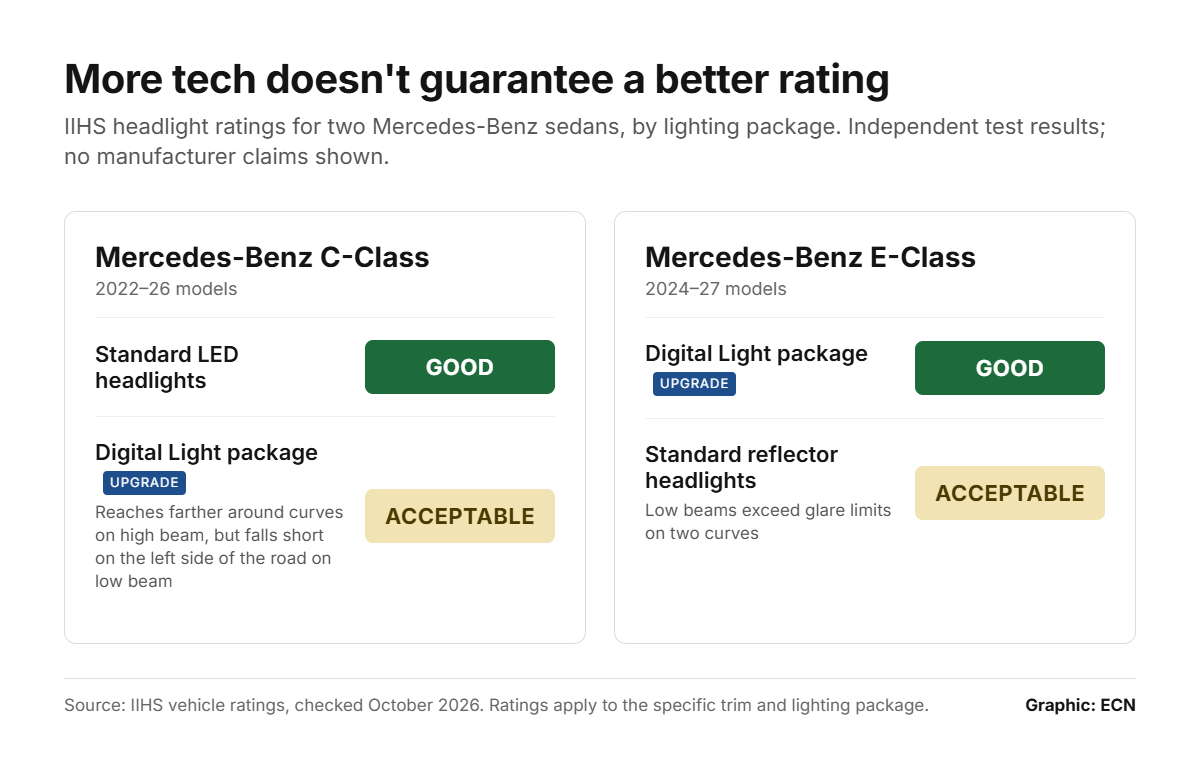
More technology doesn’t automatically score better, either. On the 2022–26 C-Class, the standard LED lights rate Good, while the curve-adaptive Digital Light package rates Acceptable: it reaches farther around curves on high beam but falls short on the left side of the road on low beam. On the E-Class, it’s the reverse. The Digital Light package rates Good and the standard reflector lamps Acceptable, because their low beams exceed glare limits on two curves.
The stakes are real. IIHS says cars with Good-rated visibility have 19 percent fewer nighttime single-vehicle crashes and 23 percent fewer nighttime pedestrian crashes than Poor-rated ones, and 46 percent of 2026-model systems rate Good. Glare, however infuriating, is cited in only one or two of every thousand nighttime crashes, and IIHS has found adaptive beams produce significantly less of it than conventional low beams.
For buyers, the practical lesson is simple: ratings can differ between trims and lighting packages of the same car, so check the IIHS result for the exact configuration you’re considering rather than assuming the most expensive option is the best one.
IIHS doesn’t test hypercars, and as of October 2026 we found no comparable independent test of Ferrari, Lamborghini, McLaren, Bugatti, Koenigsegg or Rimac headlights.
The Bottom Line
The direction of travel is clear. Micro-LED is moving downmarket, already on Audi’s compact Q3 and reportedly coming to upper trims of Mercedes’ refreshed C-Class. Lasers are fading. Road projections are spreading, from Mercedes’ snowflake to the turn-signal arrows Audi has shown for the Q9, though how far U.S. rules will allow them is unsettled. And America’s lighting rulebook is finally open for rewriting.
None of that changes what a good headlight is for. The best one isn’t the one with the biggest number in the press kit; it’s the one that lights the road you’re on and the curve you can’t yet see, without blinding the driver coming the other way. By that measure, sophistication follows engineering priorities and regulation more than price. A multimillion-dollar hypercar can be a masterpiece and still not be the car you’d choose for a moonless mountain road. That isn’t a flaw. It’s a reminder of what each car was built to do.
Frequently Asked Questions
Do more expensive cars have better headlights?
Not necessarily. The most advanced lighting systems are largely found on high-volume luxury models from Mercedes, Audi and Porsche. Supercar makers often prioritise cooling, aerodynamics and design, and few publish beam data.
Are laser headlights better than LED?
Laser high beams add a long, narrow spot to an LED beam. BMW, an early adopter, has since refocused on matrix LED, which it says distributes light better.
What is an adaptive driving beam?
A high beam split into segments or pixels that a camera-controlled system dims around other road users, keeping the rest of the road brightly lit.
Are adaptive headlights legal in the U.S.?
Yes, since NHTSA’s February 2022 rule, but systems must pass U.S.-specific testing, so few models offer them with the function active.
Why do so many brands claim 600-metre high beams?
Range is limited mainly by peak intensity, which regulations cap. There is no standard method behind these claims, so they aren’t directly comparable.
Which headlights are rated best by IIHS?
Ratings vary by model and even by option package. Check the IIHS rating for the exact trim and lighting package you’re considering.