
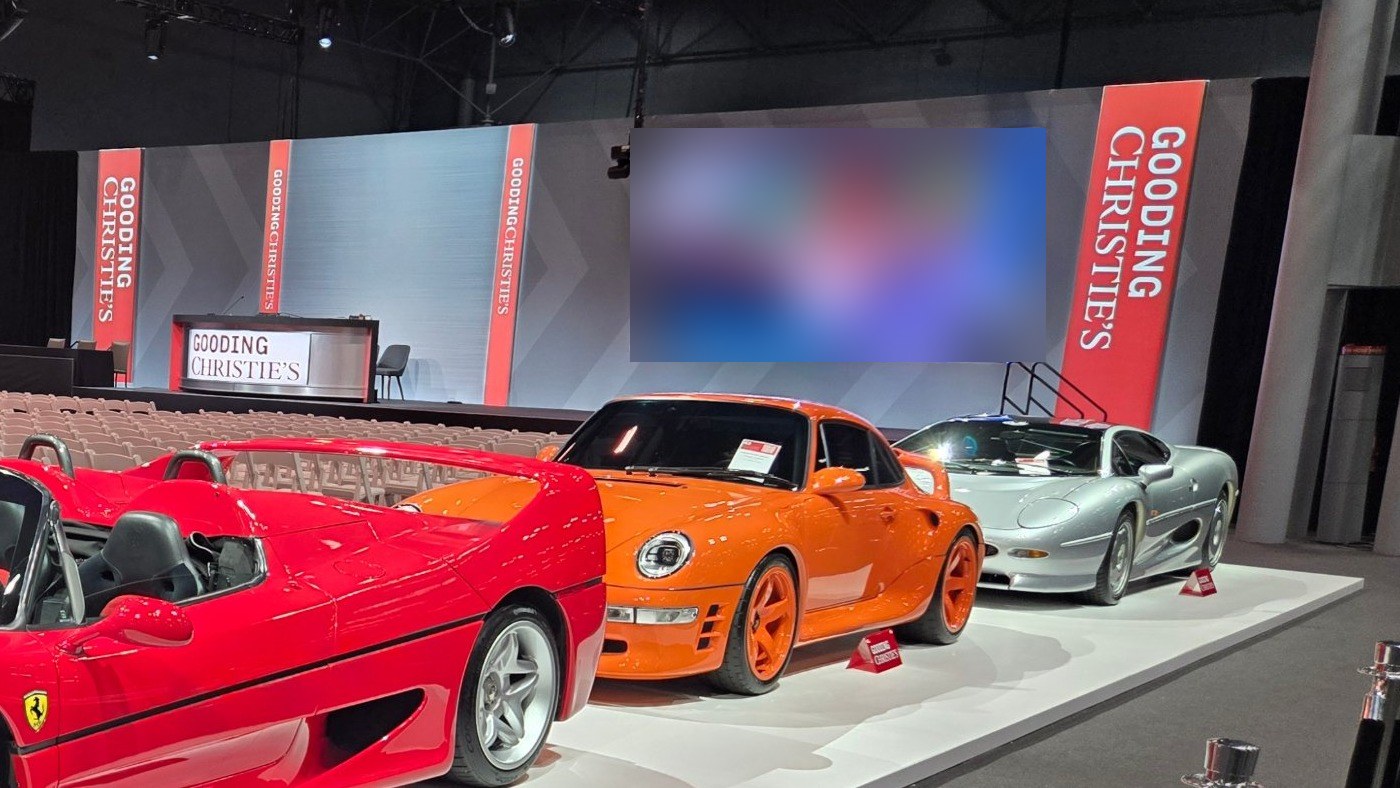
The one-off RUF Project Dragon sold for $4,075,000 on November 20 at Gooding Christie’s inaugural Rétromobile New York auction, nearly $2 million below its $6 million low estimate. Offered without reserve, it changed hands regardless. The Yellowbird’s RUF auction record survives.
Project Dragon arrived in Manhattan as the most audacious proposition of the sale: a car completed in 2024, wearing a 1998 identity, presented by its auction house as a period RUF. The room disagreed. What bidders were willing to pay, and what they weren’t, is the most useful signal the collector market has yet produced on new cars with old identities.
What You Need to Know
- Result: $4,075,000, Lot 43, against a $6 million to $8 million estimate, no reserve.
- Context: Third-highest result of the sale; the 1989 CTR “Yellowbird” ($6,055,000, 2025) remains the RUF benchmark.
- The car: A one-off built on RUF’s last unused CTR2-era shell, designed by 993 designer Tony Hatter, 621 hp, 759 miles.
- The takeaway: Bidders valued a superb new commission, not 26 years of history.
The room delivers its verdict
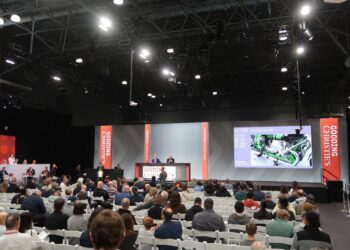
The RUF Project Dragon crossed the block on the first day of the two-day sale. With no reserve, the only question was where the bidding would settle, and it settled at $4,075,000, roughly two-thirds of the low estimate, according to Gooding Christie’s lot record.
In any other context, that is a commanding number. It was the third-highest result of the weekend, behind Steve McQueen’s 1967 Ferrari 275 GTB/4*S NART Spider at $18,925,000 and an alloy-bodied 1955 Mercedes-Benz 300 SL Gullwing. Across both days Gooding Christie’s reported $51,468,075 in sales, with 146 of 159 lots finding buyers.
But Project Dragon was consigned to make history, and the benchmark it was expected to eclipse still stands: the 1989 RUF CTR “Yellowbird” that Gooding & Company, now Gooding Christie’s, sold at Amelia Island in March 2025 for $6,055,000. The Dragon finished about $2 million short.
What the market was really pricing
The pre-sale case for Project Dragon rested on two readings of the same automobile. In one, it is a 2024 build carrying a vintage serial number: an exceptional modern commission, but a new car. In the other, which RUF’s own paperwork supports, it is the closing chapter of the CTR2 story, built by the original manufacturer on an original shell and shaped by the designer of the car it descends from.
The estimate was written for the second reading, a figure in the territory of the Yellowbird. In ECN’s reading, the bidding followed the first. Collectors were not acquiring a quarter-century of history; they were acquiring a nearly new one-off with an extraordinary backstory and an impeccable factory pedigree. That commands a great deal of money. On this evidence, it does not yet command what a period RUF with genuine racing-era fame does.
One sale cannot settle the matter. A no-reserve result records what the bidders in one room paid on one day, not a fixed market value, and a single bespoke car with no comparable sales is among the hardest lots any auction house can estimate. Even so, the distance between Gooding Christie’s estimate and the final result is the clearest data point yet on how serious buyers value provenance that has not had time to age.
The RUF Project Dragon, from idea to delivery
The idea dates to the late 1990s. According to Gooding Christie’s catalog, when RUF unveiled the CTR2 Sport, one collector, a longtime Porsche and RUF devotee who would go on to own several CTR2s in standard and Sport form, envisioned a version RUF wasn’t building. As he tells it, the technology to realize it didn’t yet exist. The platform matured, his means caught up, and Alois Ruf agreed. The car was delivered in March 2024.
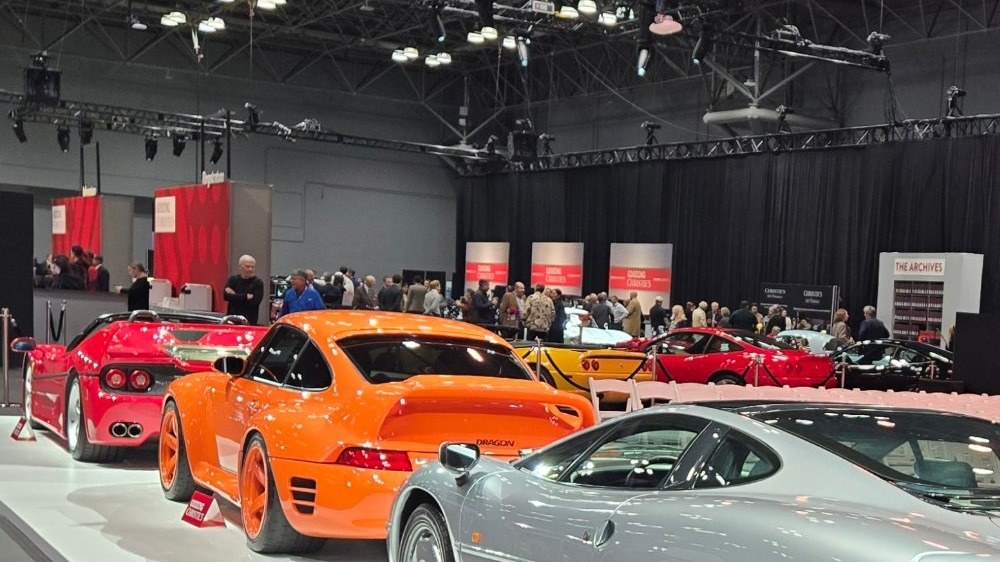
It began with the last unused shell. When CTR2 production ended, RUF retained a single W09 body-in-white, which Alois Ruf sold to the collector as “his very last one.” The distinction matters: RUF is recognized in Germany as a manufacturer in its own right, and cars built from scratch in Pfaffenhausen carry RUF’s W09 vehicle identification numbers rather than Porsche’s WP0 prefix. Because the shell’s identity dates from the CTR2 era, the finished car is catalogued as a 1998 RUF, and the factory order describes it as a “RUF CTR2 Sport ‘Dragon’” and a one-of-a-kind model.
For the design, RUF turned to Tony Hatter, the author of the 993-generation Porsche 911 on which the original CTR2 was based. The brief preserved the CTR2 Sport’s rear clamshell, two-tier wing and dramatic width, retired the period car’s door extrusions and refined the rear-quarter ducts. The bodywork is bespoke carbon fiber, finished in a color created for this car alone: Dragon Fire Orange.
Beneath it sits a reworked version of the CTR2’s twin-turbocharged, air-cooled flat-six, developing 621 horsepower at 6,500 rpm and 615 lb-ft at 5,000 rpm, sent to the rear wheels through a manual gearbox. The original CTR2 Sport was rated at about 580 hp. Carbon-ceramic brakes, Bilstein PSS10 suspension, a RUF integrated roll cage and 18-inch center-lock wheels made by OZ Racing for this car alone complete the specification. The cabin is equally personal: RUF “lollipop” seats trimmed in new-old-stock 1970s Porsche velour with orange striping, and a parcel shelf embroidered “DRAGON.” At cataloguing, the odometer showed 759 miles.
What it means for RUF and the one-off market
For RUF, a $4 million result for a car delivered in 2024 is a strong statement. It places a contemporary factory commission in the same conversation as the marque’s most celebrated historic cars. For the growing trade in modern one-offs built on legacy platforms, the lesson is subtler: provenance and paperwork matter enormously, but buyers still discount a new build until time and history have done their work.
The collector waited nearly three decades for the RUF Project Dragon to exist. The market has now set its own figure on that vision: $4,075,000.
ECN was at the Javits Center for preview night. For more from the floor, see our first look at Rétromobile New York.
At a Glance
| Car | 1998 RUF Project Dragon (CTR2 Sport “Dragon”) |
| Result | Sold for $4,075,000 (Lot 43) |
| Estimate | $6,000,000–$8,000,000, no reserve |
| Auction | Gooding Christie’s, Rétromobile New York, Javits Center, Nov. 20, 2026 |
| Delivered | March 2024 |
| Basis | Final unused W09 body-in-white from the CTR2 era |
| Design | Tony Hatter with RUF |
| Engine | Twin-turbo, air-cooled flat-six |
| Output | 621 hp @ 6,500 rpm; 615 lb-ft @ 5,000 rpm |
| Drive | Rear-wheel drive, manual |
| Mileage | 759 miles (at cataloguing) |
| RUF auction benchmark | 1989 CTR “Yellowbird,” $6,055,000 (Amelia Island, March 2025) |
Photos: Exotic Motors, taken at the Javits Center on November 18. Sources: Gooding Christie’s lot listing and results for the 1998 RUF Project Dragon (Lot 43); Gooding Christie’s Rétromobile New York sale totals; Gooding Christie’s Amelia Island 2025 results.