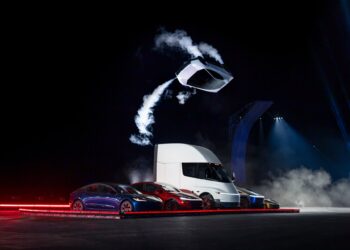

On the night Tesla showed its new Roadster hopping over a line of its own cars, a small company in San Mateo, California, answered with a video of its own. An Alef Aeronautics flying car rises straight off the ground, crosses over a parked Tesla Roadster (an earlier-generation car, not the new one) and a Cybertruck, and sets down again. Alef called it the company’s 1,000th logged flight.
The next afternoon, CEO Jim Dukhovny told CNN that the first car built for a paying customer was about three-quarters finished. He said it could reach its owner as early as the beginning of next year.
Most people have never heard of Alef Aeronautics. After decades of flying cars living mainly in films and renderings, it may be the company that has come closest to making a road-going one real. Here is who is behind it, how the machine works, and what still separates a test program from a car in someone’s garage.
Alef at a glance
- Company: Alef Aeronautics, San Mateo, Calif. Founded 2015.
- First customer model: Model A Ultralight, built to the FAA’s single-occupant ultralight rules.
- Expected price: $299,999 for early cars.
- Reservations: More than 3,500, according to Alef, with $150 and $1,500 deposits.
- Status: Hand-built in Silicon Valley since December 2025. No customer deliveries yet.
- Claimed range: About 200 miles driving and 110 miles flying. These are company figures, not independently tested.
A napkin, a café and a DeLorean
In 2015, the year Marty McFly visits in Back to the Future Part II, Dukhovny and three friends sketched a flying car on a napkin at Coupa Café in Palo Alto. His co-founders were Constantine Kisly, Pavel Markin and Oleg Petrov. The film connection isn’t a marketing afterthought: the Model A show car wears an “OUTATIME” plate, the same tag as Doc Brown’s DeLorean.
Dukhovny is not a car designer by background. His career was in software, and he has credited his co-founders with building the vehicle. He has called his late father, Leonid Dukhovny, his personal inspiration. The elder Dukhovny was a Kyiv-born folk singer-songwriter and mechanical engineer.
Early money came from Tim Draper, the venture capitalist who also backed Tesla and SpaceX in their early days. His Draper Associates Fund V put $3 million of seed funding into Alef, Reuters reported in 2022. Alef says its first full-size prototype flew in 2019. The company stayed quiet until October 2022, when it unveiled the Model A.
The whole car is the wing
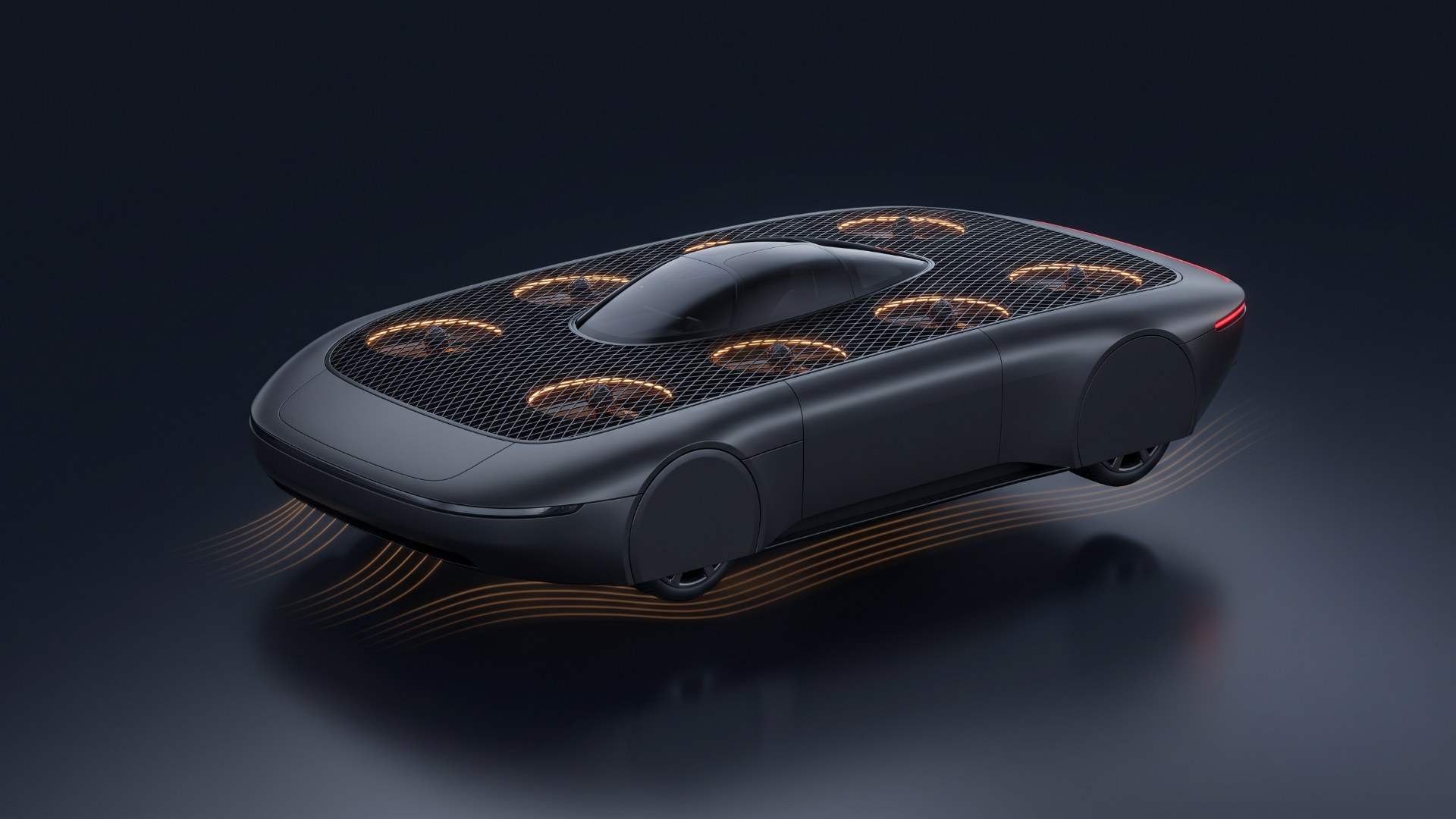
From a distance, an Alef looks like a low, wide, slightly retro sports car. Up close, most of the body is open mesh. Underneath it sit eight electric propellers, an arrangement engineers call distributed electric propulsion. Small motors in the wheels handle driving.
To take off, the propellers pull air down through the mesh and the car rises vertically, much like a drone. For longer flights, Alef’s design does something unusual. The entire body rolls 90 degrees onto its side, so the two flanks become the upper and lower wings of a biplane. Meanwhile, the cabin, mounted on a gimbal, swivels to keep the occupant upright and facing forward. “The whole car is the wing,” Dukhovny told Reuters in 2022.
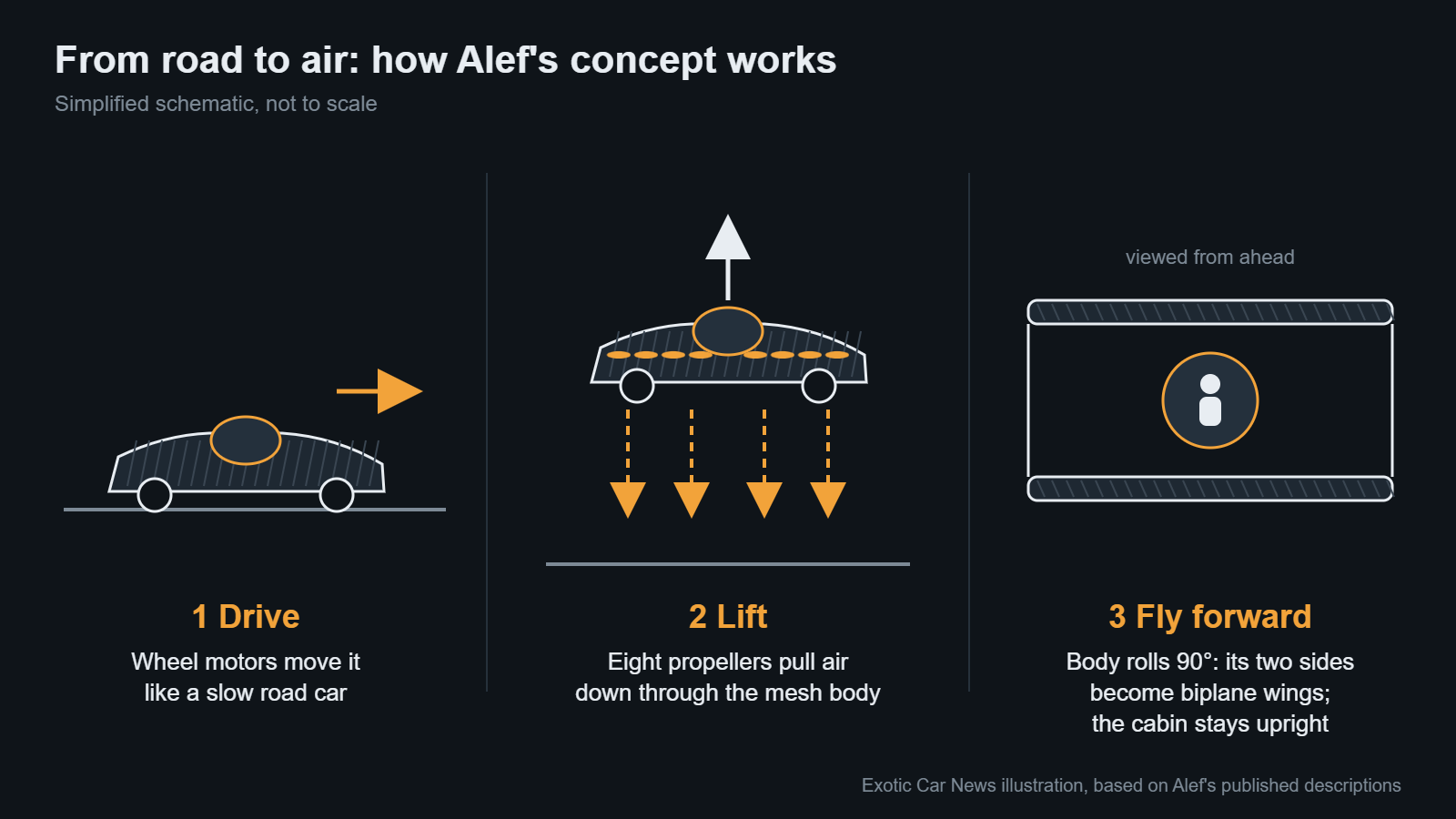
That transition is the hard part. In a hover, the propellers do all the lifting. In forward flight, the body has to start generating lift as a wing while the vehicle rotates around its occupant. The videos Alef has released, including the Cybertruck and Roadster clips, mostly show vertical takeoffs, short flights over vehicles and landings. Repeated, sustained biplane-mode flight with a person aboard is the capability to watch for.
For safety, Alef points to the redundancy of eight separate propellers and a ballistic parachute for the whole vehicle. The company says its light weight is what makes that parachute practical.
This is also what separates Alef from the electric air taxis being developed by companies such as Joby. Those are aircraft that operate from dedicated landing sites and never drive on public roads. Alef’s pitch is a car first: something that fits a normal lane, a normal parking space and a normal garage. Just don’t picture a highway cruiser. Alef previously planned to register the car as a low-speed vehicle, capped around 25 mph. Its preorder page now says the first cars are planned as “specially constructed vehicles” instead. The company hasn’t published road performance figures for the production car.
What has actually been proven
- 2019: First full-size prototype flies, according to Alef.
- October 2022: Model A unveiled alongside two working technology demonstrators.
- June 2023: The FAA issues an experimental special airworthiness certificate to the Armada Model Zero, the Model A’s precursor. It covers exhibition and research flights in limited locations. The FAA noted it was not the first aircraft of its kind to receive one.
- February 2025: An ultralight Model Zero drives down a closed San Mateo street and lifts off over a parked car, with no bystanders near the flight path.
- August 2025: Testing begins at Half Moon Bay and Hollister airports, with conventional aircraft given right of way.
- December 2025: Hand assembly of the first Model A Ultralight customer cars begins.
- October 2026: Alef reports its 1,000th logged flight.
Together, these show that a road-capable, car-shaped electric vehicle can take off vertically, fly controlled short flights and land repeatedly. They don’t yet establish how the customer car performs, how far it really flies, or how it holds up in an owner’s hands.
The flight count also deserves context. It is Alef’s own tally, and the company hasn’t said whether the flights were made by one vehicle or several Model Zero test platforms. Its May 2026 investment announcement already cited “over 1,000 flights,” and the company hasn’t explained how that figure relates to October’s 1,000th logged flight.
What owning an Alef Aeronautics flying car would really look like
The first Model A Ultralights go to a handful of early customers. Alef has said there will be no more than ten, in California and Hong Kong. Alef plans to train them, oversee compliance and handle maintenance, then use what it learns before building the cars in its reservation queue.
Dukhovny’s headline point is that no pilot license is needed, and under the FAA’s Part 103 ultralight rules that is true. The same rules come with what he called “a lot of restrictions”:
- One occupant only.
- Less than 254 pounds empty weight, not counting emergency equipment like a parachute.
- Daylight flying only.
- Air traffic control permission required in controlled airspace around busier airports.
- A top speed of 55 knots, about 63 mph.
- No flying over any congested area of a city, town or settlement, or over crowds.
That last rule matters most. The scene in every Alef video, a car rising above traffic, is exactly what Part 103 forbids in a built-up area. In its ultralight form, the Model A is something you could drive to an open field or a quiet rural airstrip and fly from. It isn’t yet a commuter that leaps over freeway jams. Alef also hasn’t published the Ultralight’s flight endurance or payload, and fitting batteries, motors and a parachute-equipped car body under 254 pounds leaves little margin.
Dukhovny says the next Alef will be certified as a light-sport aircraft. The FAA’s MOSAIC rule recently opened that category to powered-lift designs with up to two seats. That path avoids the many years of full type certification. The trade-off is that a light-sport aircraft requires at least a sport pilot certificate to fly.
Customers, money and the math
Each early car takes several months to build using a mix of robotic, industrial and mostly hand manufacturing, with many test flights before delivery. Dukhovny said the first car costs Alef almost its $300,000 price to make. He says higher volume could eventually bring the price under $25,000, a long-term goal rather than a plan with dates.
Alef counts more than 3,500 pre-orders and values them at about $1 billion. That figure is the sticker price multiplied out, not revenue. Deposits are $150 for the general queue and $1,500 for priority. A reservation is not a sale, and no customer has yet taken delivery.
The company’s backers include Draper Associates, Impact VC, Draper B1, Bronco Ventures and Splash VC. In May 2026, Alef also opened a public crowdfunding round on Wefunder under the SEC’s Regulation Crowdfunding.
Where Tesla fits in
Alef and Tesla share an early investor in Draper, and both build electric vehicles that leave the ground. That’s where the similarities end. Alef’s eight propellers push on the surrounding air and are designed for sustained flight, with the body acting as a wing. The new Roadster’s Thrust and Rocket versions use cold-gas thrusters for brief hops and flips, as we explained in our engineering breakdown of the Roadster.
Dukhovny argued on CNN that Tesla would need full FAA type certification, a process measured in years and billions of dollars. He welcomed the competition anyway, saying Tesla’s arrival proves the market and draws investors. In reality, the two are chasing different buyers: one is a high-performance sports car that uses thrusters for short airborne stunts, the other a slow road car built to genuinely fly.
What comes next
The next year will show whether Alef can turn a test program into an ownership experience. The milestones to watch:
- The first customer delivery.
- How those early owners actually use their cars.
- Repeated flights with a person aboard, through the full transition to biplane mode.
- Published endurance and range data.
- A road registration that works.
- Light-sport certification for the next model.
- Manufacturing that takes weeks per car instead of months.
Dukhovny thinks mass adoption could be about five years away. That is an optimistic forecast in an industry full of missed dates, and nothing about it is guaranteed. But Alef has already done something rare. It has moved the flying car out of science fiction and into a logbook.
For decades, the running joke has been “Where’s my flying car?” Alef’s answer: in a workshop in Silicon Valley, mostly finished, waiting for its first owner.