

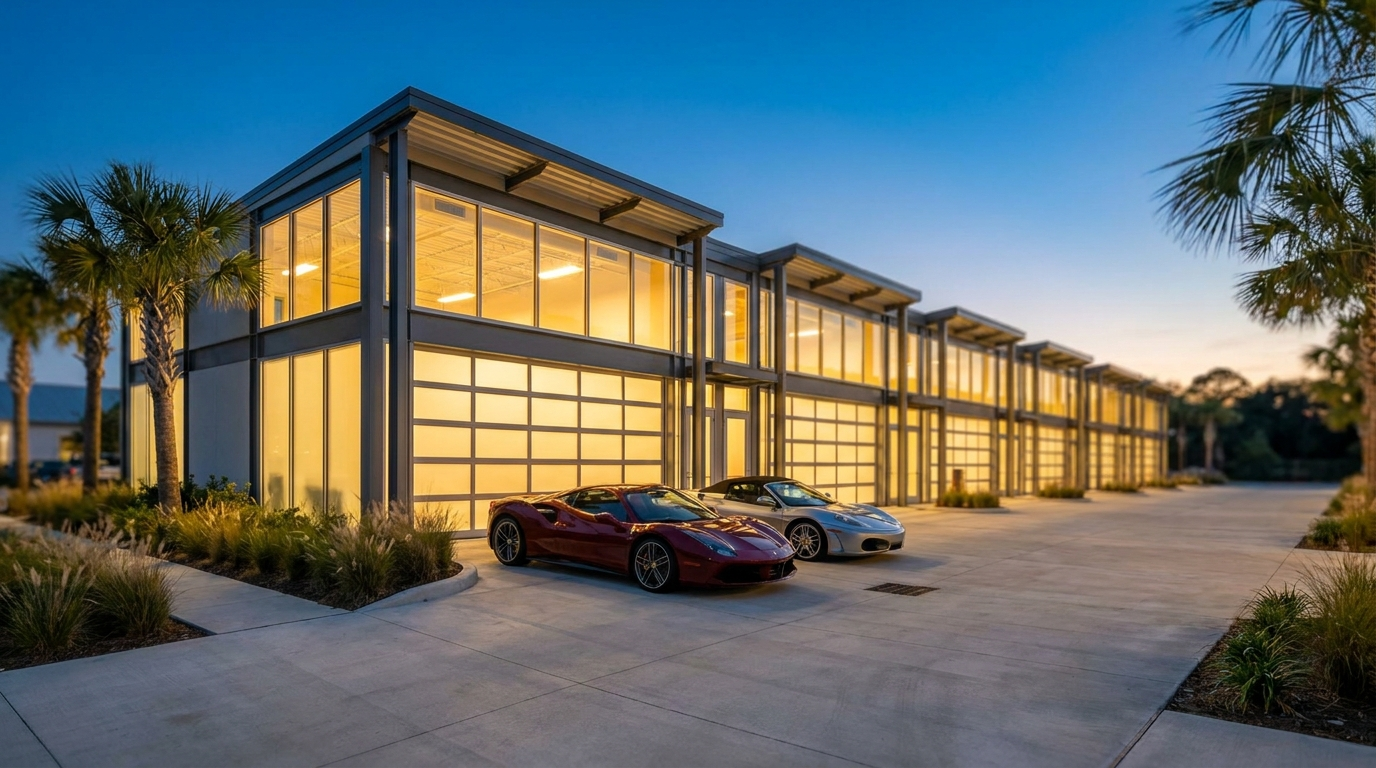
The garage condo has quietly stopped being a novelty. National trackers now count roughly 540 garage condo projects across 43 states, and the sector entered 2026 with the strongest development pipeline on record. What started a decade ago as private, deeded storage for cars, boats and RVs has matured into something the industry now openly calls an asset class.
That maturity brings professional developers, branded operators, waiting lists and a functioning resale market. It also brings a risk the sector has so far been reluctant to talk about openly.
The short version
- A garage condo is a privately owned, deeded garage unit inside a managed development — you hold title, you can finish it, and you can sell it.
- Roughly 540 projects are now tracked across 43 states, the largest pipeline the category has ever had.
- Prices run from under $150,000 to more than $1.2 million. New Class A construction is landing around $219 to $250 per square foot.
- Every quoted price is a shell price. Lifts, floors, cabinetry, HVAC and a finished mezzanine are the owner’s cost, and they are not a rounding error.
- These are financed as commercial real estate, not homes — larger down payments, shorter terms, no 30-year fixed.
- The risk is local overbuilding. Supply constraint is what drove appreciation. Several hundred new units in one metro is what removes it.

The numbers behind the boom
- ~540 garage condo projects tracked nationally across 43 states as of spring 2026
- 60%+ of all projects sit in the Upper Midwest and the Sun Belt
- 440+ collector-automotive locations tracked across the US and Canada, including 335 private car clubs and 43 private tracks
- $30.9B to $43.4B — growth in the global classic car market between 2020 and 2024, excluding exotics
- ~30% of avid collectors surveyed had still never heard of the garage condo concept
That last figure is the one worth sitting with. A category with a record pipeline is still unknown to roughly a third of its own target buyer. That gap is either the best argument for the sector’s runway or the clearest warning about how fast supply is arriving relative to awareness, depending on which side of a purchase you are standing on.
Why collectors are buying instead of renting
The demand drivers are unglamorous and durable. Residential lots have gotten smaller. HOAs have not gotten more permissive about oversized vehicles or workshop activity. Zoning in most suburbs never contemplated a collector who needs eight bays and a lift.

Meanwhile the cars themselves got more valuable, which changed the storage calculation. A climate-controlled rental bay solves the problem month to month and builds nothing. A deeded unit solves the same problem, can be customized, and can be sold. For an owner planning to be in a market for a decade, the math stops being close.
There is a second driver that has less to do with cars. Downsizers moving out of large houses use garage condos to keep a collection they would otherwise have to break up. Remote professionals use them as a workspace fully separated from the house. Boat and RV owners use them to stop paying for an outdoor lot. Developers have noticed, and the marketing has followed.
Renting versus owning, side by side
| Factor | Rented storage bay | Deeded garage condo |
|---|---|---|
| Cost structure | Monthly rent, raised at the operator’s discretion | Purchase price plus fixed monthly association dues |
| Equity | None | Owner holds title and any appreciation |
| Build-out | Rarely permitted | Lifts, mezzanines, cabinetry, lighting at owner’s cost |
| Access | Often gated by staffed hours | Typically 24/7, keyed to the owner |
| Exit | Give notice and leave | Resale in a thin, slower-moving market |
| Financing | Not applicable | Commercial real estate terms |
Where the growth is concentrated
The Sun Belt gets the magazine coverage, but the Upper Midwest is quietly the center of gravity. By development count, Minnesota leads the nation, followed by Florida, Arizona, Texas and Colorado. Together the Upper Midwest and Sun Belt account for more than 60 percent of tracked projects — a reminder that this product is driven less by weather than by lot sizes, zoning and the price of a second garage.
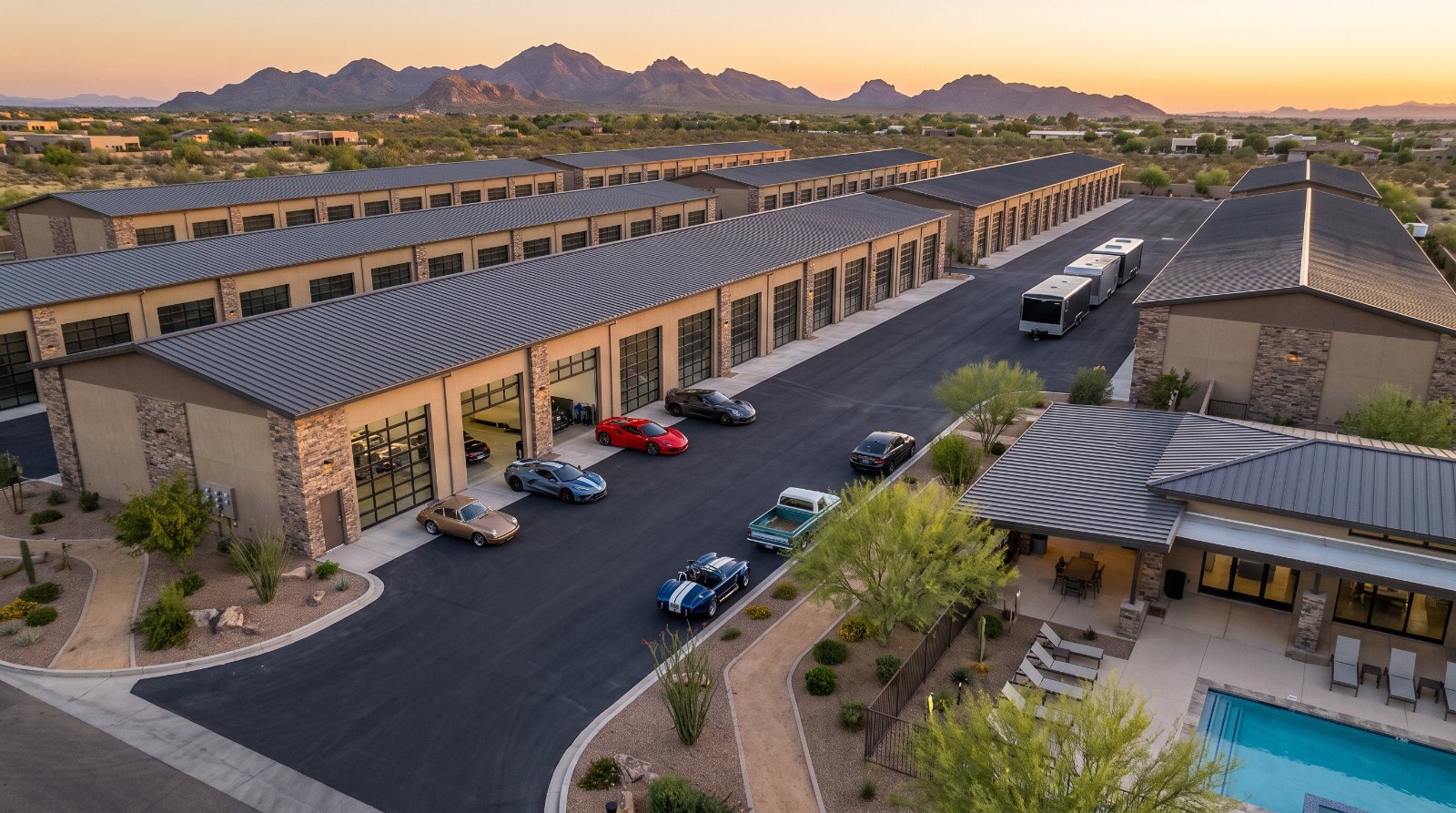
Colorado is the clearest example of a market that matured fast. It now ranks fourth nationally with 43 tracked developments and roughly 1,950 units, spanning the Denver metro out to the Western Slope, with seven more in construction or planning. Marketplaces covering the category, including Motor Stables, now organize inventory by market rather than nationally, which is itself a signal of how localized the buying decision has become.
A sample of what is moving in 2026 gives a sense of the range:
| Development | Market | Status and detail |
|---|---|---|
| Motor Vault Queen Creek | Queen Creek, AZ | 20-ft ceilings, full HVAC, late-2026 delivery |
| Torque Motor Suites | Birmingham, AL | 105 units; Phase I from $399,500 to $480,000 |
| Blue Ash Motor Suites | Cincinnati, OH | 1,800 SF suites, $395K–$450K |
| Motor Condos at Independence | Independence, MN | 120-unit master-planned campus |
| Luxe Corsa Car Condos | Lake Zurich, IL | 121 units fully approved |
| Iron Gate Motor Condos | Naperville, IL | Expansion units planned for 2026 |
| MARQUE Collection Suites | Rogers, AR | Phase 1 nearly sold; townhome phase fall 2026 |
| Jetport Motor Suites | Naples, FL | Phase 1 deliveries began March 2026 |
| The Hangar | Westhampton, NY | Groundbreaking late 2026, a Long Island first |
Near Phoenix-Goodyear Airport, an $18.5 million, 140,090-square-foot facility opened in January 2026 with 206 units — but only 61 of those are condos for purchase, with 145 held as rentals. That split is worth noting. Not every operator is convinced the ownership model is where the whole market is going.
What garage condo units cost in 2026
Pricing spans a wider band than most buyers expect. Entry-level storage units start under $150,000 in some markets. Mid-market units generally run $150,000 to $400,000. New Class A construction is landing around $219 to $250 per square foot, which puts an 1,800-square-foot suite in the $395,000 to $450,000 range. Premium collector suites in established markets clear $1 million, and one lifestyle community currently lists units from $395,000 up to $1.2 million.
| Tier | Typical price | What you are buying |
|---|---|---|
| Entry / flex bay | Under $150,000 | Smaller shell, basic power, limited or no amenities |
| Mid-market | $150,000–$400,000 | Tall door, higher ceiling, mezzanine-ready, gated campus |
| Class A new build | $219–$250 per SF | Full HVAC, 20-ft clear height, glass doors, clubhouse |
| Premium collector suite | $1 million and up | Large footprint, finished interior, marquee address |
The number nobody quotes: finishing the unit
Every figure above is a shell price. What most developers hand over is conditioned space, a slab, a door, a panel and a rough-in. The garage in the brochure photograph — the mirror floor, the lift, the cabinetry, the mezzanine with the leather chairs — is the owner’s line item.
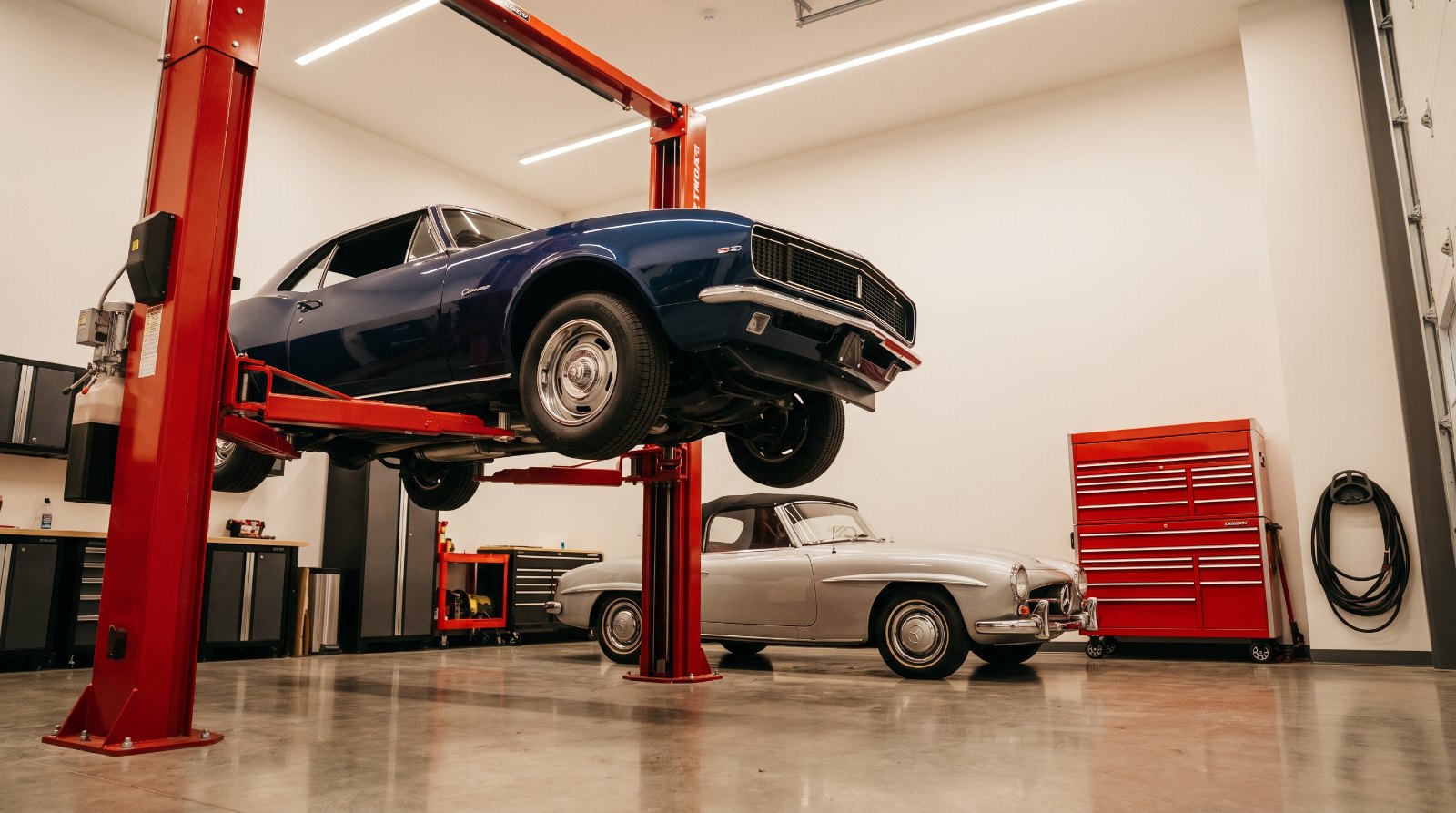
Budget realistically for the pieces that make a shell usable:
- Lifts. A two-post or four-post lift plus installation and any required slab verification. Ask the developer for the slab thickness and PSI before you order one.
- Flooring. Epoxy and polyaspartic coatings commonly run from the low single digits to the low teens per square foot installed. On 1,800 square feet, that is a real number.
- Mezzanine. Framing, stairs, railing and finishes, plus whatever the local building department requires for an occupied second level.
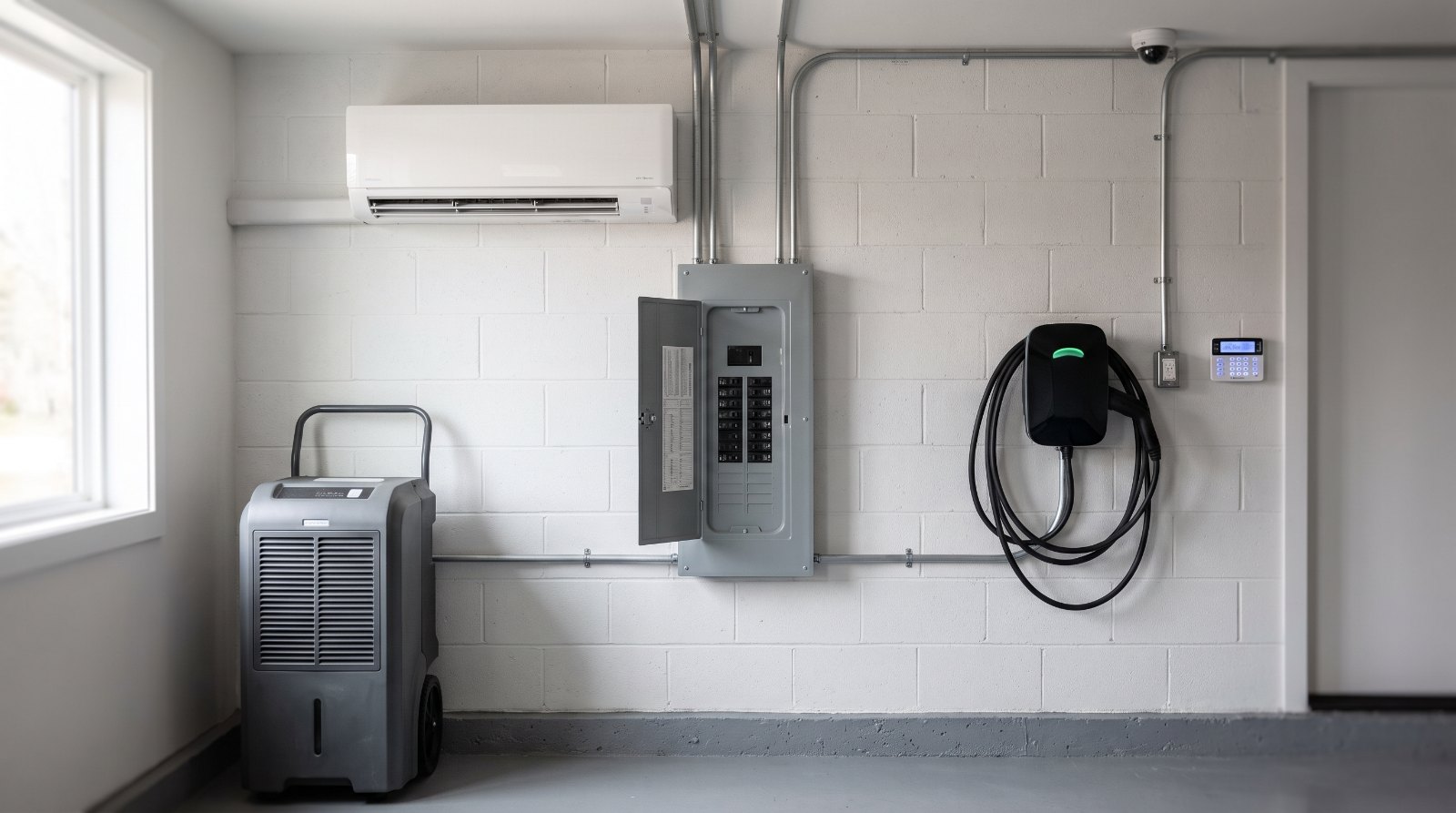
- Climate control. Mini-split HVAC and, in humid markets, dedicated dehumidification. Cars stored long term care more about humidity than temperature.
- Power and air. Additional circuits, EV charging, compressed air lines, and lighting well beyond the two strip fixtures the shell arrives with.
- Cabinetry, plumbing and finishes. A slop sink, a half bath if the association and code permit one, storage, and a TV wall.
None of this is exotic, but it routinely adds a meaningful percentage to the purchase price, and it is the most common source of buyer surprise in the first year of ownership.
Financing, insurance and the systems you now own
Financing catches buyers out more than anything else. Because a garage condo is not a residence, lenders generally treat it as commercial real estate. In practice that means a larger down payment, a shorter term than a home purchase, amortization that outruns the term, and often a personal guarantee. There is no 30-year fixed, no FHA and no VA. Local and regional banks, credit unions and portfolio lenders do most of this business, and some owner-user buyers pursue SBA financing where the use case qualifies. Motor Stables covers the mechanics in its garage condo buyer’s guide.
There is an interesting contrast here. Residential condo lending got materially tighter in 2026: Fannie Mae retired the streamlined Limited Review for applications dated on or after August 3, 2026, and the minimum reserve allocation for eligible projects rises from 10 percent to 15 percent of budgeted assessment income on January 4, 2027. Garage condos sit entirely outside that framework. That is a convenience and a hazard at once — nobody is forcing a project review, which means you are the underwriting standard.
Insurance splits along the same seam. The association’s master policy typically covers the building shell and common areas; the owner insures the build-out, the contents and, separately, the vehicles. A collector car policy is not a substitute for a unit-owner policy, and an agreed-value classic policy will have opinions about where and how the car is stored. Confirm what the master policy actually names before you assume it covers your mezzanine.
Monthly dues cover the roof, paving, landscaping, security and access control, common-area utilities, master insurance and — if the association is run well — reserves. Ask for the reserve study, not the amenity brochure.
The amenities arms race

New developments increasingly compete on everything except the garage. Members-only clubhouses, fitness rooms, racing simulators, bars, display space, track access, outdoor kitchens and event calendars are now standard pitch material. At least one community counts a NASCAR Hall of Famer among its owners and treats that as part of the pitch.

Amenities are a reasonable way to differentiate a commodity box, and the community is genuinely what many owners are buying. They are also a recurring cost that lands on the owners association, and a clubhouse is considerably easier to build than to fund for twenty years. Buyers touring a development on the strength of its simulator lounge should ask what the reserve study says.
The risk nobody wants to name
Overbuilding. It gets mentioned in trade coverage as a footnote, usually one sentence before returning to the growth numbers, and it deserves more than that.
The comparison being drawn inside the industry is Florida’s residential condo market, which has run through multiple boom and bust cycles. The parallel is not perfect, but the mechanics rhyme: a category with genuine demand, a compressed window where capital and developers pile in simultaneously, and pre-sales used to justify the next groundbreaking.
Garage condos carry a specific vulnerability that residential does not. This is a thin market. The buyer pool is small, specialized, and concentrated in a narrow income band. Supply constraint is precisely what has driven appreciation in established corridors like the Scottsdale Airpark. Remove the constraint by delivering several hundred units into a metro over eighteen months, and the thing that made the asset appreciate is the thing that disappears first.
There is a second-order version of the same problem. A development that sells out slowly leaves the developer controlling the association longer, with dues set to move units rather than to fund a roof. The bill for that arrives in year five or year eight, as a special assessment, in a building where a third of the owners are already trying to sell.
None of that means the boom is a bubble. It means location and timing are going to matter far more in 2027 than they did in 2020, and that the phrase “documented supply constraints” in a pre-construction brochure is a claim to verify rather than accept.
How to read a development before you buy
- Count the pipeline, not just the inventory. Ask how many competing units are permitted or planned within thirty minutes — then check the county permit portal yourself.
- Read the reserve study before the amenity list. Underfunded reserves become special assessments.
- Ask when the developer hands over control of the association, and who sets the budget in year five.
- Verify the certificate of occupancy and the use restrictions. Overnight stays, commercial activity, subleasing and short-term rental rules vary widely between developments.
- Check the slab and the clear height against the lift you intend to install, in writing, before closing.
- Expect commercial financing. These are not residential mortgages — larger down payments, shorter terms, and a lender who wants to see the project as well as the borrower.
- Look at actual resales inside the development, not developer list prices. Ask how many units have traded twice and what they made.
- Treat resale as slower than a house. A thin market cuts both ways.
- Do not over-personalize the build-out. The next buyer may want something else entirely.
Frequently asked questions
What is a garage condo?
A garage condo is a privately owned, deeded garage unit inside a managed development. The owner holds title and can customize and resell the unit, while an association maintains the shared campus, security and common areas. It is also called a car condo, a motor suite or a motorcondo.
How much does a garage condo cost in 2026?
Entry-level units start under $150,000 in some markets, mid-market units run $150,000 to $400,000, and premium collector suites in established markets exceed $1 million. New Class A construction is pricing around $219 to $250 per square foot, which puts an 1,800-square-foot suite between roughly $395,000 and $450,000. Those are shell prices; interior build-out is additional.
How many garage condo developments are there in the US?
National trackers counted roughly 540 garage condo projects across 43 states as of spring 2026, the strongest development pipeline the sector has recorded. Minnesota, Florida, Arizona, Texas and Colorado lead by development count.
Are garage condos a good investment?
Established markets with constrained supply have shown meaningful appreciation, but this is a thin market with a small buyer pool and slower resale than residential property. The current wave of new construction makes local supply the variable to examine most closely. This is general information rather than investment advice; review a specific project’s financials with your own advisors.
How do you finance a garage condo?
Garage condos are generally financed as commercial real estate rather than as homes. Expect a larger down payment, a shorter term with a balloon, amortization longer than the term, and possibly a personal guarantee. Residential products such as 30-year fixed conventional loans, FHA and VA financing do not apply. Local and regional banks, credit unions and portfolio lenders are the most common sources.
Can you live in a garage condo?
No. Garage condos are zoned for storage or flex-commercial use and carry a certificate of occupancy that does not permit habitation. Some communities allow occasional overnight stays; others prohibit overnight occupancy outright. Always confirm the rule in the specific development’s governing documents.
What do garage condo HOA dues cover?
Typically the roof and building exterior, paving and landscaping, gates, cameras and access control, common-area utilities, the master insurance policy, management, and reserve contributions. Amenity-heavy developments also fund clubhouse operations. Dues vary widely, and the reserve contribution is the line most worth scrutinizing.
What is the difference between a garage condo and rented car storage?
Rented storage is a service: you pay monthly, the operator controls access and rules, and you build no equity. A garage condo is real property: you hold a deed, you can finish the interior, you pay association dues instead of rent, and you can sell the unit. Renting is more flexible; owning usually wins for collectors who expect to stay in one market for years.
Where this goes
The garage condo has earned its place. The demand is real, it is driven by structural changes in housing and zoning that are not reversing, and the product genuinely solves a problem that renting does not. For a collector who intends to stay put, buying is usually the better answer.
What has changed is that the easy part is over. When there were forty developments nationally, almost any of them was a reasonable bet. With five hundred and counting, the spread between a well-located development with a healthy association and an overbuilt corridor with three competitors breaking ground is going to be wide. The category is no longer the story. The specific building is.
Buy the market and the association, not the brochure.
Further reading
- What is a garage condo? — ownership structure, costs, financing, dues and resale
- Browse garage condo developments by market
Motor Stables, a garage condo and automotive real estate marketplace referenced in this article, is a sister property of Exotic Car News. Interior and exterior images in this article are photo illustrations created to represent typical garage condo construction, not specific named developments. Nothing here is investment, legal or tax advice.