
The short answer: A one-of-one supercar almost never gets written off. When the value of the car dwarfs the cost of putting it back together — and with a genuine one-off, it always does — the economics that total a normal car simply stop applying. The wreck goes back to the factory that built it, often to the same artisans who laid the original carbon, and comes home two or three years later with a bound book documenting every stage. The owner usually pays. The insurer usually argues. And the car, more often than not, ends up worth exactly what it was worth before.
There is a specific sound that follows a serious accident in a very expensive car, and it is not the impact. It’s the silence afterward — the tick of hot carbon cooling, the hiss of something that shouldn’t be hissing, and the slow arithmetic starting up behind the driver’s eyes. In a normal car, that arithmetic runs to a few thousand dollars and a deductible. In a car that exists exactly once in the world, it runs somewhere else entirely, into a place where the usual rules of collision repair, insurance adjustment and resale value quietly cease to function.
Because here is the thing nobody tells you about crashing something irreplaceable: it is not the disaster you’d assume. It is worse and better at the same time. Worse, because the bill will be genuinely absurd and the wait will be measured in years. Better, because the car will almost certainly live.
Why a one-off is nearly impossible to total
Start with the word “totaled,” because it does not mean what most people think. An insurer declares a total loss when the cost of repair crosses a threshold against the vehicle’s value — typically somewhere in the region of half to three-quarters of what the car is worth. It’s a purely economic judgment, and it has nothing to do with whether the car can be fixed.
That threshold is brutal on ordinary supercars. A McLaren 720S Spider that met a curb during an enthusiastic joyride was condemned as a total loss on a $326,000 car — damage that looked cosmetic to an untrained eye turned out to have compromised the structure underneath. In Finland, an SF90 Stradale aquaplaned into a barrier at speeds mild enough that the airbags never fired. The hood alone was quoted at roughly €30,000. After months of assessment, the insurer gave up and wrote a cheque for €530,000, one of the largest payouts in the country’s history.
Now run the same math on a car worth eight figures. The repair bill is enormous in absolute terms and trivial as a percentage. Specialists who work on this equipment daily will tell you the same thing: multimillion-dollar cars are almost impossible to total, because the cost of fixing them is incremental against what they’re worth. A $2 million repair on a $17 million car is a rounding error. Nobody scraps it. The only real question is who does the work and how long the owner is willing to wait.
Which leads to the second thing nobody tells you: the first phone call usually isn’t to the insurance company.
The factory takes it back
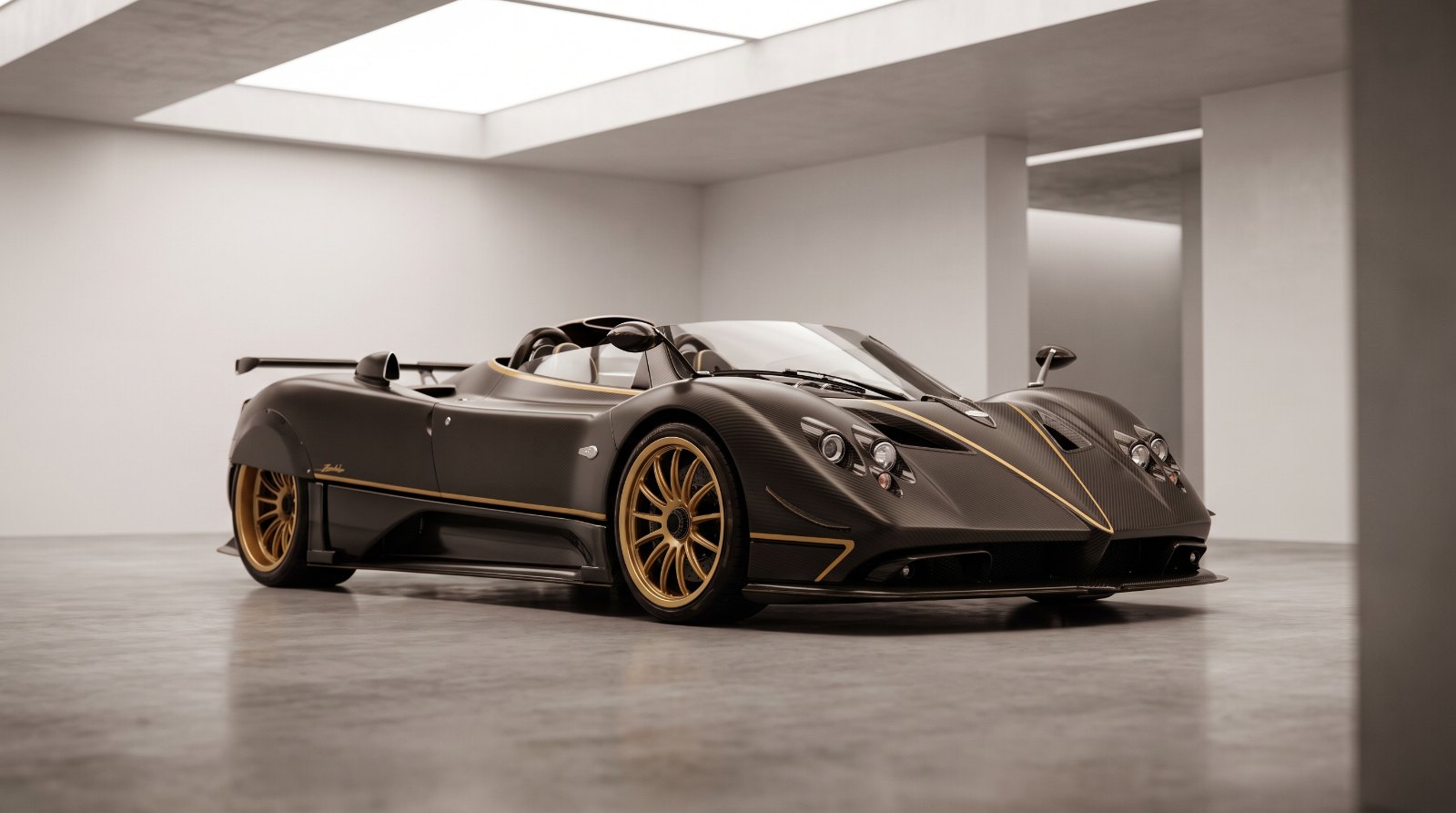
In 2022, during a Supercar Owners Circle drive through a small town in Croatia, a Pagani Zonda HP Barchetta got out of shape on a narrow street, snapped sideways and hit an oncoming Ford Fiesta. The impact tore the rear wheel clean off along with the suspension and brake hardware, and did serious damage to the matte carbon bodywork.
Pagani built three Zonda HP Barchettas. Genuine one-offs and few-offs sit at the very top of the market, alongside programmes like the Rolls-Royce Coachbuild collection. Horacio Pagani kept one for himself. The other two went to customers at an estimated $17 million apiece. This one belonged to Oleg Egorov, the man behind TopCar Design and the owner of one of the most extraordinary Pagani collections on earth — two Zonda Cinques, a Zonda R, a 760 Roadster, a Tricolore, a Huayra BC.
The car went back to Modena. Not to a bodyshop, not to a specialist, but to the factory that made it, where the original molds still exist and where the people who laid up the first set of panels can lay up a second. Two years later it reappeared on the streets of Warsaw, matte carbon and gold, looking exactly as it had before. Every damaged component had been replaced rather than patched.
The postscript is the best part. Rather than bin the shattered original panels, the owner had them refurbished and reassembled into a bare, empty shell — the ghost of the car — to hang on a wall as a sculpture. The crash didn’t destroy the object. It produced a second one.
This is not improvisation. Pagani formalized it years ago as Rinascimento, a restoration program run out of a dedicated workshop inside the atelier. Original molds, original methods, original materials, one team assigned to one car at a time, every phase photographed and documented and handed back to the owner as a bound book. Cars that complete the process are certified by the factory as officially restored — which matters enormously, as we’ll get to.
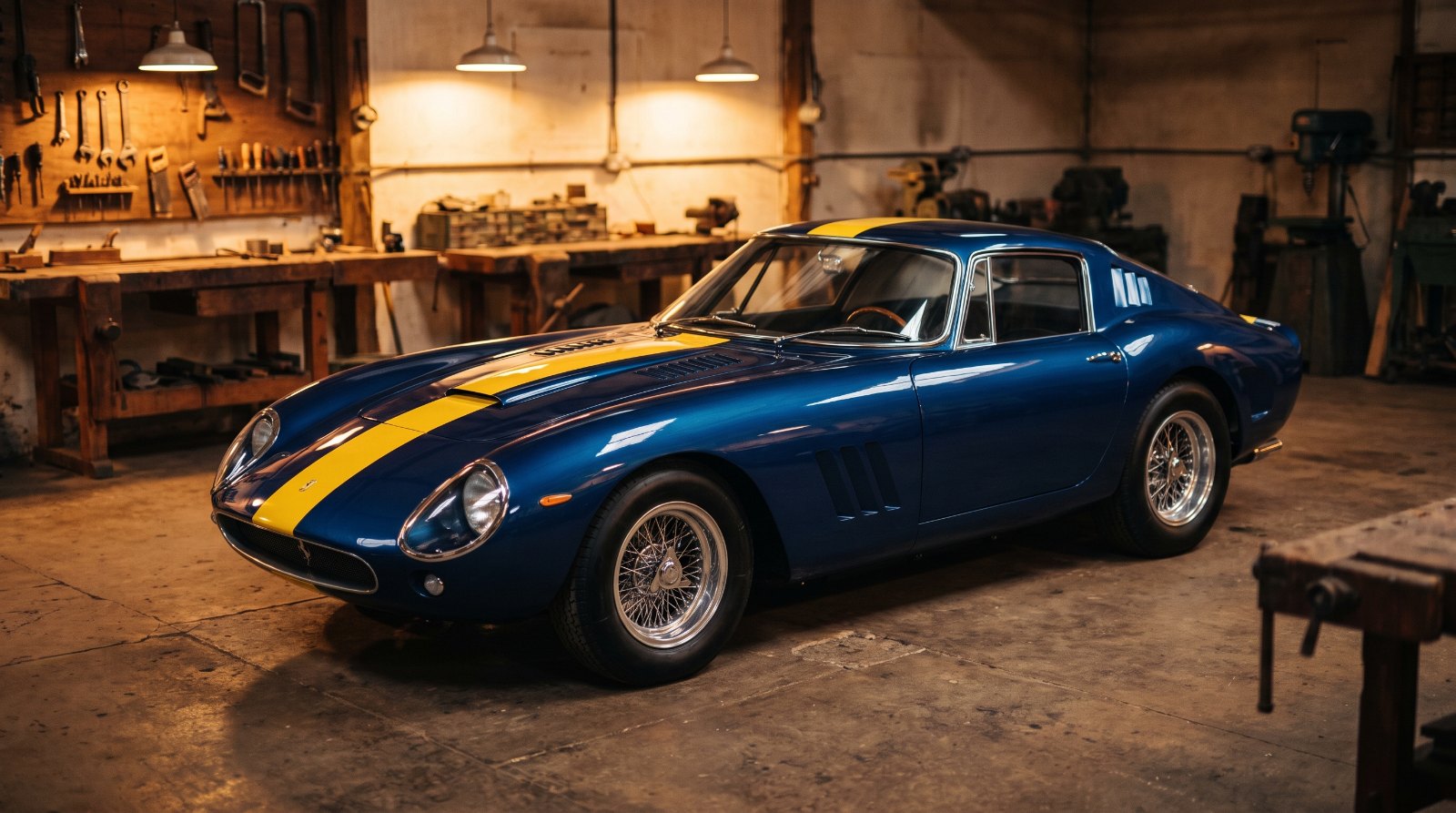
Ferrari runs the same idea under the name Classiche, and has for far longer. When a 250 GTO — chassis 3445GT, one of thirty-nine, in its distinctive blue-and-yellow livery — was hit from behind during the run-up to the 2012 Le Mans Classic and shunted into the path of an oncoming van, the owner didn’t call a loss adjuster. He sent it to Maranello. Classiche spent more than two years returning it not merely to running order but to the exact specification in which it had left the factory for its first owner in 1962. McLaren Special Operations does the same job for the F1s, including the one Rowan Atkinson crashed twice and drove happily afterward.
The pattern is consistent across every maker at this level: the wreck goes home.
Carbon fiber is the whole story
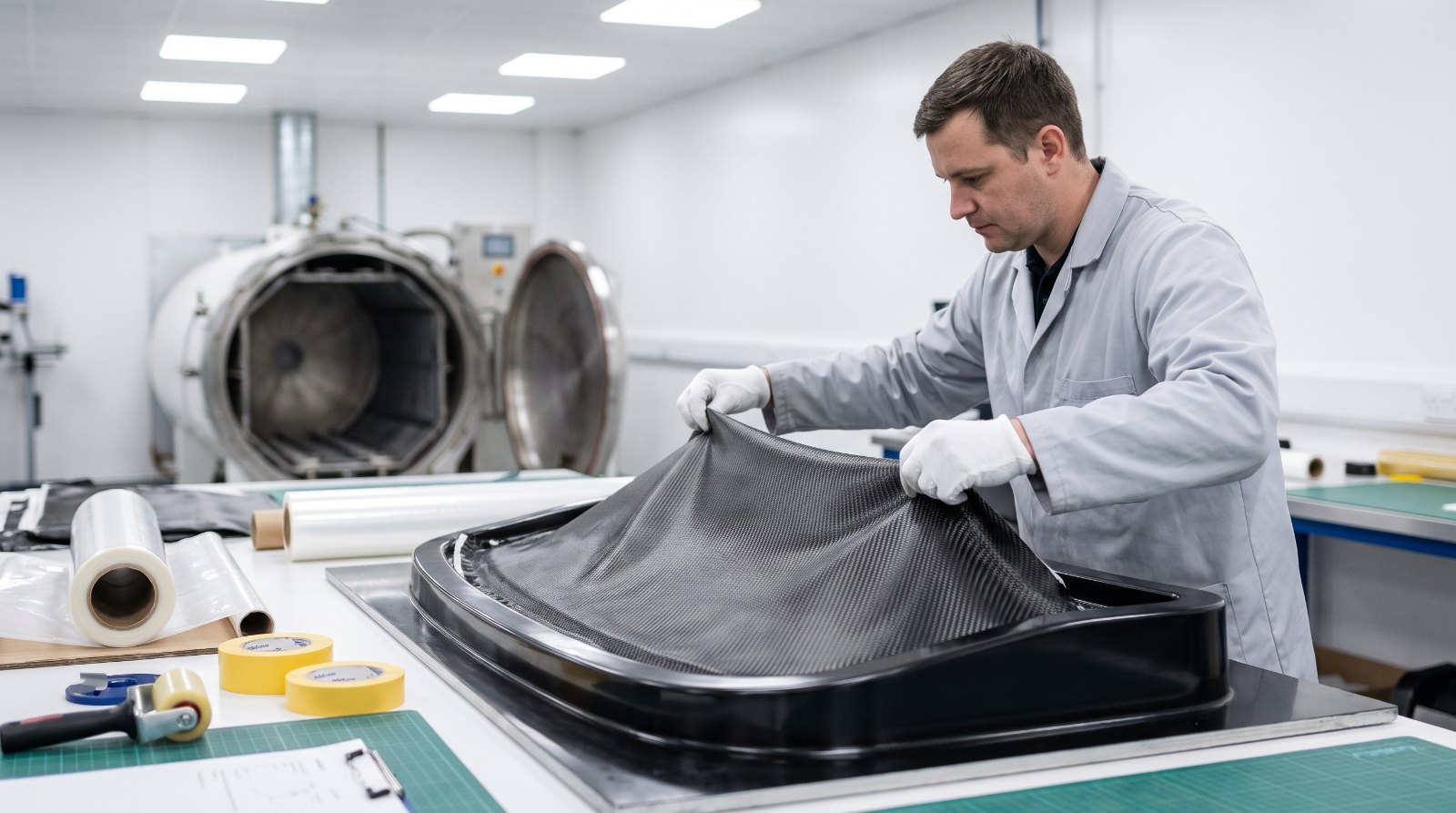
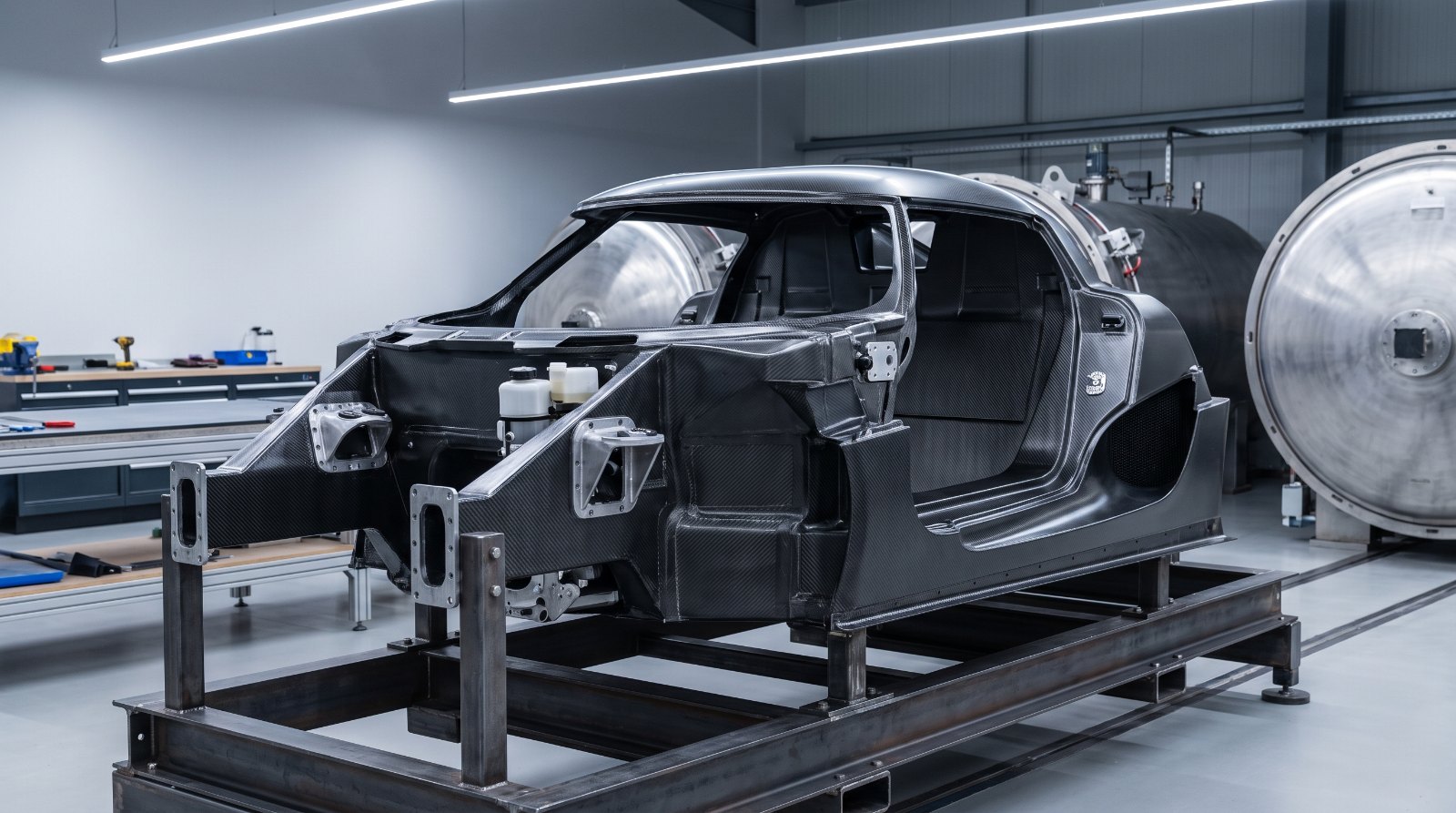
The reason a modern hypercar crash becomes a factory problem rather than a bodyshop problem comes down to one component. Steel bends and can be pulled straight. Aluminum can be worked. A carbon fiber monocoque can do neither. It cannot be bent back, it cannot be welded, and once it has cracked or delaminated it must be either bonded by people who understand the layup schedule or replaced outright.
Modern designs anticipate this. McLaren has been building road cars on carbon tubs since the F1, and the tub is deliberately shielded by sacrificial structures — crash cans at the front, the engine frame at the rear, reinforced door apertures — that are designed to be destroyed so the tub isn’t. In a great many accidents that look catastrophic in photographs, the survival cell is untouched, and the fix is a matter of unbolting the wreckage and bolting on new. Even in development testing, McLaren found that replacing the sacrificial elements put cars back on the road quickly.
What’s telling is where the real damage tends to come from. It isn’t dramatic crashes. It’s rocks kicked up into the underfloor, and it’s well-meaning mechanics outside the factory network putting a jack in the wrong place. Damage from a stray jack pad is a genuinely common way to hurt a carbon tub, which should tell you something about who ought to be touching these cars.
When the tub survives, inspection still means visual assessment backed by ultrasound to find delamination that isn’t visible. Simple repairs get done with room-temperature resin infusion by trained technicians. Anything more complicated goes back to the engineers who designed the structure in the first place. And afterward, every sensor, camera and control module buried in the bodywork has to be recalibrated, because a supercar’s stability and damping behavior depends on hardware that was just unbolted and moved.
The money, and who actually pays it
Insurance at this level does not work like insurance. Two features matter more than anything else on the policy.
The first is agreed value. A standard policy pays market value, which is a meaningless concept for a car that has no market because there is only one of it. An agreed-value policy fixes the number in advance, in writing, between owner and underwriter — and negotiating that number is the single most consequential thing an owner of a genuine one-off will ever do with a piece of paper.
The second is diminution of value, which covers the gap between what a car was worth before an accident and what it’s worth after, even when the repair is perfect. On a normal car that’s a nuisance clause. On a hypercar it can be the largest single line in the claim.
Even with both, the process is slow and adversarial. The Finnish SF90 case took months of assessment and, by some accounts, years of negotiation, on a car with a published price and a factory parts catalogue. Multiply that by a vehicle with no comparables, no parts on a shelf and a repair estimate that has to be produced from scratch by an atelier in Italy, and you begin to see why many owners at this level simply don’t file. They pay.
The repairs nobody puts on paper
Which brings us to the least discussed part of this world. A significant share of high-end damage never touches an insurer at all. Owners pay cash, quietly, hoping the incident never appears on a history report.
Specialists see the evidence constantly — a car comes in for routine service and there’s masking tape residue in the door shuts, or a panel that doesn’t quite match under the right light, or paint depth readings that tell a story the seller didn’t. And it does get found, usually at the worst possible moment, usually during a pre-purchase inspection with a deal on the table. The saving is real and the risk is real, and it is one of the strongest arguments for buying anything at this level with a proper inspection rather than a handshake.
Does the crash follow the car forever?
Here’s where the intuition of the ordinary car market fails completely.
The 250 GTO that got hit at Le Mans went back to Maranello, came out after two years of Classiche work, and is understood to have lost no meaningful value at all. It is worth what an uncrashed one is worth, because what the market is buying is the chassis number, the history and the factory’s certification that the car is what it claims to be. A repair executed by the manufacturer, documented and certified, doesn’t undermine that. It reinforces it.
And the histories themselves are full of wreckage. Chassis 3851GT — one of the most storied GTOs of all — was crashed into the corner of a house in period, killing its driver, folded nearly in half, taken back to Maranello, straightened, repainted red and sold on. It went on to become one of the most valuable cars on the planet, the kind that anchors the headline results at every major auction. Even the Ferrari Enzo that Stefan Eriksson split in two on the Pacific Coast Highway in 2006, engine and rear section scattered across the tarmac, was rebuilt by Ferrari’s technical assistance operation and later crossed an auction block in Paris.
The distinction that matters is not crashed versus uncrashed. It’s who fixed it and can they prove it. A factory rebuild with a documentation book behind it is provenance. An undisclosed repair by an unknown shop is a discount, and a permanent one.
The part that isn’t about money
In late 2025 a Zonda F went off the road in Italy and hit a stone wall hard. It was number four of the run, and it had belonged to Benny Caiola, Pagani’s very first customer and a close friend of Horacio Pagani, who had tracked the car down years later and bought it back for his own collection.
Nobody needed to calculate a repair-to-value ratio on that one. It was always going to be rebuilt, and it was always going to jump the queue, because the people who will do the work know the weave patterns by heart and know exactly whose car it is. The bill is irrelevant. The timeline is irrelevant. What’s being repaired isn’t really an asset.
That’s the honest answer to the question. Crash a one-of-one and you will not lose the car. You’ll lose two or three years of driving it, a sum of money that would buy a very good house, and a certain amount of sleep. Then a truck will bring it back, and it will be indistinguishable from the thing you remember, and there will be a book on the passenger seat explaining precisely how it got that way.
The cars outlive the accidents. They almost always have.
Frequently asked questions
Can a one-of-one supercar actually be declared a total loss?
Technically yes, but it’s rare. Total-loss decisions compare repair cost to vehicle value, and on a car worth eight figures even a seven-figure repair falls far below the threshold. Total losses at this level tend to involve fire, submersion, or theft rather than collision damage.
Who repairs a crashed hypercar?
The manufacturer, in most cases. Pagani runs its Rinascimento program from the atelier in Italy, Ferrari has the Classiche department for its classic and special cars, and McLaren Special Operations handles the F1 and other significant models. Factory-certified collision centers handle less severe damage on series production cars.
How long does a hypercar rebuild take?
Plan on years, not months. The crashed Zonda HP Barchetta took roughly two years to return to the road. Ferrari Classiche spent more than two years on the damaged 250 GTO. Parts often have to be manufactured from original molds rather than pulled from a shelf.
Does crashing a rare car destroy its value?
Not if the factory repairs it and documents the work. Certified factory restorations preserve value because the market is buying chassis identity and provenance, not an unblemished record. Undisclosed repairs by non-specialists are what genuinely damage value.
Can a carbon fiber chassis be repaired after a crash?
Sometimes. Carbon cannot be bent back or welded, so cracked or delaminated structures require specialist bonding or full replacement. Modern designs surround the survival cell with sacrificial crash structures specifically so the tub itself usually survives.
What insurance do owners of one-off cars use?
Agreed-value policies, which fix the payout figure in advance rather than relying on a market value that doesn’t exist for a unique car. Diminution-of-value coverage and umbrella liability layers are also standard at this level.