

Volkswagen, Stellantis and Renault sell more than 1,200 vehicles for every Ferrari. Investors are betting on Ferrari’s profitability, pricing power and future earnings instead.
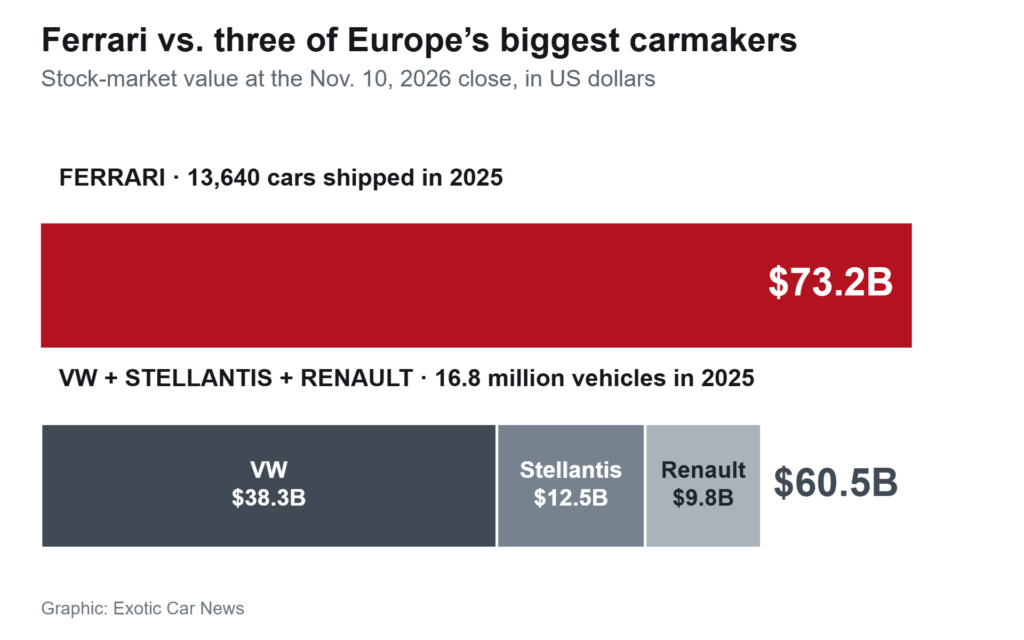
Volkswagen, Stellantis and Renault sold roughly 16.8 million vehicles between them in 2025. Ferrari shipped 13,640. On the stock market, the smaller company is still worth more than all three combined.
At the close of trading on November 10, 2026, Ferrari’s market value was about $73.2 billion. Volkswagen, counting both its ordinary and preferred shares, was worth about $38.3 billion, Stellantis about $12.5 billion and Renault about $9.8 billion. Together, that is roughly $60.5 billion, about $12.6 billion less than Ferrari on its own.
This is not a brand-new milestone. European coverage noted the same gap earlier in November, using November 5 prices, and the comparison moves every trading day. We could not establish exactly when Ferrari first crossed the line. What matters more is why it holds.
| Company | Market value* | 2025 vehicles | Margin** |
|---|---|---|---|
| Ferrari | $73.2B | 13,640 | 29.5% |
| Volkswagen | $38.3B | 8.98M | 2.8% |
| Stellantis | $12.5B | 5.48M | −0.5% |
| Renault | $9.8B | 2.34M | 6.3% |
| VW + Stellantis + Renault | $60.5B | 16.8M | — |
Ferrari market value: what it measures, and what it doesn’t
Market capitalization is simply share price multiplied by the number of shares. It is what investors are collectively willing to pay today for a claim on a company’s future profits.
It is not revenue. Volkswagen took in about $361 billion in 2025 (€321.9 billion), roughly 45 times Ferrari’s $8 billion (€7.15 billion). It is not assets either. The three larger groups own dozens of factories and employ hundreds of thousands of people. And it is not enterprise value, which adds debt and would change the picture for carmakers with large financing arms and borrowing.
So the comparison says something narrower and more interesting: investors value Ferrari’s expected stream of earnings more highly than the combined equity of three of Europe’s biggest manufacturers.
What investors are paying for at Ferrari
Start with profitability. Ferrari’s operating margin in 2025 was 29.5%, on operating profit of about $2.37 billion (€2.11 billion). Volkswagen’s was 2.8%. Stellantis posted an adjusted operating loss. Renault, the healthiest of the three on this measure, reached 6.3%.
A deliberately crude ECN calculation makes the gap concrete. Divide each company’s 2025 operating profit by the vehicles it reported, and Ferrari earned roughly $173,000 per car. Volkswagen earned about $1,100 per vehicle. Neither figure is pure car profit: Ferrari’s includes sponsorship, racing and brand income, and Volkswagen’s includes trucks and financial services. Both are converted at the November 10 exchange rate. The two-orders-of-magnitude difference is still the point.
Next is growth that does not depend on volume. In the third quarter of 2026, Ferrari shipped 3,368 cars, 33 fewer than a year earlier. Its operating profit still rose 12%, to about $631 million (€563 million), which the company credited to a richer mix, led by the F80, and to personalization. It has since raised its full-year guidance to about $8.6 billion in revenue and at least $2.56 billion in operating profit (€7.65 billion and €2.285 billion).

Then comes visibility. Ferrari says its order book now reaches into 2028, and according to Reuters, planned 2027 sales of the Luce, its first electric car, are already fully allocated. Few businesses can see demand that far ahead.
Controlled supply helps, but scarcity alone does not explain the valuation. Plenty of low-volume carmakers lose money. Ferrari pairs limited output with pricing power, high-margin personalization and strong cash generation. It produced about $1.72 billion (€1.54 billion) of industrial free cash flow in 2025 and is running a multi-year share buyback of about $3.9 billion (€3.5 billion).
Investors pay up for that combination. At the November 10 price, Ferrari traded at about 41.6 times its 2025 diluted earnings per share of about $10.05 (€8.96), by our calculation. That is the multiple of a luxury business, not a car factory.
What investors are discounting elsewhere
The larger groups are being priced for a harder road. Volkswagen’s operating result fell 53% in 2025, to about $10 billion (€8.9 billion), and in March it guided to an operating return of 4% to 5.5% for this year.
Stellantis reported a net loss of about $25 billion (€22.3 billion) for 2025 after about $28.5 billion (€25.4 billion) of charges tied largely to resetting its plans. The company said the results reflected “the cost of over-estimating the pace of the energy transition.” Its New York-listed shares closed November 10 at $4.26, about a third of their 52-week high.
Renault lifted sales 3.2% to 2.34 million vehicles in 2025. It still booked a net loss of about $12.2 billion (€10.9 billion), mostly because of its stake in Nissan, and has guided to an operating margin of about 5.5% this year.
The common thread is thin margins in a capital-intensive business: heavy spending on electrification, price competition, tariffs and restructuring. Selling millions of cars does not protect a company from any of that. In some ways, it multiplies the exposure.
What could weaken Ferrari’s premium
High expectations cut both ways. Over the past 52 weeks, Ferrari’s Milan-listed shares have traded between about $302 and $438 (€269 to €390.70). A stock priced for durable growth can fall sharply on any sign that growth is slowing.
The bigger risks are strategic. Ferrari could be tempted to build too many cars, eroding the scarcity and resale values that support its prices. The Luce has to prove that buyers will value an electric Ferrari over years of ownership, not just at launch. Results lifted by limited series such as the F80 eventually face tougher comparisons. And a downturn in global wealth would test even the longest order book.
None of those risks is unique to Ferrari. What is unusual is how much of its valuation depends on managing them with discipline.
More than a car company
Part of the answer sits outside the balance sheet. As we explored in Ferrari’s approach to belonging, the company builds long-term relationships with its owners. Those relationships help explain why its demand is visible years in advance, and that visibility is exactly what investors pay for.
The lesson for the rest of the industry is uncomfortable but simple. Selling more cars does not automatically create a more valuable company. Investors also price profitability, resilience and confidence in future earnings, and on those measures, a carmaker that ships fewer than 14,000 cars a year is currently ahead.
How we calculated this: Market values use November 10, 2026 closing prices on each company’s primary listing (Ferrari and Stellantis on Euronext Milan, Volkswagen on Xetra, Renault on Euronext Paris), multiplied by company-reported share counts. Ferrari and Stellantis exclude treasury shares and non-traded special voting shares. Volkswagen includes 295.1 million ordinary and 206.2 million preferred shares. Renault uses its 295.7 million issued shares. Cross-listed shares are counted once.
Euro values are converted at the European Central Bank reference rate of $1.1214 per euro for November 10. Other euro-reported figures in this article, including 2025 results and the 52-week share-price range, are converted at the same rate for comparability, with the original euro amounts in parentheses. Delivery and margin figures are full-year 2025 company figures. This article is for information only and is not investment advice.