

RYN Motors says its FP3 is a Formula-style car you can register for the road. That claim belongs to the three-wheel version. The kit that adds a fourth wheel comes with fine print worth reading first.
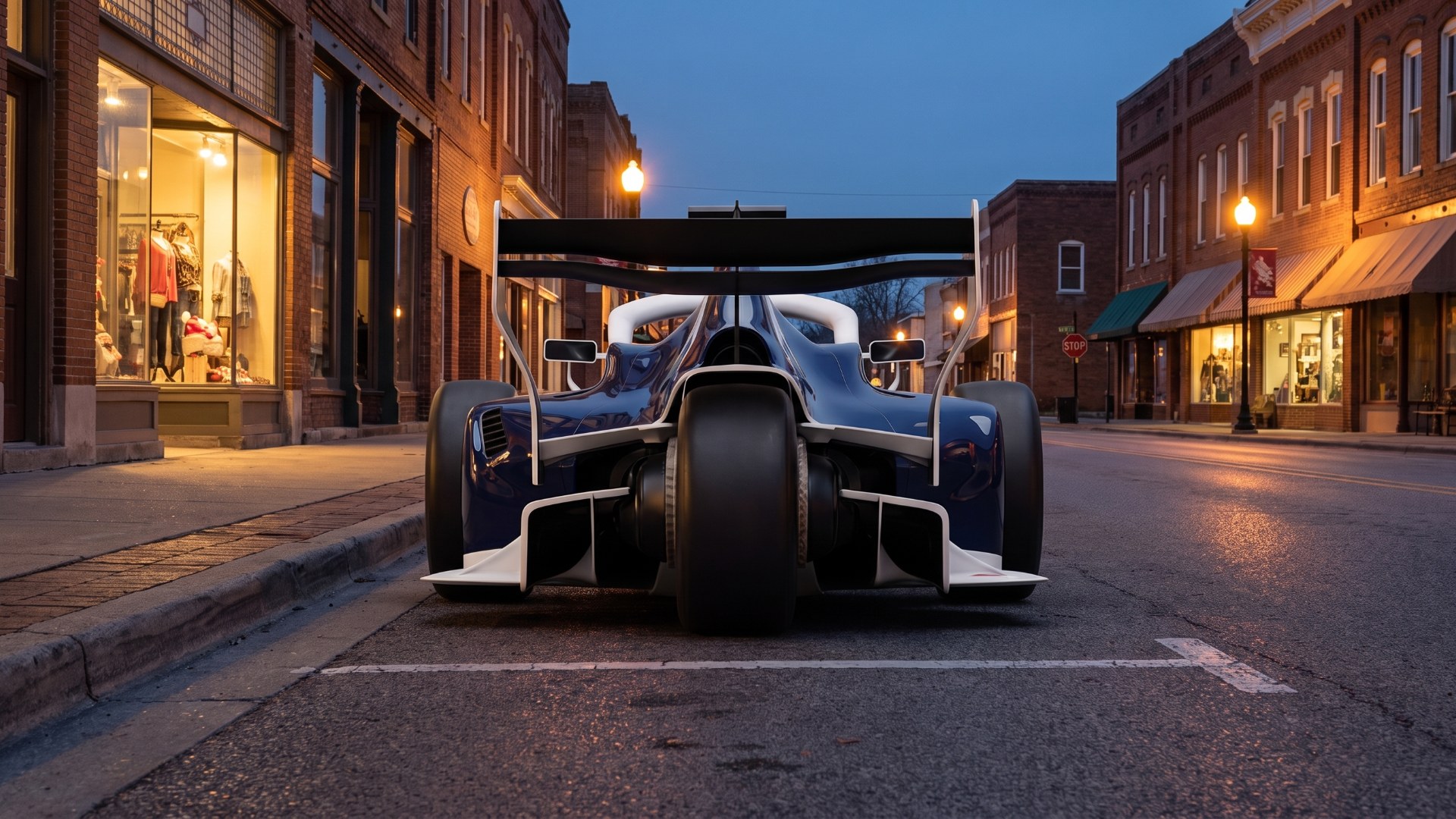
Seen from behind, the RYN FP3 looks like a small Formula car with something missing. Where two rear tires should be, there is one wide tire in the middle.
That is deliberate. RYN Motors, a startup in Austin, Texas, says every FP3 will be delivered as a three-wheeler, with a kit that adds the fourth wheel after delivery. The three-wheel layout is the basis of its claim to have built the first street-legal Formula car.
The fine print matters more than the pitch. RYN describes the four-wheel kit as an aftermarket part designed for the track and says it is “not FMVSS-compliant,” a reference to the Federal Motor Vehicle Safety Standards. Driving a converted car on the street, the company adds, is at the owner’s own risk and responsibility.
We found no publicly documented customer deliveries or independent performance tests as of October 10. By RYN’s own schedule, the first customer cars are due in November, which is when that distinction starts to matter to owners.
Why three wheels matter
Federal safety rules sort vehicles by type, and the type decides which standards apply. The federal definition of a motorcycle covers any motor vehicle with a seat or saddle that is designed to travel on “not more than three wheels.” It says nothing about handlebars.
So a three-wheeler with a steering wheel and a racing harness is a motorcycle in Washington’s eyes. The Polaris Slingshot stands on the same footing.
Motorcycles answer to far fewer federal standards than passenger cars, and not to the crash-protection rules that shape a modern car’s structure. RYN says as much: passenger-car rules, in its telling, would make a true Formula-car shape impossible.
One correction to the marketing. RYN calls the FP3 an “autocycle,” but that is not a federal vehicle class. It is a label states use in their own registration and licensing laws, and those laws differ.
The federal paperwork matches the strategy. NHTSA’s manufacturer database lists RYN Motors LLC, in a filing from November 2025, as a maker of motorcycles. That is an identification record, not an approval. NHTSA does not sign off on vehicles before they are sold; manufacturers certify their own compliance.
What the fourth wheel changes
Mechanically, RYN’s spec sheet lists a chain-driven limited-slip differential, and direct drive for the three-wheel variant. The company has not published how long the swap takes, who should do it, or whether it is meant to be reversed for the drive home.
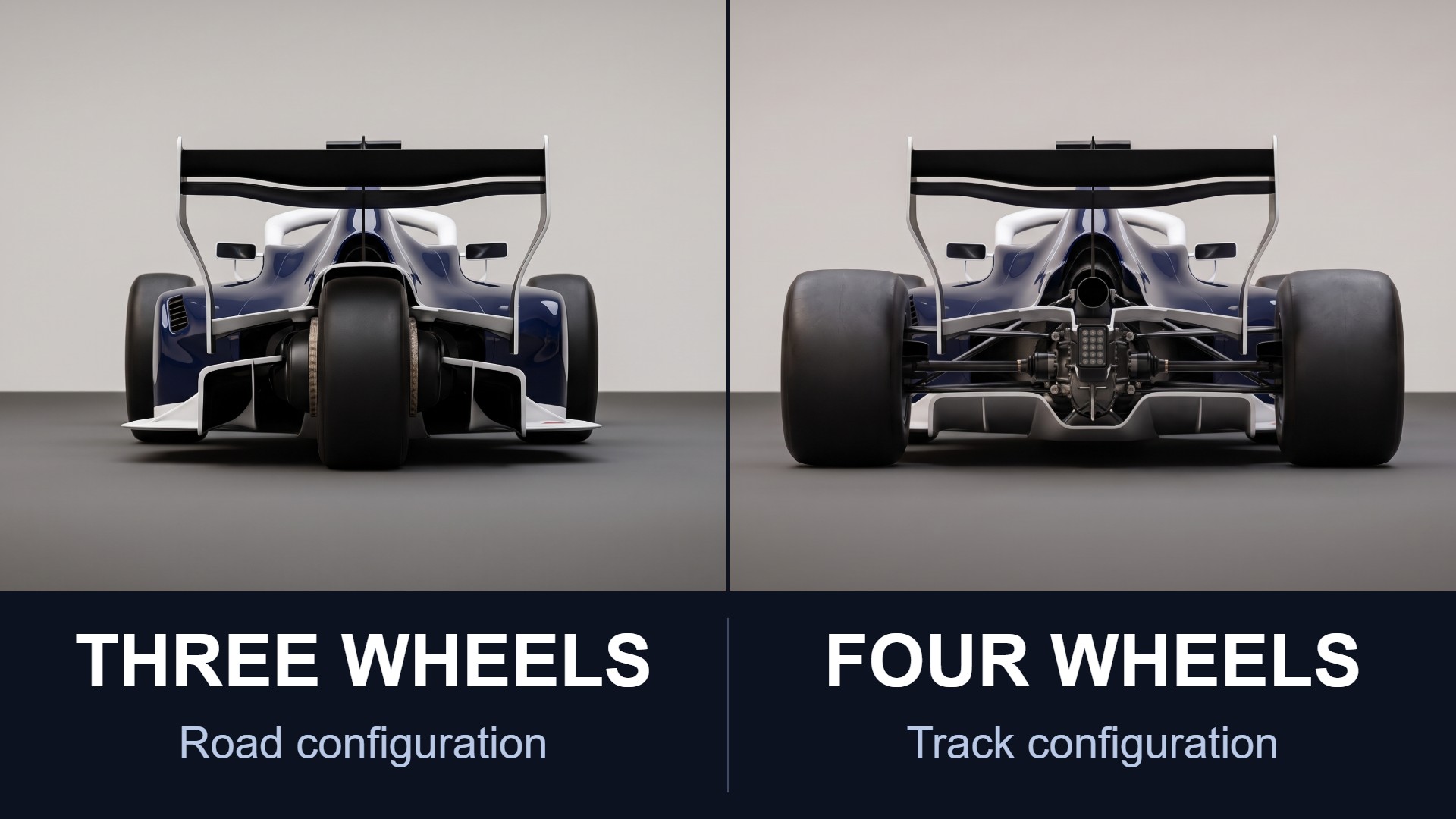
Legally, the change is bigger than it looks. In a 1980 interpretation letter to a company planning a three-wheeler, NHTSA’s chief counsel wrote that the agency classifies a vehicle “simply by counting those wheels.” Swap the single rear wheel for two, the letter said, and the vehicle is a passenger car, with the longer list of standards that comes with it.
That letter is old and was not about the RYN FP3. But the definition it applied reads the same today.
So the road claim belongs to the three-wheel car, and RYN does not say otherwise. Its promises of legality in all 50 states and simple autocycle insurance describe the car as delivered. Whether a state would register a RYN FP3 on four wheels, or an insurer would cover one, is a question for that state and that insurer.
RYN’s site calls the kit optional in one place and included in another. Its order configurator settles it: the kit is part of the $78,499 price, and deleting it takes $2,000 off.
How real is the RYN FP3?
The RYN FP3 is a development car, not yet a customer car. RYN’s most recent build update, dated August 14, said the first body panels were being fitted to the development car. Its spec sheet is labeled as a forecast.

One detail stands out. In the test-car photographs on RYN’s website reviewed for this article, from an early prototype to April’s shakedown and July’s track testing, the car is on four wheels. The three-wheel street version appears there in renderings.
That is not unusual for chassis development, and RYN says it has street-tested the car. In the published photographs reviewed for this article, the three-wheel road configuration is less documented than the four-wheel test chassis.
The delivery estimates on RYN’s site start with a limited Early Access batch in November 2026. Founder’s Edition cars follow in May 2027, Launch Edition cars in December 2027 and the standard Core Edition in May 2028. RYN lists the Founder’s and Launch runs as sold out, on $100 refundable deposits. A reservation is not a delivered car.
The RYN FP3’s performance numbers are the company’s targets: 210 hp from a 1,340 cc Suzuki Hayabusa engine, about 1,140 pounds, 0–60 mph in 2.8 seconds and 2.6 g of cornering grip with four wheels. A 290-hp Turbo starts at $101,499. RYN also reported a 1:22.29 test lap that it says beats a typical Porsche 911 GT3 at the same circuit. It did not name the circuit.
One more variable sits in Congress. H.R. 3385, which a House subcommittee advanced in February, would narrow the federal motorcycle definition to vehicles with handlebars and a seat the rider straddles. It has not become law. It could remove vehicles such as the Slingshot and FP3 from the federal motorcycle category if enacted in that form.
One wheel, two sets of rules
None of this makes the RYN FP3 a trick. A road-oriented three-wheeler with a separate four-wheel track configuration is a coherent idea.
It is also a narrower promise than a street-legal Formula car. The street-legal part is the three-wheeler. The Formula-car part, by RYN’s own description, is for the track.

The fourth wheel is a small piece of hardware. As far as Washington counts, it is the difference between a motorcycle and a car.
ECN illustrations, including the lead image, are based on RYN’s published design. Depicted conversion hardware is illustrative. Track-testing photo: RYN Motors.
Sources: RYN Motors’ FP3 product page, order configurator and news updates (December 2025 to August 2026), reviewed October 10, 2026; 49 CFR 571.3; NHTSA interpretation letters nht80-2.24 (1980) and 06-007883as (2007); NHTSA’s vPIC manufacturer database; H.R. 3385, 119th Congress.