
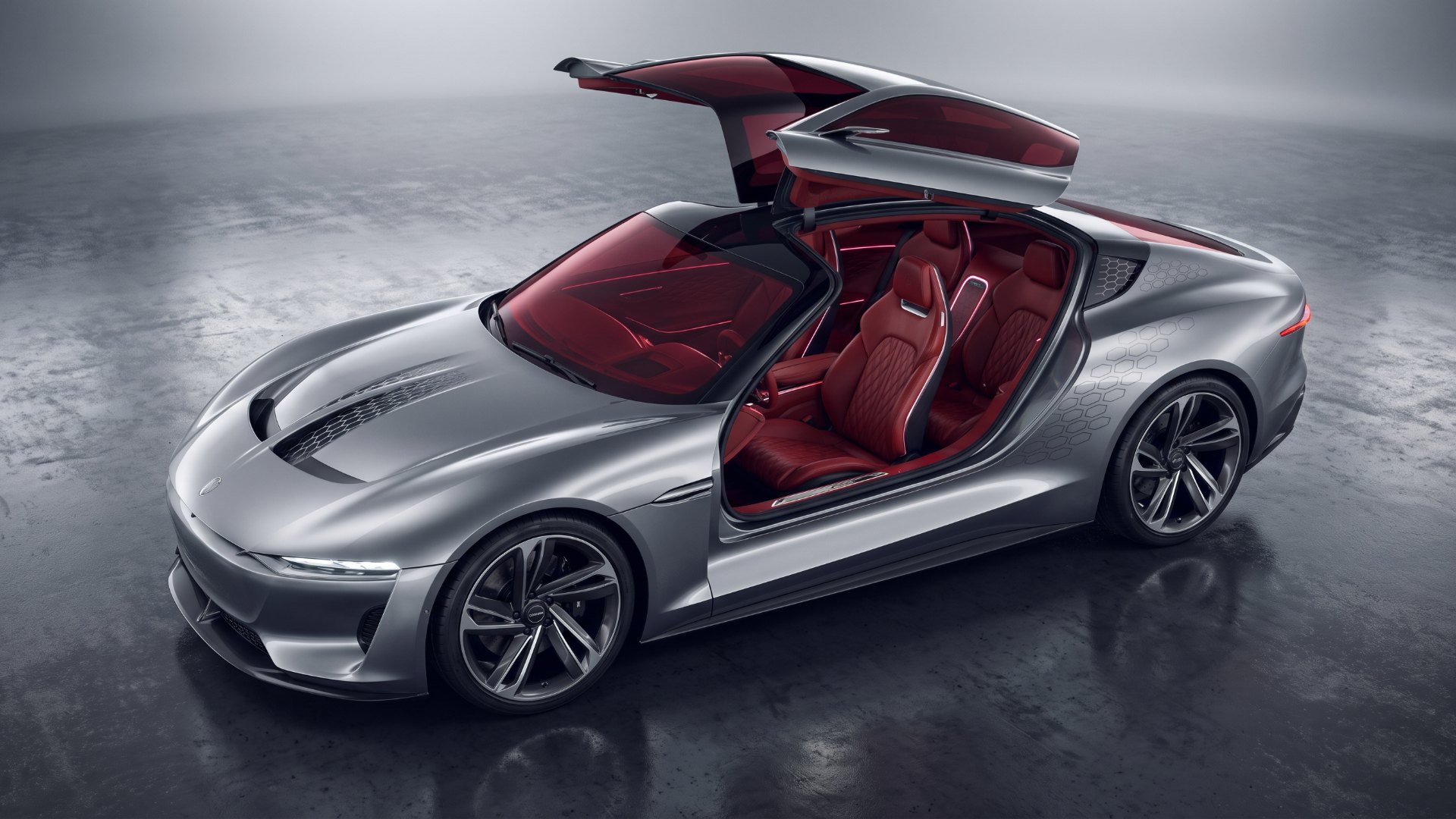
When Renault rolled the Trezor onto its stand at the Paris Motor Show in late September 2016, the car did not look like a forecast. It looked like a dare: a long, low, red-glazed electric grand tourer with no doors, a roof that lifted like the lid of a jewelry box, and a cabin finished in red leather and layered ash. Renault said it previewed trends likely to appear in future models. Most concept cars say that. Very few are worth checking a decade later.
The Renault Trezor is. Strip away the show-stand theater and it was a bundle of specific technical bets: laser-fed fiber-optic taillights, a carbon passenger cell, a 0.22 drag coefficient, a Formula E-derived motor, a curved OLED dashboard and a car that changed its exterior lighting when it drove itself. By October 2026, some of those bets paid off, some showed up on other companies’ cars with no documented connection to Renault, and a few still belong on a turntable. Here is how the scorecard reads ten years on.
What Renault actually showed
The Trezor followed the 2010 DeZir, the concept that launched design chief Laurens van den Acker’s overhaul of Renault styling and fed into the 2012 Clio. In Renault’s life-cycle design strategy, the DeZir stood for falling in love; the Trezor was meant to signal maturity. Underneath the narrative, Renault published an unusually specific technical sheet for a show car.
| Renault Trezor (2016) | Manufacturer figures |
|---|---|
| Layout | Two-seat electric GT, rear-wheel drive |
| Motor | 260 kW (350 metric hp), 380 Nm (280 lb-ft) |
| 0–62 mph | Under 4 seconds (claimed) |
| Batteries | Two packs, one front and one rear; capacity and range not disclosed |
| Structure | Central carbon cell with tubular steel frames front and rear |
| Weight | 1,600 kg (3,527 lb) |
| Drag coefficient | 0.22 (claimed; test conditions not published) |
| Length / width / height | 185.0 / 85.8 / 42.5 in (4,700 / 2,180 / 1,080 mm) |
| Wheels | 21-inch front, 22-inch rear, bespoke Continental tires |
None of those numbers was independently tested. This was a show car, and Renault never said how far it could travel on a charge.
The taillights that made the Trezor famous
The Trezor’s most photographed detail sat at the back. Renault described a “rope-like” assembly of optical fibers fed by a red laser, producing a fine, threaded tail signature rather than the familiar glow of LEDs behind a diffuser. Stefano Bolis, then head of Renault’s advanced design studio, told Top Gear at the reveal that the team was chasing a kind of mirage effect.
Then comes the brake-light claim. Renault’s release says that under braking, the twisting and stacking of the fibers creates a visual effect and raises the intensity of the light. That sentence has often been retold as the fibers physically rearranging themselves when the driver presses the pedal. Renault’s wording does not actually say so. It can just as easily mean the fibers are permanently twisted and stacked, and that this arrangement produces a distinctive pattern when the brake function brightens. We found no Renault document or engineering account that settles the question, so ECN treats the moving-fiber version as unconfirmed.
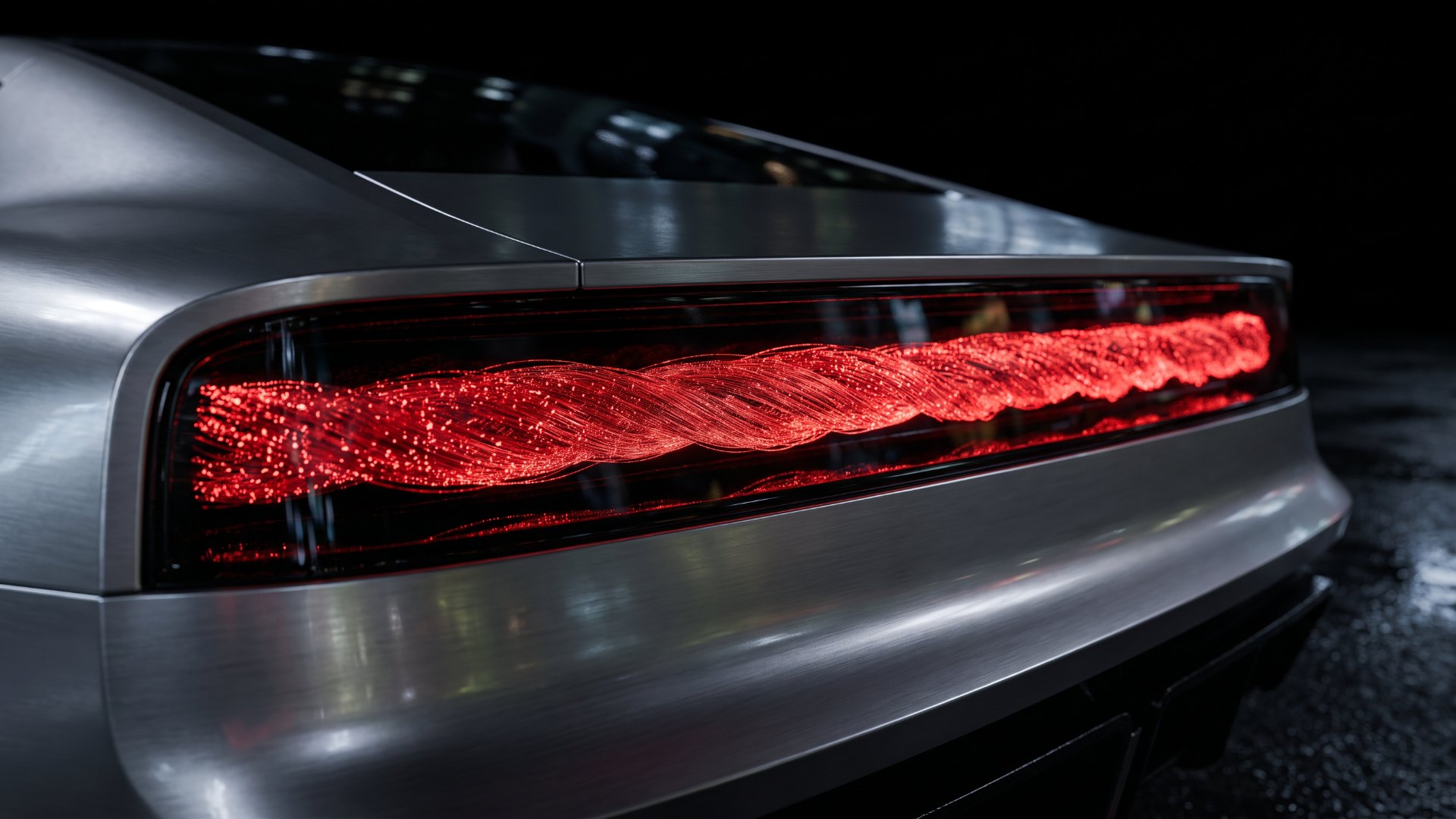
Either way, the core idea was real and early: a laser pushing red light down fibers too fine for conventional light guides. The Trezor had one more lighting idea. In autonomous mode, Renault said, the exterior lighting signature changed and extended to the side and rear logos, telling other road users that the car was driving itself. That one comes back later.
Six years later, a BMW put laser threads into production
In May 2022, BMW revealed the M4 CSL, a limited-run lightweight special, with taillights that BMW said debuted a new technology in a series-production car. Every legally required lamp function still uses LEDs. Woven into the glass covers are fine light threads illuminated by laser: three of them run parallel across the inner part of each lamp and overlap at the outer edge to trace BMW’s L-shaped signature, with “BMW Laser” lettering on the lens.
Those threads are not the same thing as the BMW Laserlight headlights also offered on the car, which use lasers to light the road ahead. Nor should either be confused with Mercedes-Benz DIGITAL LIGHT, an LED-based headlamp system. Laser rear lighting is a styling and signature technology, not a road-illumination one.
The lamp came from Marelli, which says it developed and produced it for BMW M at its rear-lamp competence center in Tolmezzo, Italy. According to Marelli, the system couples a red laser diode, developed for its first automotive use, with optical sidelight fibers no more than 1 mm in diameter. Conventional plastic light guides, by the supplier’s account, run about 6 mm across and weigh more; the laser also creates a shimmering speckle along each fiber. The lamp was named a CES 2024 Innovation Award honoree, and Marelli describes itself as the first lighting maker to bring a red laser paired with a rear-lamp function to market.
That claim does not conflict with the Trezor, which was a one-off show car. The technical roles differ, too: on the BMW, the laser threads are a signature layer over LED lamps, while Renault never specified which functions, if any, the Trezor’s laser system performed on its own.
What ECN could not find is any evidence that BMW or Marelli drew on the Trezor; no source we reviewed connects the projects. The defensible reading is parallel development: two teams, six years apart, chasing lines of light thinner than LEDs allow, and one of them clearing the cost, durability and homologation work a show car never faces. A decade on, the BMW–Marelli lamp is the production application we could confirm from manufacturer and supplier sources. Real, but boutique.
Carbon tub, steel frames and a roof for a door
Renault’s weight recipe was a central carbon cell mated to tubular steel frames front and rear, with the monocoque and the access hatch made of carbon. The result, Renault said, was 1,600 kg (3,527 lb) for a 15.4-foot electric GT carrying two battery packs. Carbon at the core with simpler structures attached at either end remains a familiar supercar formula, one with a longer history than most enthusiasts assume, as the forgotten MCA Centenaire shows.
Renault has never sold a carbon-tub car. Its lightweighting instinct did resurface in the Renault 5 Turbo 3E, the limited-run electric hot hatch Renault confirmed for production in 2025: a carbon body on a bespoke aluminum platform, a claimed 1,450 kg (3,197 lb), and a run capped at 1,980 cars. Renault has not presented it as a Trezor descendant, and we don’t either. It does show the brand still reserves exotic materials for halo cars.
The roof never came back. Occupants stepped over the sill much as they would climb into a period race car, helped by headrests that reclined automatically. It was unforgettable theater, and no Renault production model has adopted it.
A 0.22 drag coefficient, and a car that seemed to breathe
Renault credited the Trezor’s claimed 0.22 drag coefficient to its ultra-low body, alongside wide tracks and a long wheelbase. In 2016, that was a headline number. By 2021, Mercedes-Benz said its A-Class sedan and current S-Class were both rated at 0.22, and claimed 0.20 for the EQS in one specific configuration: 19-inch AMG wheels, Sport mode, measured in its own Sindelfingen wind tunnel.
Those figures are not directly comparable. Renault never published how the Trezor’s number was obtained, and a drag coefficient is only half the story: drag scales with the coefficient multiplied by frontal area, so a 42.5-inch-tall coupe and a full-size sedan with the same coefficient face different resistance at speed. The fair conclusion is that the Trezor’s target is now within reach of production cars.
Cooling was where the Trezor got poetic. The honeycomb intake on the hood echoed hexagonal panels on the rear bodywork, and its hexagons moved as a variable-geometry inlet. Renault said each of the two batteries had its own cooling system, optimized by that intake, and that the movement made the car look as if it were breathing. Active grille shutters now do a similar job on many production cars, far less theatrically. Renault’s materials describe the hexagon pattern and its function but not the method used to design it, so ECN does not characterize it as parametric or algorithmic design.
A Formula E motor in a grand tourer’s suit
Renault said the Trezor’s motor derived from the Renault e.dams Formula E program, then a two-time teams’ champion. It quoted 260 kW (350 metric hp) and 380 Nm (280 lb-ft) to the rear wheels, with 0 to 62 mph in under four seconds. The two batteries sat one at the front and one at the rear for weight distribution, and brake-energy recovery came from the Rechargeable Energy Storage System (RESS) technology Renault developed for Formula E.
Regenerative braking is now standard on electric cars, so the Trezor was showcasing the principle rather than inventing it. The split battery layout did not catch on; mainstream EVs settled on flat packs under the cabin floor. Renault itself left Formula E after its fourth season in July 2018, handing its entry to alliance partner Nissan. At the time, Renault said what it learned about high-performance EVs and energy management directly benefited its customers. That is a company claim, and we found no specific Formula E-derived component in a Renault road car to point to.
Renault’s wildest production EV now takes a different route: the 5 Turbo 3E pairs an 800-volt battery with two rear in-wheel motors for a quoted 540 hp. It shares the Trezor’s spirit more than its hardware.
The cockpit: the shape survived, the OLED did not
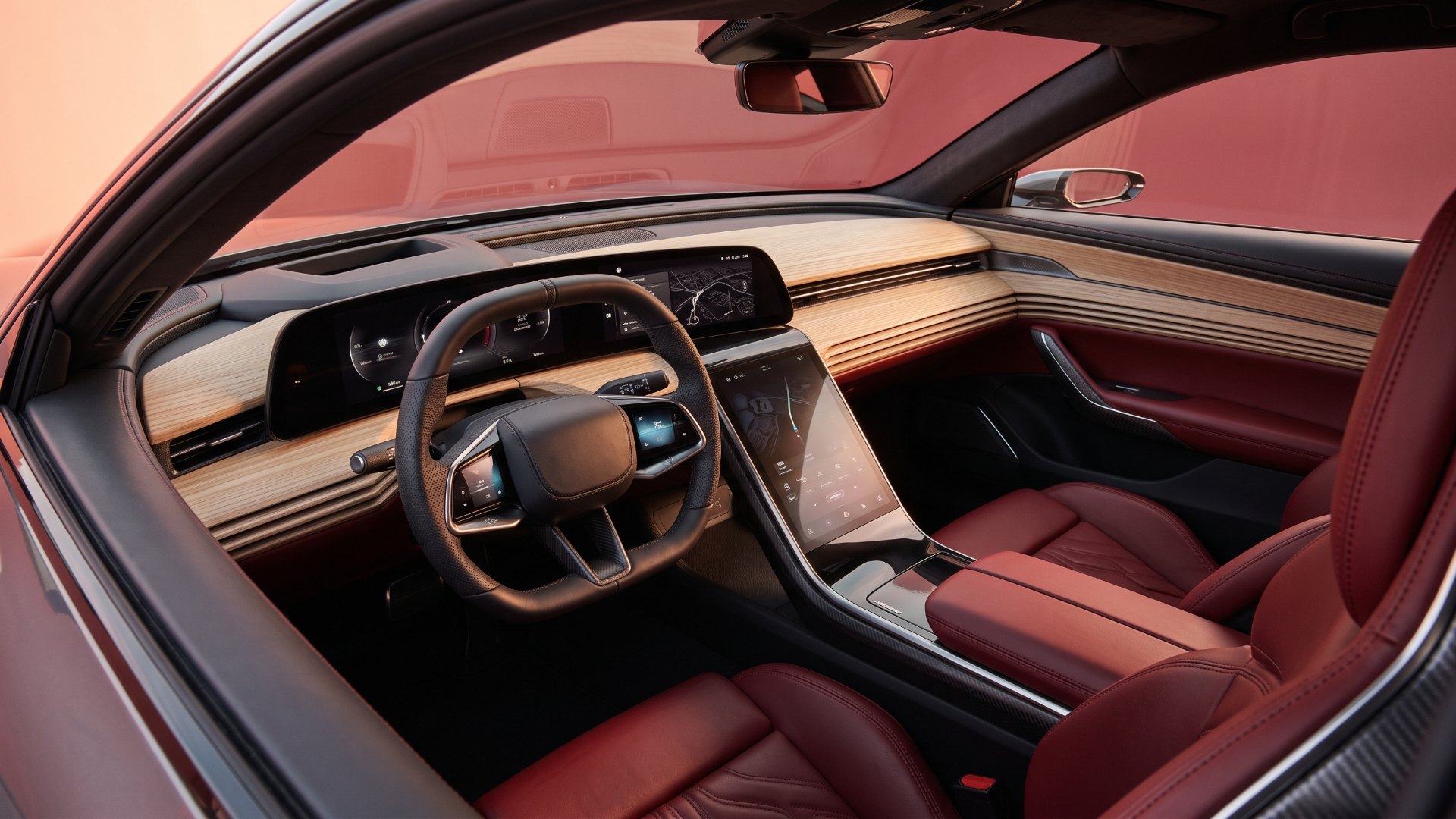
Inside, the Trezor combined instruments and infotainment in one curved, L-shaped display, pairing OLED with Corning Gorilla Glass. Renault pointed out that OLED needs no backlight, which means deeper blacks and no halo. Around the screen sat a dashboard made by French bicycle builder KEIM-cycles from thin superimposed strips of ash, which Renault said rivaled modern composites for strength, plus deep-red leather and a front luggage space with made-to-measure cases.
A phone dropped into a pocket under the armrest brought its apps to the screen, and the rectangular steering wheel swapped stalks for two touchscreens, widening in autonomous mode to open a panoramic view of the display.
This is the clearest case of direct lineage, because Renault draws the line itself. The company says the inverted-L, all-in-one double screen was tested on the Trezor, the 2017 Symbioz and the 2019 Morphoz before reaching production as the OpenR display, which debuted on the 2022 Mégane E-Tech Electric. OpenR pairs a 12.3-inch driver display with a 12-inch vertical touchscreen, with up to 774 square centimeters of screen area. The Trezor’s phone-centric vision arrived as software rather than a pocket: OpenR Link runs on Google’s platform and updates over the air.
The display technology is a different story. Describing the Austral’s OpenR screen, Renault says the central display is an IPS LCD built by Continental under Gorilla Glass-type aluminosilicate glass. The shape and the glass made it to production at Renault; the OLED did not, at least on that model. Curved OLED did reach production, just not through Renault. Cadillac launched the 2021 Escalade with what it called the industry’s first curved OLED display, more than 38 inches diagonally, and Mercedes-Benz’s optional MBUX Hyperscreen in the EQS uses OLED for its central and passenger displays beneath a single curved glass cover about 141 cm wide. That is parallel evolution, not lineage.
The touchscreen steering wheel never left the stand. As ECN has argued, big screens stopped being a luxury signal once they arrived everywhere, which may be the most telling footnote to the Trezor’s cabin.
Autonomy: the most confident prediction aged the worst
Renault’s Multi-Sense system gave the Trezor three modes: neutral, sport and autonomous. The press kit said that beyond 2020, Renault aimed to make safe hands-off, eyes-off driving available on mainstream models at an affordable price. That did not happen. In 2024, Renault said it saw no case for taking private cars beyond Level 2 or Level 2+ driver assistance, arguing that the cost of Level 3 would leave customer demand insufficient. Its higher-autonomy work moved to public transport, with Level 4 electric minibuses developed with WeRide and trialed in France and Spain.
The Trezor’s autonomy lighting has a more interesting afterlife. Mercedes-Benz developed turquoise automated-driving marker lights following SAE recommended practice J3134 and won approvals in California, for testing, and Nevada, for model-year 2026 production cars equipped with its Level 3 Drive Pilot. Then, in January 2026, Mercedes was reported to be dropping Drive Pilot from the facelifted S-Class and refreshed EQS in favor of a supervised Level 2++ system. There is no documented link between the Trezor and the Mercedes lights. The idea simply proved logical enough to resurface independently, and fragile enough to stall with the systems it was meant to announce.
The Renault Trezor scorecard, 2016 to 2026
Similarity is not lineage, so we sorted each idea three ways: direct adoption, where a documented line runs from the Trezor to a production car; parallel evolution, where similar technology arrived with no evidence Renault influenced it; and unrealized, where the idea stayed experimental or unconfirmed.
| Trezor idea | Status by October 2026 |
|---|---|
| Laser-fed fiber-optic taillights | Parallel evolution. BMW M4 CSL (2022), Marelli-built; no documented Renault link |
| Fibers changing under braking | Unconfirmed, even for the concept |
| Carbon cell, steel frames | Parallel evolution. Supercar territory; not adopted by Renault |
| Clamshell canopy | Unrealized. No production adoption |
| 0.22 drag coefficient | Parallel evolution. Matched and beaten in production, with differing methods |
| Breathing hexagonal intake | Unrealized. Active shutters do the job quietly |
| Formula E-derived motor | Unrealized as specific hardware; no documented descendant |
| Regenerative braking | Already established before 2016; universal on EVs |
| Front and rear battery packs | Unrealized. Mainstream EVs use floor packs |
| L-shaped display layout | Direct adoption. Renault OpenR (2022), per Renault; LCD on Austral |
| Curved OLED dashboard | Parallel evolution. Cadillac Escalade (2021), Mercedes EQS Hyperscreen |
| Eyes-off autonomy by the 2020s | Unrealized. Renault private cars remain at Level 2/2+ |
| Exterior autonomy lighting | Parallel evolution. Mercedes turquoise lights approved, then Drive Pilot paused |
The verdict
The Renault Trezor’s record is better than most concept cars’. Its most theatrical ideas, the canopy, the breathing hexagons and the widening steering wheel, stayed on the stand. The ideas that became real arrived two ways: through Renault’s own product line, as with the L-shaped screen, and through other companies working in parallel, as with BMW and Marelli’s laser threads and Mercedes’ autonomy lights. Its biggest miss was the one Renault stated most confidently, mainstream eyes-off driving.
The Trezor’s stagecraft rarely survived contact with a business case. But the expensive problems it posed, how to draw light thinner than an LED can and how to make an electric GT slippery and light, eventually found buyers willing to pay for the answers. They just tended to be buying a limited-run BMW or a flagship Cadillac, not a Renault. That is what a good concept car is for: not a promise of a product, but a laboratory whose experiments occasionally escape.