
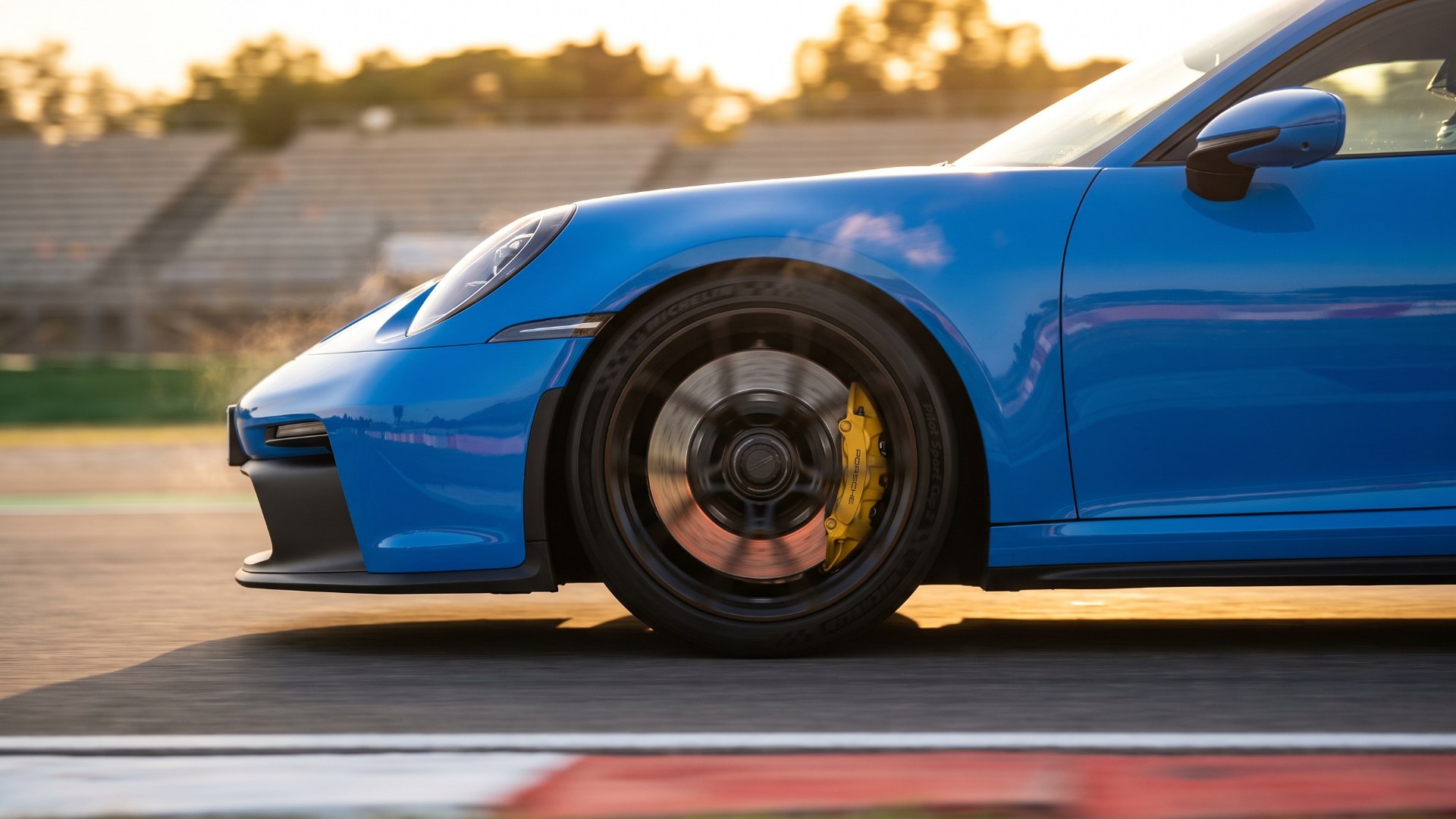
Lead image: illustration of a Porsche 911 GT3 under braking.
For a quarter of a century, the grey, speckled disc behind a forged wheel has been one of the clearest signals that a car is serious. Carbon-ceramic brakes arrived on the Porsche 911 and the Ferrari Enzo, and they still mostly live where the price tags have commas in the wrong places. The obvious question for anyone who drives a hot hatch, a sports sedan or a pony car is whether that hardware will eventually trickle down.
The more interesting answer is that the biggest change heading for everyday performance cars may not be a new disc at all. It may be the arrival of brakes that are commanded by software, applied by electric motors and managed one wheel at a time. The next braking revolution could be as much about controlling stopping power as creating better discs.
What you need to know
- Carbon-ceramic discs roughly halve rotor weight and shrug off repeated hard stops, but cost around $9,000 to $10,000-plus as factory options and can mean five-figure replacement bills.
- They are not the same thing as the “ceramic” brake pads sold at every parts counter.
- Newer continuous-carbon-fiber discs are an evolution of the carbon-ceramic idea, not a proven universal successor.
- Brake-by-wire is already in production cars, and fully “dry” electromechanical systems from suppliers such as Brembo and ZF entered series production in 2026.
- No brake, however exotic or intelligent, can stop a car faster than its tires allow.
First, a vocabulary check: carbon-ceramic discs vs. “ceramic” pads
The word “ceramic” causes more confusion in brake conversations than almost any other. When enthusiasts talk about carbon-ceramic brakes, they mean the discs (or rotors): carbon-fiber-reinforced silicon carbide, a composite that Brembo describes as a ceramic matrix of silicon and silicon carbide reinforced by a mass of carbon fibers. Brembo’s process carbonizes the material at around 900°C and then infiltrates it with silicon at around 1,700°C.
Ordinary “ceramic” brake pads are something else entirely. They are friction compounds that use ceramic fibers and fillers to cut dust and noise, and they clamp a conventional cast-iron disc. They are a sensible upgrade for a daily driver, but they do not turn a car into a 911 GT3.
The fiber question matters too. Carbon fiber is the reinforcement inside a carbon-ceramic disc; it is not a brake material on its own in road cars. So “carbon-fiber brakes” is shorthand to avoid. The accurate term is carbon-ceramic, and the accurate way to describe its skeleton is carbon-fiber reinforcement.
Why carbon-ceramic brakes are so desirable
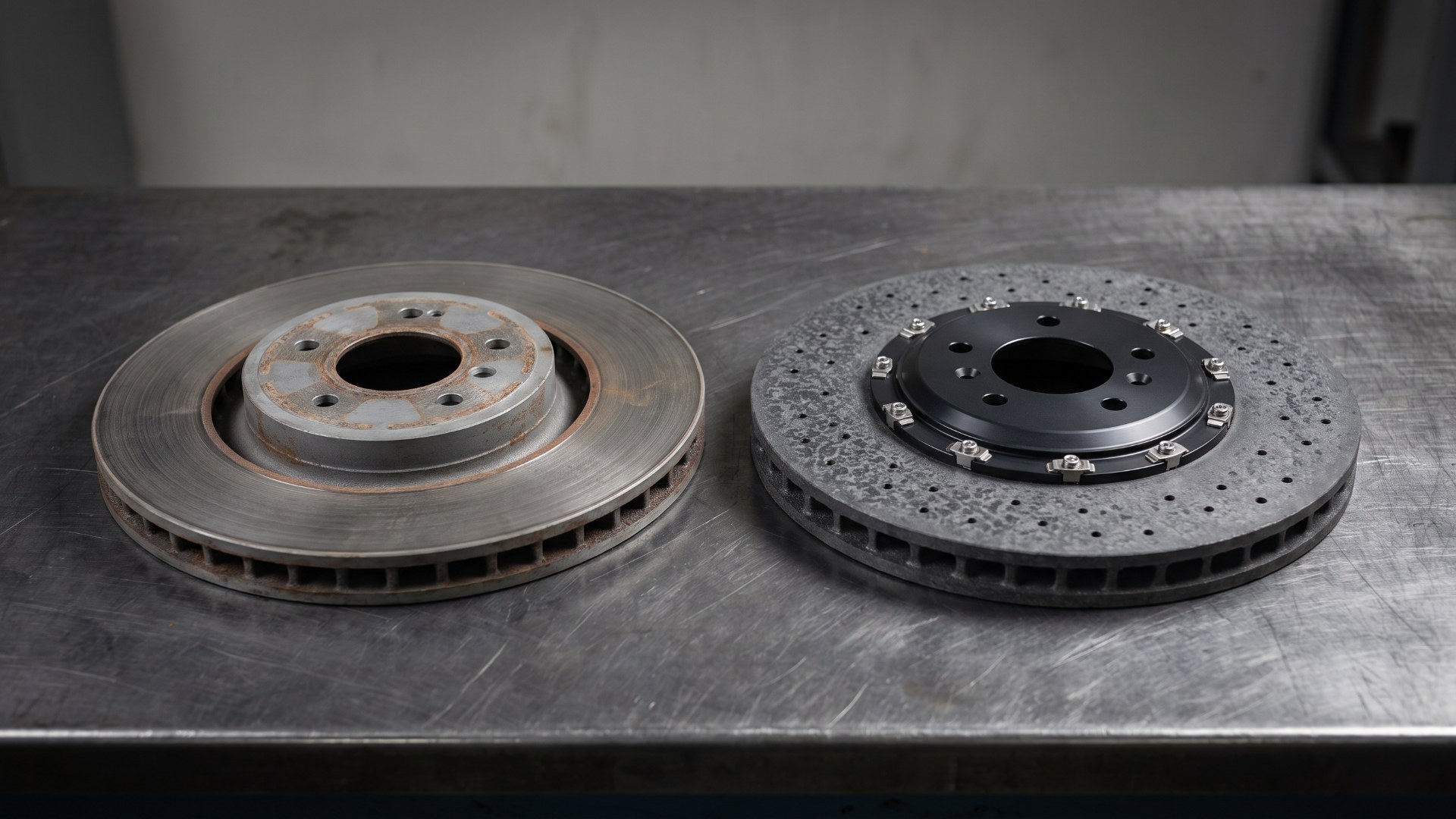
Weight. Brembo and Porsche both put the weight saving at roughly half compared with an equivalent cast-iron disc. Porsche says that adds up to about 20 kg (44 lb) across a car, depending on the model. Because that mass is unsprung and rotating, the benefit is felt more than a similar saving in the trunk would be. The suspension has less to control over bumps, and the wheels are easier to spin up and slow down.
Heat. Brakes are energy converters: they turn speed into heat. Brembo says its carbon-ceramic discs operate comfortably at 600 to 750°C and can tolerate initial spikes approaching 1,000°C. That thermal stability is why they resist fade through lap after lap or a long mountain descent.
Repeated hard braking. This is the real party trick. One emergency stop from highway speed does not separate good iron brakes from carbon ceramics by much. The tenth consecutive hard stop from triple digits on a track does, and with power outputs still climbing, every extra horsepower eventually has to be turned back into heat. Brembo also claims road-use life of around 150,000 km (about 93,000 miles) for its discs, while the low wear rate means far less brake dust on expensive wheels.
The catch: the money
Chevrolet lists carbon-ceramic brakes (RPO J57) at $9,000 on the 2027 Corvette Z06. On cars such as the BMW M4 and Porsche 911 GT3, the option has typically run from about $8,500 to more than $10,000. When the discs eventually need replacing, a full set of rotors and pads can reach five figures. Accidental damage, such as a dropped wheel or a tire-change tool knocking a disc edge, becomes a costly mistake.
Manufacturing is the root of the price. A cast-iron rotor is a foundry-and-machining job. A carbon-ceramic disc is built from fiber preform to carbonization, silicon infiltration and finishing over a process that takes days rather than minutes. That cost structure, not engineering snobbery, is the main reason the technology has not migrated to a $35,000 sports sedan.
There are road-car compromises too. Carbon ceramics can feel less progressive when cold, some setups squeal, and many owners never use enough of the brakes’ thermal headroom to notice the fade advantage. For most street drivers, the benefit is primarily unsprung weight, dust and longevity, not a shorter single stop.
The middle path already exists
Before carbon ceramics go anywhere near mainstream, coated iron is doing a lot of the work. Porsche’s Surface Coated Brake (PSCB), which uses a tungsten-carbide coating on an iron disc, is described by Porsche as offering “almost” the performance of PCCB with the same thermal stability, for “a significantly more competitive cost.” It also produces little dust and resists rust. For a manufacturer that wants a premium brake story without a five-figure option, coated discs are the obvious stepping stone.
What comes after today’s carbon ceramics?
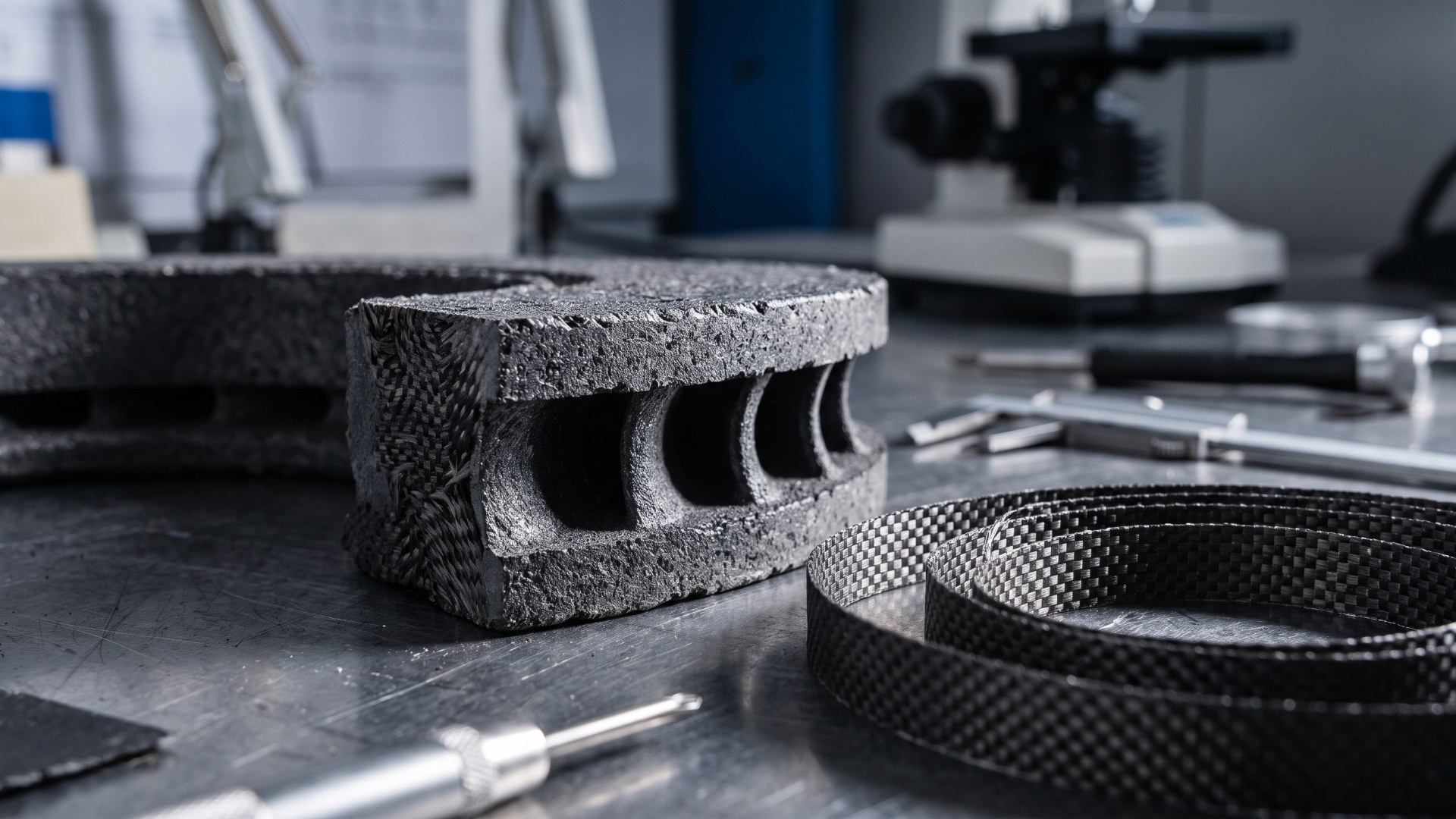
Most carbon-ceramic discs use short, chopped carbon fibers distributed through the ceramic matrix. Britain’s Surface Transforms took a different route. It interweaves continuous carbon fiber into a three-dimensional, multi-directional structure before converting the material into carbon-silicon carbide. The company claimed this gives a stronger, more durable disc with three times the heat conductivity of standard production components, keeping system temperatures lower and performance more consistent.
That is a genuinely interesting engineering direction, but it is an evolution within carbon ceramics, not a proven universal successor. Surface Transforms’ own history shows why. The company built a substantial order book with sports-car manufacturers, yet reported manufacturing yields ranging from 41% to 83% against a target above 85%. It entered administration in April 2026, and its business and assets were sold on May 22 to CCST Limited, which says it plans to restart carbon-ceramic disc production at the existing Liverpool site.
ECN’s read: the next material leap is less about inventing a magic composite and more about making advanced composites repeatably, quickly and profitably. Until yields and cycle times improve dramatically, better discs will keep arriving at the top of the market first.
Can the braking system become smarter than its hardware?
Here is where the story turns. On many modern cars, the brake pedal is already less a hydraulic plunger and more a request.
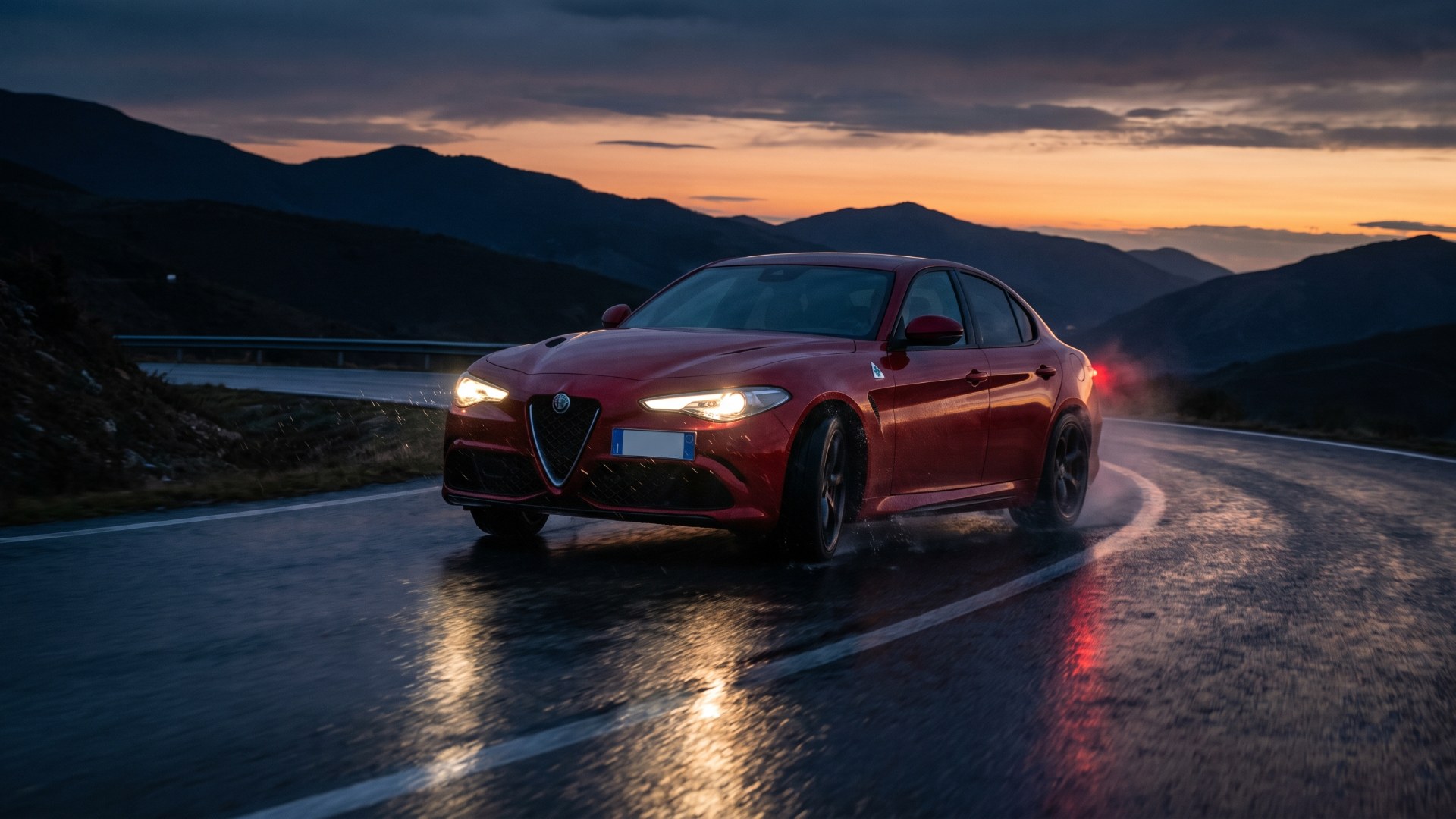
Brake-by-wire is not new. In 2016, the Alfa Romeo Giulia became the first series car to use Continental’s MK C1 integrated brake system. It combines the brake actuation, booster and ABS/stability control in one electro-hydraulic module, with the pedal decoupled from the hydraulics. Continental said the system builds pressure faster than conventional setups and weighs roughly 9 lb less. Hybrids and EVs have used similar electro-hydraulic arrangements for years, because they must blend regenerative and friction braking without the driver feeling the hand-off.
The next step removes fluid altogether. In a fully electromechanical brake (EMB), the pedal sends an electronic signal, and an electric motor at each caliper squeezes the pads. ZF describes its portfolio as spanning purely hydraulic, hybrid and fully electromechanical “dry” systems. A typical hybrid layout uses hydraulic front brakes with electromechanical rear calipers. ZF says its dry design eliminates brake fluid, reduces parts and workshop servicing, and uses duplicated connections and systems for redundancy. In January 2025, ZF announced a contract to supply a hybrid brake-by-wire system, with electromechanical rear brakes and hydraulic front calipers, for nearly 5 million vehicles with an unnamed global automaker.
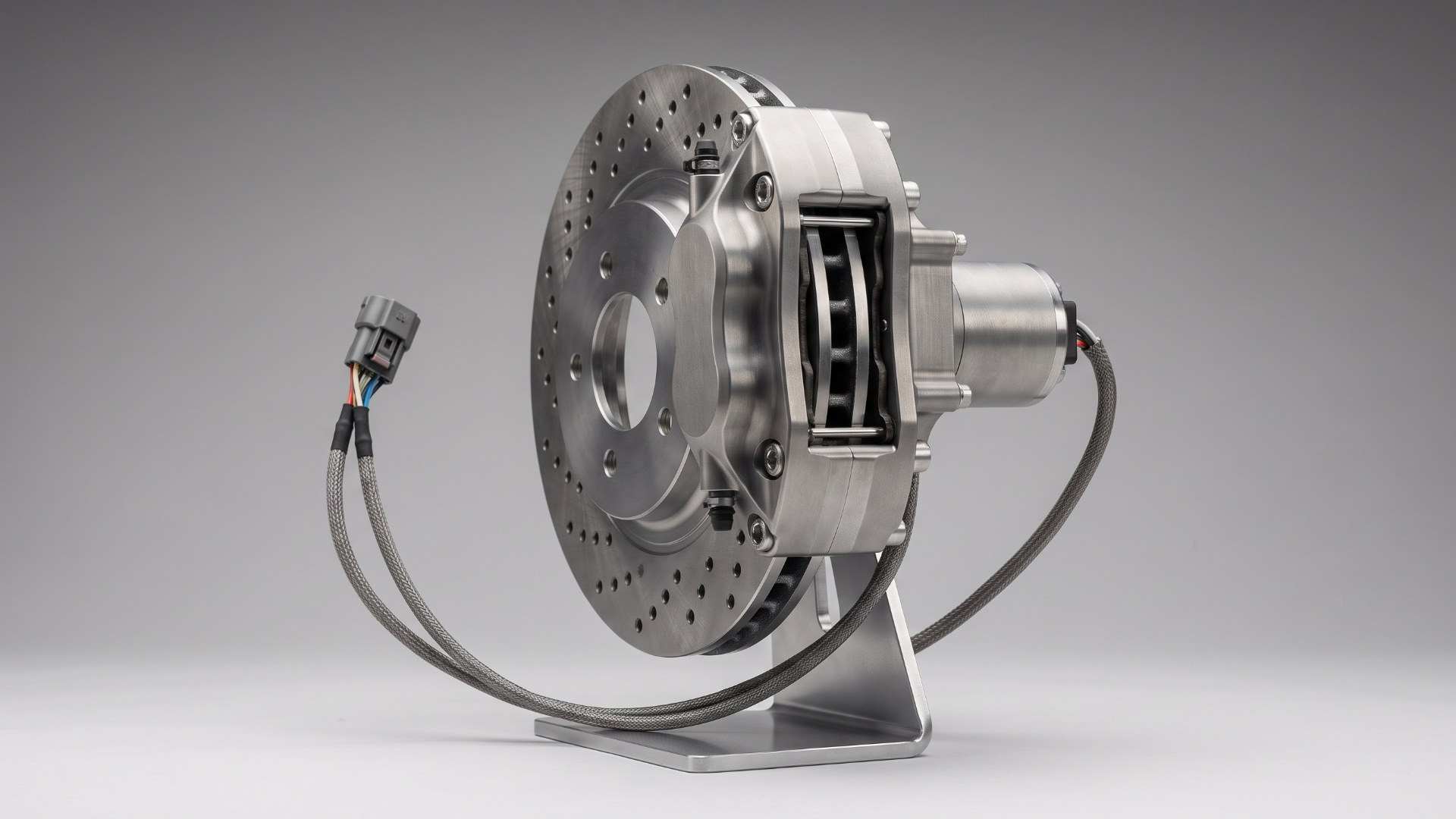
Fully dry systems reached production in 2026. Chery said its Exeed EX7 would become the world’s first mass-produced car with pure electromechanical braking when it launched in China in the first quarter of 2026, while Li Auto also filed an EMB-equipped model. On May 4, 2026, Brembo announced that SENSIFY, its fluid-free intelligent braking platform, had entered series production as standard equipment across a program for an unnamed “leading global manufacturer,” with volumes expected in the hundreds of thousands of vehicles per year.
How the whole system works together
Think of a modern performance car’s brakes as a team rather than a single component. During a hard stop, several systems are working together:
- The driver’s command. Pedal travel and force are measured and translated into a deceleration request.
- Regenerative braking (in hybrids and EVs). The electric motors slow the car while recovering energy. They handle as much of the job as the battery, motor and conditions allow.
- Friction brakes. Discs and pads supply the rest. They take over completely in a panic stop, on a hot track lap or when the battery cannot accept more charge.
- Grip information. Wheel-speed sensors, ABS logic and stability control estimate how much each tire can handle at that moment.
- Stability control. It can brake individual wheels to tighten or straighten the car’s path.
Brembo describes SENSIFY as using information about the vehicle, the driver and the environment to adjust braking at each wheel independently. When the system was first shown, Brembo said it could adapt to individual braking styles and to changing road and weather conditions. The hardware still matters, but the brains decide how much of it to use, where and when.
That is the real promise for a performance-car driver. Instead of a single hydraulic pressure that ABS then trims back wheel by wheel, an independent system can deliver a tailored braking force at each corner from the start. In theory, that means steadier stops on mixed surfaces, quieter and less disruptive ABS intervention, and pedal feel that engineers can tune. A track mode could have a firmer, shorter pedal; a comfort mode could have a softer progression.
The non-negotiable: the tires decide
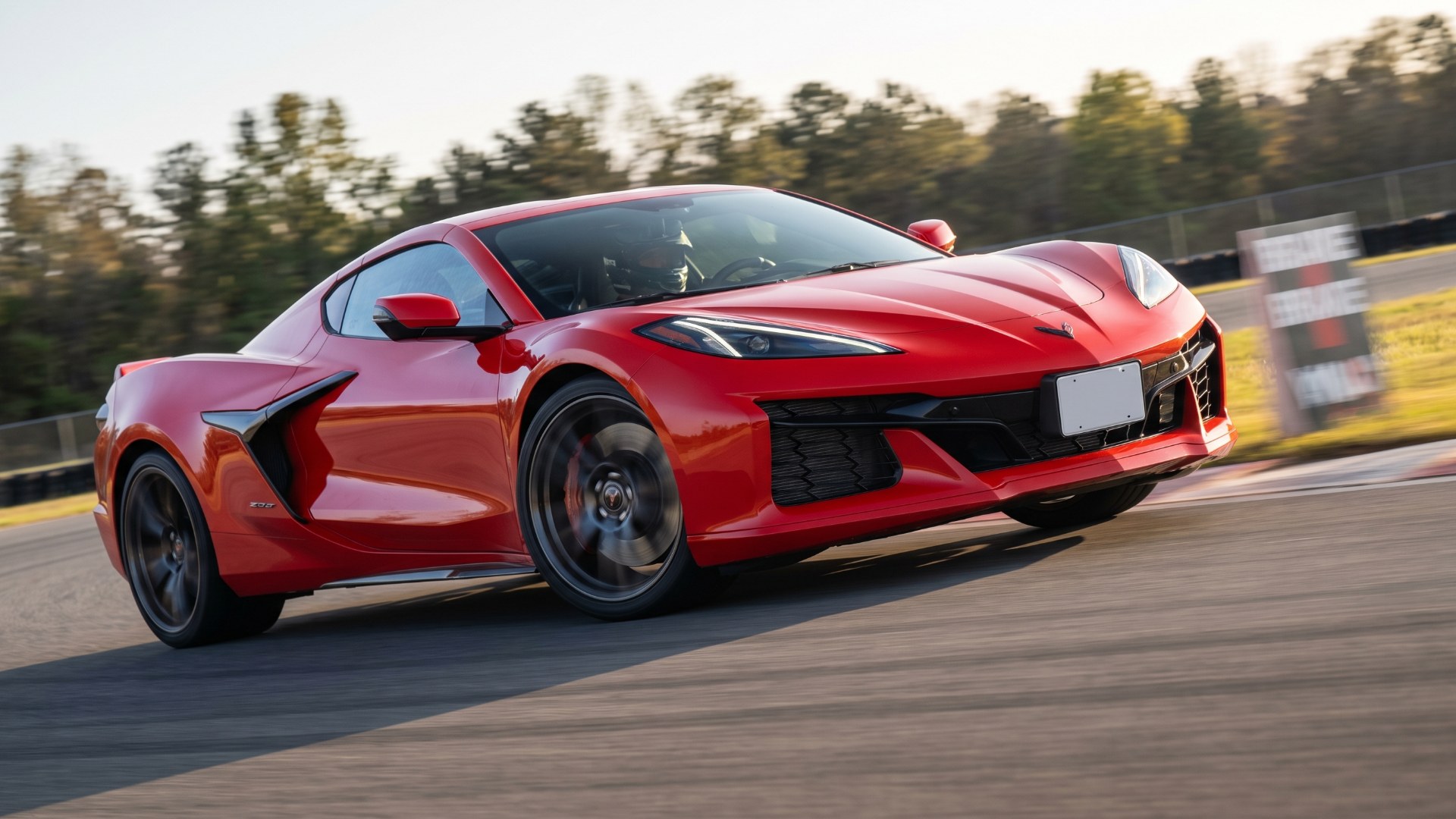
Every brake system, whether cast iron, carbon ceramic, hydraulic or dry, ultimately asks the same four contact patches for help. Each is roughly the size of a hand. Once a tire reaches the limit of its available grip, more clamping force does not stop the car sooner; it just locks or saturates the wheel, and ABS steps in.
That is why carbon ceramics do not intrinsically shorten a single stop compared with healthy iron brakes on the same tires. It is also why the smart-brake pitch is compelling. Software cannot create grip, but it can make better use of the grip that exists, particularly when it differs from wheel to wheel, as on a wet road with a painted line or a corner with weight shifting outward. ZF claims its electromechanical approach can cut emergency stopping distances from 100 km/h by up to 9 meters, but such claims depend heavily on the comparison baseline and test conditions. The tire is still the final authority.
What will actually reach mainstream performance cars?
Impressive specifications are not what decide adoption. Cost, service, feel and long-term reliability do. Here is how the contenders stack up for the kind of car most enthusiasts can actually buy.
| Technology | Status today | Cost to build | Servicing | Pedal feel | Mainstream outlook* |
|---|---|---|---|---|---|
| Carbon-ceramic discs | Production since 2000s; premium option | High; days-long process | Long life, very costly to replace | Excellent hot; can be less progressive cold | Stays premium unless cycle times fall |
| Coated iron discs | Production (e.g. Porsche PSCB) | Moderate | Familiar, less dust | Conventional | Most likely near-term upgrade |
| Continuous-fiber carbon ceramics | Low-volume production; supplier restructured in 2026 | High; yield-sensitive | Claimed durability gains | Similar to carbon ceramics | Unproven at scale |
| Electro-hydraulic brake-by-wire | Widespread production since mid-2010s | Moderate | Still uses brake fluid | Synthetic but tunable | Already mainstream |
| Hybrid or fully “dry” electromechanical | Entered series production in 2026 | Fewer parts; electronics-heavy | No fluid changes; new diagnostics | Fully programmable | Likely to spread from EVs to performance cars |
*Outlook is ECN analysis and forecast, not manufacturer guidance.
Manufacturing cost. This is where smart brakes have a structural advantage. A dry system replaces brake lines, a fluid reservoir, a booster and much of the plumbing with wiring and electric actuators. ZF argues that this reduces assembly and logistics costs. Carbon-ceramic discs move the other way, adding cost per corner.
Servicing. Dry brakes eliminate fluid flushes, but workshops will need to diagnose motors, sensors and software rather than bleed lines. Carbon ceramics last a long time on the road, but replacement and track wear remain expensive.
Pedal feel. This is the enthusiast’s sticking point. Early brake-by-wire cars drew criticism for numb or inconsistent pedals. The upside is that feel becomes a calibration choice rather than a byproduct of hydraulics, so a manufacturer that cares can make it excellent and consistent from the first stop to the last.
Reliability. Brakes are the least forgiving place to introduce new technology. Fully electrical systems rely on redundant power and communications, and international braking regulations are still being amended to accommodate them. That suggests a measured roll-out. Hybrid layouts, with electromechanical rear brakes and hydraulic front brakes, are likely to come before pure dry systems on high-performance models.
ECN forecast: who gets there first?
This is analysis, not a manufacturer roadmap. On the evidence available, smart braking is likely to reach mainstream performance cars before carbon-ceramic discs do.
The reasoning is simple. Brake-by-wire is already in volume production, and fully electromechanical systems entered series production in 2026 with supply contracts measured in hundreds of thousands to millions of vehicles. Those systems are being adopted for efficiency, packaging and driver-assistance and safety reasons, not because enthusiasts asked for them. That kind of volume pushes costs down. Carbon-ceramic discs, by contrast, are still limited by a slow, yield-sensitive manufacturing process. The most promising newer approach recently came from a company that went through administration.
The likely sequence for a typical performance car over the coming years is electro-hydraulic brake-by-wire as standard, coated discs as the premium upgrade, and electromechanical rear axles or full dry systems arriving first on EVs and hybrids. Carbon ceramics will remain the halo option and could become more affordable, but they are unlikely to become the default.
For the ordinary performance-car driver, that may be the better deal. A smart system that applies exactly the right force at each wheel, feels consistent and costs less to maintain can make a car faster and safer on a wet Tuesday commute. An exotic disc only shows its advantage after the fifth hard lap.
Why it matters
For decades, brake upgrades meant bigger discs, more pistons and more exotic materials. The next era adds a second dimension: control. The best braking systems of the next decade will likely combine strong hardware with software that knows how much grip each tire has and uses all of it. Carbon ceramics will still look great behind a set of forged wheels. But the most important brake upgrade many drivers receive may be one they never see.
Images: Exotic Car News. The vehicle and component images in this story, including the lead image, are editorial illustrations, not manufacturer, press or event photography.
FAQ
Are carbon-ceramic brakes the same as ceramic brake pads?
No. Carbon-ceramic brakes are discs (rotors) made from carbon-fiber-reinforced silicon carbide. Ceramic brake pads are a pad compound used against ordinary cast-iron discs to reduce dust and noise.
Do carbon-ceramic brakes stop a car faster?
Not in a single stop with the same tires. Stopping distance is limited by tire grip. Their advantages are lower unsprung weight, fade resistance during repeated hard braking, long road life and less dust.
How much do carbon-ceramic brakes cost?
As factory options, they typically run from about $8,500 to more than $10,000; Chevrolet lists them at $9,000 on the 2027 Corvette Z06. A full replacement set of discs and pads can reach five figures.
What is a “dry” brake-by-wire system?
It is an electromechanical system with no brake fluid. The pedal sends an electronic signal, and an electric motor at each caliper applies the pads. ZF and Brembo both offer fluid-free systems, and hybrid layouts pair hydraulic front brakes with electromechanical rear brakes.
Is Brembo SENSIFY in production?
Yes. Brembo announced on May 4, 2026 that SENSIFY had entered series production as standard equipment for an unnamed global vehicle manufacturer.
Will carbon-ceramic brakes become standard on mainstream performance cars?
ECN’s forecast is that it is unlikely in the near term. High manufacturing costs and slow production keep them premium, while coated iron discs and software-controlled brake-by-wire systems are better positioned for wider adoption.
Sources
- Brembo: SENSIFY enters production (May 4, 2026)
- Brembo: The innovation of carbon-ceramic discs
- ZF: Brake-by-wire, purely electric brake system
- Porsche: PCCB explained
- Surface Transforms: Technology
- Surface Transforms plc (in administration): sale of business and assets
- Continental: MK C1 debuts in the Alfa Romeo Giulia