

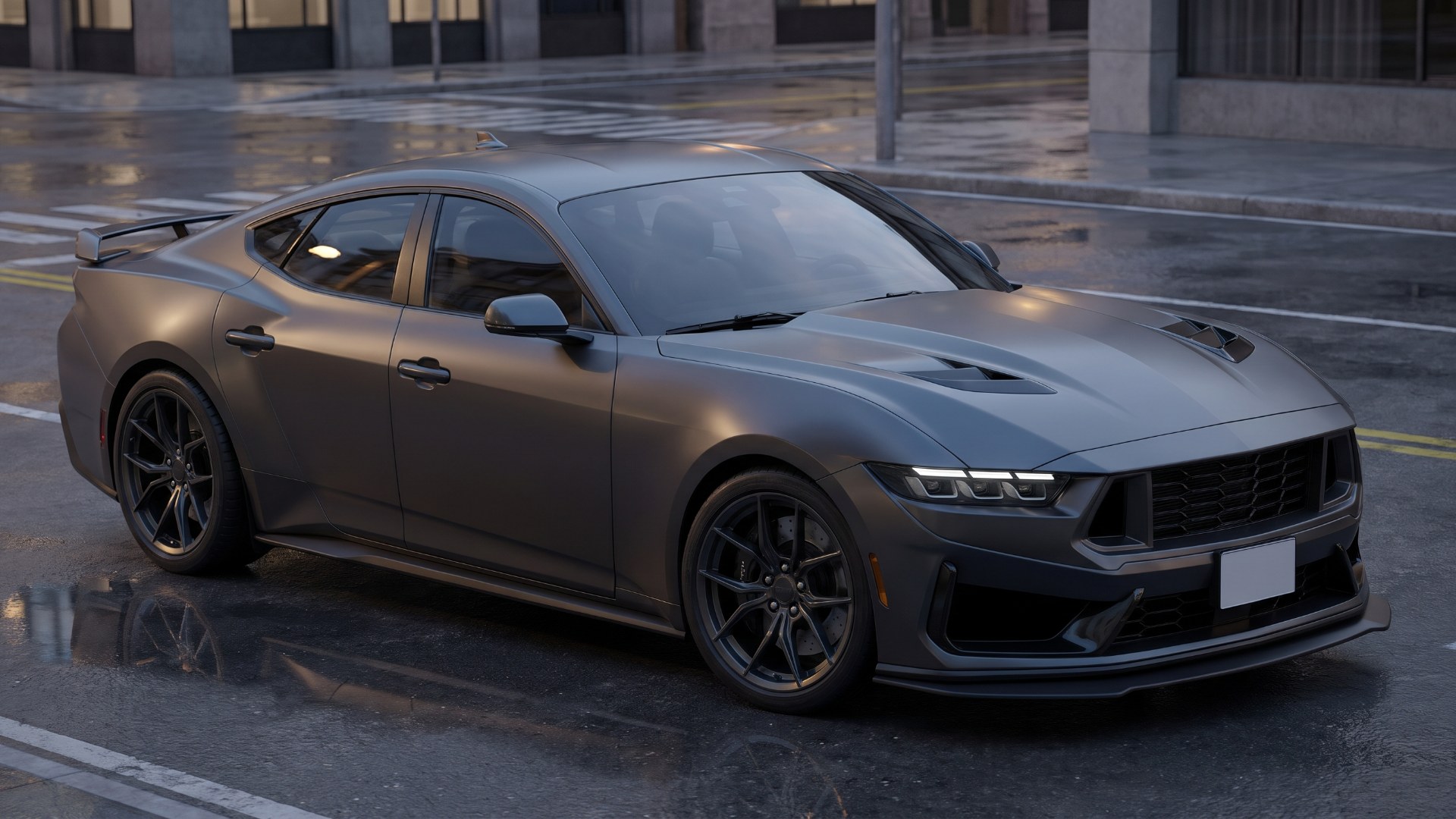
For six decades, the Ford Mustang has been defined by what it refuses to be. It has been a coupe, a convertible, a fastback and, since 2020, the name on an electric crossover. It has never been a four-door car with a Mustang body.
That may be about to change. At Ford’s annual dealer meeting in Las Vegas in early August, attendees say executives presented a four-door Mustang and pitched it with three striking targets: a starting price under $40,000, a 0-60 mph time under four seconds, and more rear-seat room than a Porsche Panamera.
The entry-level car is a business story. The more compelling question runs the other way. Over the past three years, Ford has turned the Mustang into an 815-horsepower, $325,000 Nürburgring weapon. Could a four-door Mustang follow it there? The engineering suggests that one version of that idea is entirely plausible, and the other would be a very different, very expensive machine.
What Ford has actually shown
The story begins with a closed room. The Wall Street Journal first reported that Ford showed dealers a four-door Mustang at its Las Vegas meeting, which ran August 3 to 6 and was attended by executive chair Bill Ford and CEO Jim Farley. Automotive News, the Detroit Free Press and The Detroit News followed with their own attendee accounts.
Those accounts do not entirely agree. According to Automotive News, Ford brought an early prototype on stage and let dealers see it up close; people who saw it likened its size and shape to a Panamera. A dealer who spoke to the Free Press described Ford revealing an image of the car and its plans. Another dealer told The Detroit News that the engine sounded like a V8. No photographs have surfaced.
On powertrains, the reporting is thinner still. Sources told the Journal the car would be gasoline-powered, likely with hybrid assistance, and one source mentioned a hybrid V8. The Free Press dealer said Ford did not specify an engine. No source described a fully electric version.
Timing points to the end of the decade. The Free Press dealer was unsure whether it would be a 2028 or 2029 model. Hagerty’s dealer sources suggested a reveal before the end of 2027 and sales in 2029.
Ford’s official position is a careful non-answer. A spokesperson told the Journal the company does not comment or speculate on future products. Weeks later, responding to related Automotive News reporting, a Ford spokesperson went further, calling much of the speculation around its future products inaccurate.
The paper trail is more concrete. Ford filed to register “Mach 4,” the name dealers heard at a 2024 meeting, with the U.S. Patent and Trademark Office in February 2025, claiming priority from a Jamaican filing made in August 2024. USPTO records show the application was published for opposition in September 2025 and received a notice of allowance in November. In April 2026, Ford was granted an extension to file proof of use. That is a company keeping a name alive, not a company announcing a car.
What Ford hasn’t said
- That a four-door Mustang will be built, or when.
- What it will be called. “Mach 4” is a trademark, not a confirmed model name.
- Any engine, price or performance figure.
- Anything about Dark Horse, SC or GTD versions. Those are this article’s hypotheses.
Sixty years of a four-door idea
The four-door Mustang is older than the Mustang itself. Ford’s heritage archivist, Ted Ryan, dates a four-door clay model in the company’s styling archive to January 1963, more than a year before the original car went on sale. It never progressed. A 1966 station-wagon study met the same fate.
The idea kept returning. When Ford revealed the current S650 Mustang in 2022, its official design sketches included a four-door. In 2024, dealers were shown renderings of a four-door coupe called Mach 4. Farley set the condition in an interview with Autocar that year: other Mustang body styles were possible, but only with the performance and attitude of the original.
What has changed is the market around the car. Ford has not sold a sedan in America since the Fusion ended in 2020, leaving the Mustang as its only passenger car. Dodge now sells its Charger with two or four doors. Chevrolet is reported to be weighing a four-door Camaro. In June 2026, Ford Blue and Model e president Andrew Frick said Ford was looking to expand the Mustang family. A sedan built on a name buyers already love is a far easier sell than a new nameplate.
The GTD changed the definition of a Mustang
To understand why a high-performance four-door is even worth discussing, look at the ladder Ford has built.
The Dark Horse, at 500 horsepower, is the naturally aspirated track Mustang. Above it, the Dark Horse SC uses a supercharged 5.2-liter V8 rated at 795 horsepower and 660 lb-ft, with a seven-speed dual-clutch gearbox. Ford prices it from $103,490 before destination, rising to $139,990 with the Track Pack and $170,970 for the Track Pack Special Edition. The Track Pack borrows directly from the GTD: carbon-ceramic Brembo brakes with 16.5-inch front rotors, next-generation MagneRide dampers and GTD-derived Variable Traction Control.
At the top sits the Mustang GTD, and it is a different species. Its supercharged V8 makes 815 horsepower and 664 lb-ft. The eight-speed dual-clutch gearbox is mounted at the rear axle as a transaxle, linked to the engine by a carbon-fiber driveshaft. The rear suspension is a race-style pushrod design with Multimatic spool-valve dampers, and the car can lower itself by 40 millimeters. An active rear wing with a drag-reduction system mounts to the rear pillars.
The results speak plainly. The GTD lapped the Nürburgring Nordschleife in 6:52.072 in 2025, and the GTD Competition variant cut that to 6:40.835 in April 2026. A window sticker obtained by Car and Driver showed $327,960 including destination and gas-guzzler tax. More than 7,500 people applied to buy one.
The lesson is not the price. It is that buyers accepted a Mustang as a genuine rival to Porsche and Mercedes-AMG engineering. That is the permission a performance four-door would build on.
What happens when two more doors meet GTD engineering?
This is where the idea has to survive contact with physics. Imagine two hypothetical cars.
Concept A: a four-door Dark Horse SC. This is the easier engineering case. The SC already keeps its gearbox up front and uses a conventional rear suspension, and the coupe already carries rear seats. The engine, cooling, brakes and traction software could transfer largely intact.
The hard part is the body. The current Mustang rides on a 107.1-inch wheelbase; the Panamera that dealers used as their comparison stretches to 116.1 inches. Closing that gap means new floors, roof, doors and structure, not a simple stretch.
Then there is mass and traction. Every rival making more than 700 horsepower in this class weighs over 5,000 pounds and drives all four wheels. A rear-drive Mustang sedan at Dark Horse SC power would be traction-limited off the line. The Mustang has never offered all-wheel drive. A hybrid system with a front electric axle could theoretically solve that, though no report has linked one to a high-performance version.
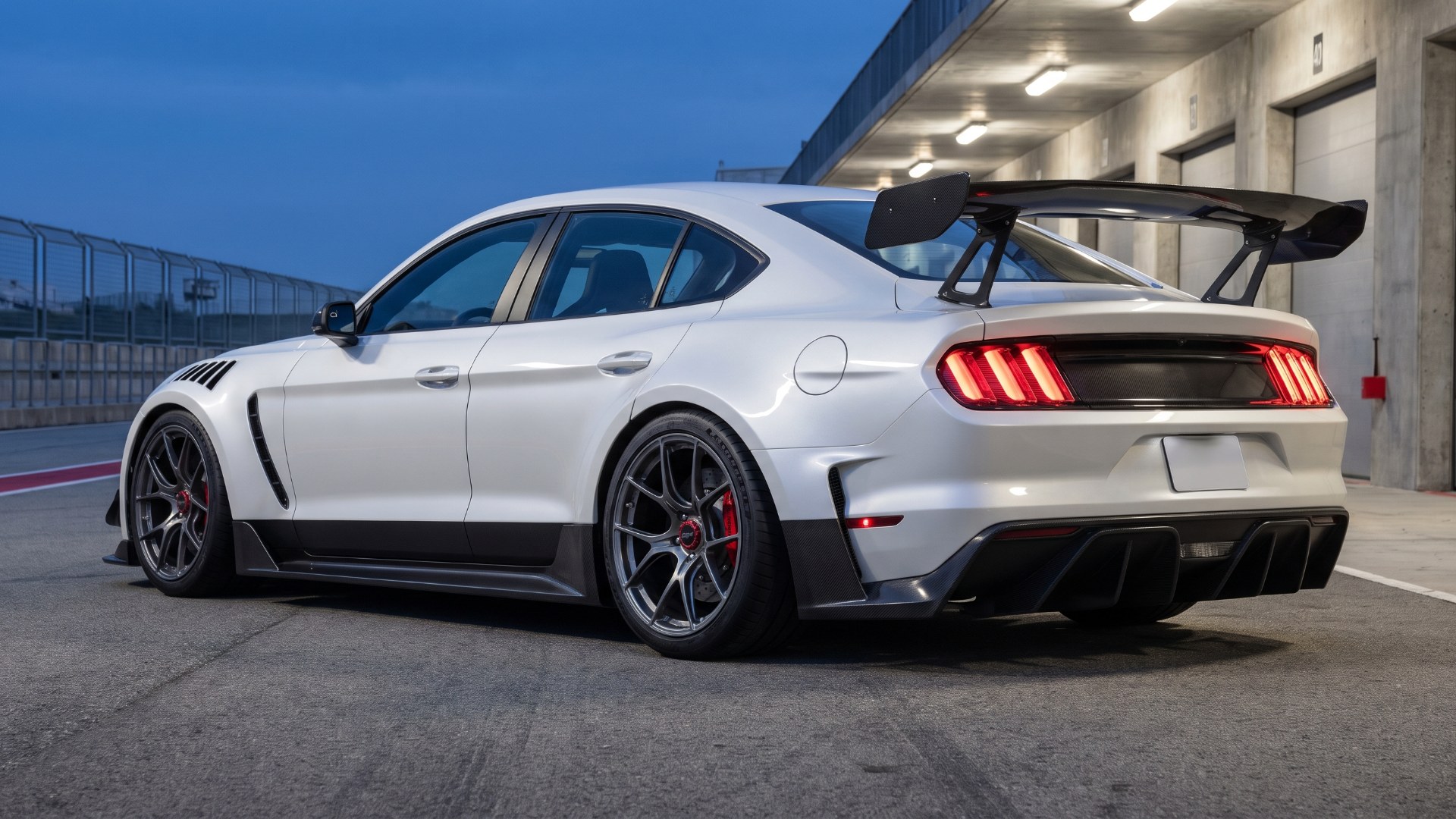
Concept B: a four-door GTD. Here the problem is architectural. In the GTD, the transaxle, its cooling hardware and the inboard pushrod rear suspension occupy the space where the coupe’s rear seats used to be. You can see the suspension through a window in the cabin. A four-door with real rear seats has to put all of that somewhere else.
It has been done. Aston Martin’s Rapide placed its gearbox at the rear in a transaxle layout and still carried four adults, though owners’ guides note the hardware costs cabin space. Maserati’s fifth-generation Quattroporte did the same. When Maserati later swapped in a conventional automatic, it had to move the gearbox forward, alter the floorpan and redesign the rear suspension. A transaxle does not sit inside a sedan; it shapes the whole car around itself.
A four-door GTD would therefore need a bespoke rear structure, and probably conventional rear suspension carrying the same spool-valve dampers instead of the pushrod layout. Its active wing would have to work from a trunk lid rather than rear pillars. The carbon bodywork that helps the GTD justify its price would multiply with every extra door and pillar.
That distinction matters. A four-door Mustang with GTD-derived brakes, dampers and electronics is a realistic product. A four-door with true GTD engineering is possible, but it would be a low-volume, clean-sheet project of the kind Ford has historically handed to Multimatic. The engineering is not the obstacle. The business case is.
America’s next super-sedan?
Any high-performance Mustang sedan would enter a field that has grown heavier, more electrified and more expensive.
Output, drivetrain and U.S. base price:
- BMW M5: 717 hp / 738 lb-ft · AWD · $124,750
- Mercedes-AMG GT 63 S E Performance 4-Door: 831 hp / 1,032 lb-ft · AWD · $200,500
- Porsche Panamera Turbo S E-Hybrid: 771 hp / 737 lb-ft · AWD · $226,500 (2025 model)
- Cadillac CT5-V Blackwing: 668 hp / 659 lb-ft · RWD · $98,900
- Dodge Charger Scat Pack four-door: 550 hp / 531 lb-ft · AWD · $56,995
The three Europeans share a recipe: twin-turbo V8, plug-in hybrid assistance, all-wheel drive. Mercedes lists its four-door at 5,269 pounds; the M5 is listed at 5,390. The Cadillac is the outlier and the closest in spirit to a Mustang: supercharged V8, rear-wheel drive, a manual gearbox. It is also reported to be in the final year of its current generation.
The American end of the market is shifting too, as Detroit’s V8 comeback continues. Automotive News reports that Dodge plans to return the supercharged Hellcat V8 to both two- and four-door Chargers for the 2028 model year. Dodge has not confirmed it.
One caution on the targets Ford reportedly gave dealers. Reports do not say whether the sub-$40,000 price and sub-four-second acceleration describe the same car. Our read is that they mark two ends of a range, with an entry model at one end and a quicker, costlier version at the other. Ford has not said.
Could a limited edition become collectible?
Ford already knows how to make a car collectible. The 2017 to 2022 Ford GT sold for about $450,000 to buyers chosen through an application process, who agreed not to resell for two years. On the open market, examples have since sold far above that, from $845,000 for a 2022 car on Bring a Trailer to $1.815 million at Mecum in 2018.
The GTD uses the same playbook, but its scarcity is softening. Ford built 384 of them in the first eight months of 2026, and reopened applications in April for the 2027 to 2029 model years. Hagerty’s July 2026 price guide places a GTD in good condition in the low-to-mid $400,000s, and dealers are asking roughly $387,000 to $540,000 for available cars. Those are valuations and asking prices; ECN found no verified public auction sale of a GTD yet.
Sedans offer a sobering comparison. BMW’s M5 CS, a celebrated one-year special with roughly 400 cars allocated to the U.S., cost $143,995 new. Reported sales since range from $105,000 for a high-mileage modified car to $196,000 for one with 118 miles. Cadillac’s numbered Blackwing editions, such as the 101-car Le Monstre, are too new to judge, and they are mechanically identical to the standard car.
Beware the headline numbers. The first Dark Horse SC, VIN 001, sold for $1.25 million at Barrett-Jackson in January 2026, but it was a charity sale. It says nothing about market value.
The pattern is consistent. Scarcity alone does not create a collector car; scarcity combined with genuine engineering substance and disciplined allocation does. A four-door Mustang with true GTD-level engineering, built in small numbers, would have a case. A GTD-styled sedan would more likely behave like the M5 CS: well loved, well kept, and close to its sticker price. None of this predicts future values.
The bigger bet Ford is making
For Ford, the four-door Mustang is less about performance than about using its strongest names. Ford has built its recent strategy around icons such as Mustang, Bronco and F-150, and a Mustang sedan lets it return to a segment it abandoned without starting from zero. The dealer who spoke to the Free Press summed up the pitch simply: a car that broadens the Mustang’s appeal to young families.
The counterarguments are serious. Purists have not forgotten the backlash to the Mustang Mach-E. A new four-door body is expensive to develop for a sedan market that remains far smaller than the SUV market. Extra weight works against everything the GTD stands for. And the Dark Horse SC Track Pack already costs about $140,000, so a premium four-door would compete directly with the established European names.
There is also Ford’s own warning. Product plans change, and Ford has canceled announced vehicles before. The company has said much of the speculation about its future products is wrong.
The Mustang’s next frontier
A four-door Mustang now looks more likely than at any point since that 1963 clay model. What it becomes is still open. The base car would broaden the Mustang. A Dark Horse SC sedan would challenge Cadillac and BMW with American muscle. A true four-door GTD would be the boldest step of all, and the least likely.
Ford has proved that the Mustang can stand with the world’s best performance cars. The next question is whether it can do that with four doors. For now, the answer is Ford’s to give.