
The original Lexus LFA is remembered for many things: its carbon-fiber construction, its obsessive development, its rarity, its balance, and its place as one of the most unexpected cars Lexus ever built.
But ask an enthusiast what defines the LFA, and one answer usually comes first.
The V10.
Its 4.8-liter naturally aspirated engine produced 552 horsepower and revved to 9,000 rpm, but the numbers tell only part of the story. The throttle response, the induction noise and that extraordinary exhaust note became inseparable from the car. Only 500 were built between 2010 and 2012, and over time the sound of that V10 became almost as recognizable as the LFA itself.
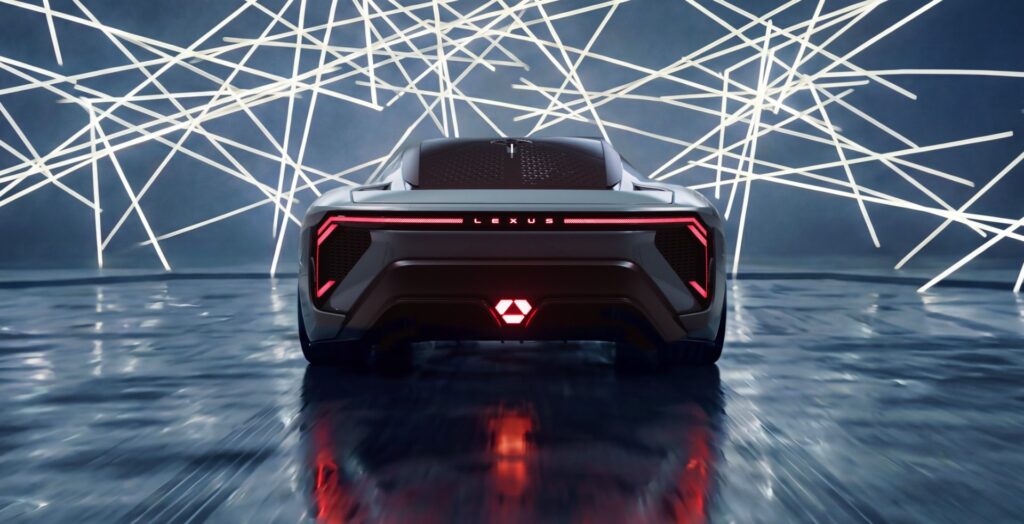
Now Lexus wants the LFA name to continue — without an engine at all.
What You Need to Know
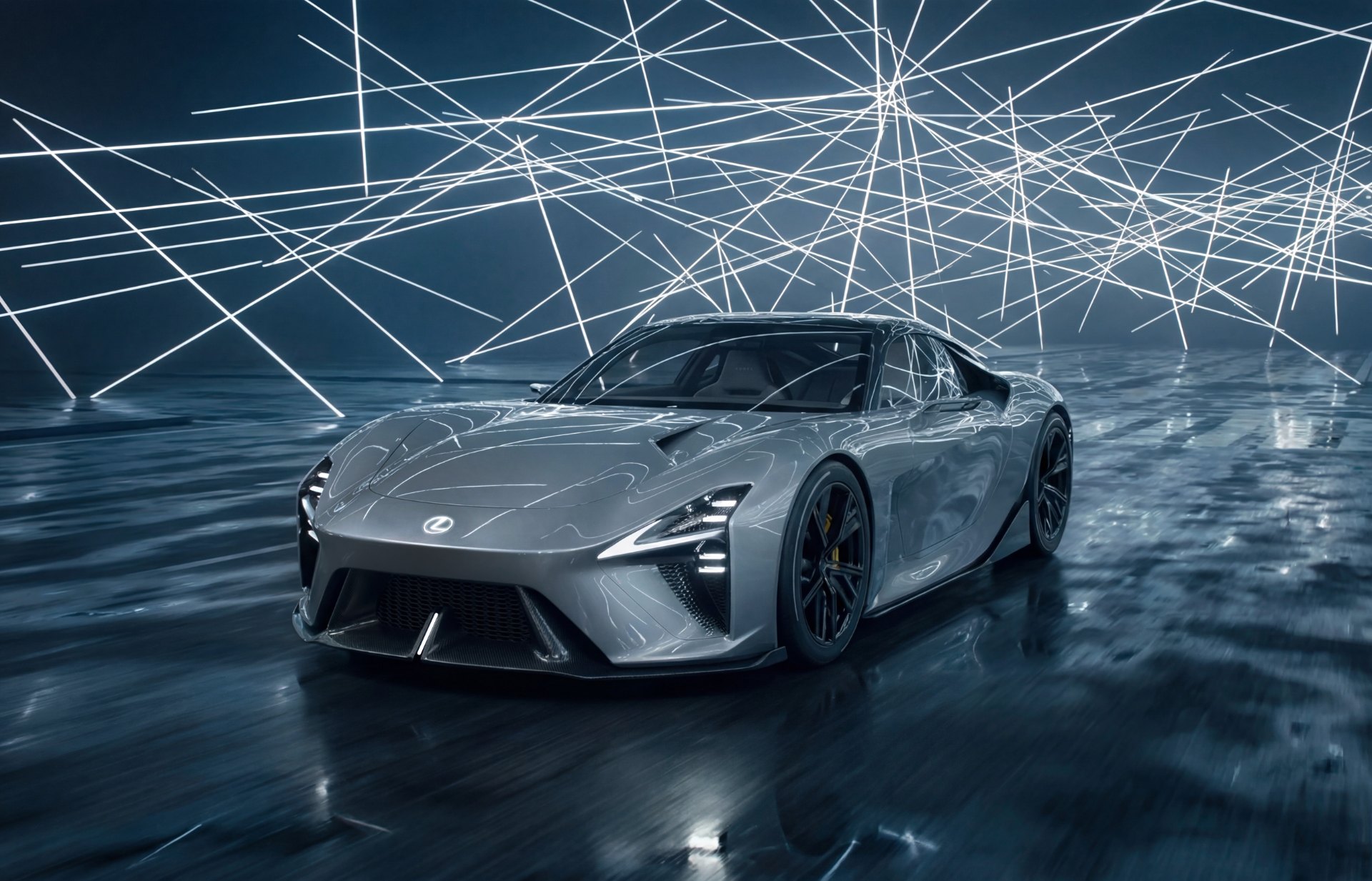
- The Lexus LFA Concept is a battery-electric sports car, revealed on December 5, 2025, and developed alongside Toyota Gazoo Racing’s V8-powered GR GT and GR GT3.
- It drops more than the V10: the original’s carbon-fiber body structure gives way to an all-aluminum frame shared with the GR GT.
- A camouflaged prototype made its first public runs up the Goodwood hill in July 2026.
- Lexus has not confirmed power, battery, range, weight, price or production timing.
Lexus describes the concept not as an attempt to reproduce the original, but as a new expression of the same engineering philosophy. That creates a difficult question.
Can a successor inherit an icon’s identity when it abandons the component that defined the original?
Lexus Says the LFA Was Never Just a V10
Lexus anticipated the argument. When it revealed the LFA Concept, the company did not frame the project as an electric recreation of the original car. It framed the LFA as part of a process of passing engineering knowledge from one generation to the next.
Toyota ties that philosophy to Shikinen Sengu, the Japanese tradition in which a Shinto shrine is periodically rebuilt so that the skills required to build it do not disappear. The physical object changes. The knowledge survives. Toyota presents the GR GT, the GR GT3 and the LFA Concept together as its modern version of that ritual, born from Chairman Akio Toyoda’s conviction that certain car-making skills must be preserved.
Lexus went further in its reveal announcement, describing “LFA” as a name no longer bound to combustion engines — one that stands for the technologies engineers of each era should preserve and pass on.
That is a sophisticated argument. If Lexus is right, the V10 was never the identity of the LFA. It was simply the technology that best expressed the LFA’s philosophy at that particular moment in automotive history.
But that interpretation creates another problem. The original engine became so extraordinary that it stopped feeling like merely one component of the car. It became part of what the name meant.
The V10 Was More Than the Thing Producing Horsepower
The LFA’s engine did not simply move the car. It communicated with the driver. Its response, its vibration and its rising urgency created a progression toward 9,000 rpm that became central to the experience.
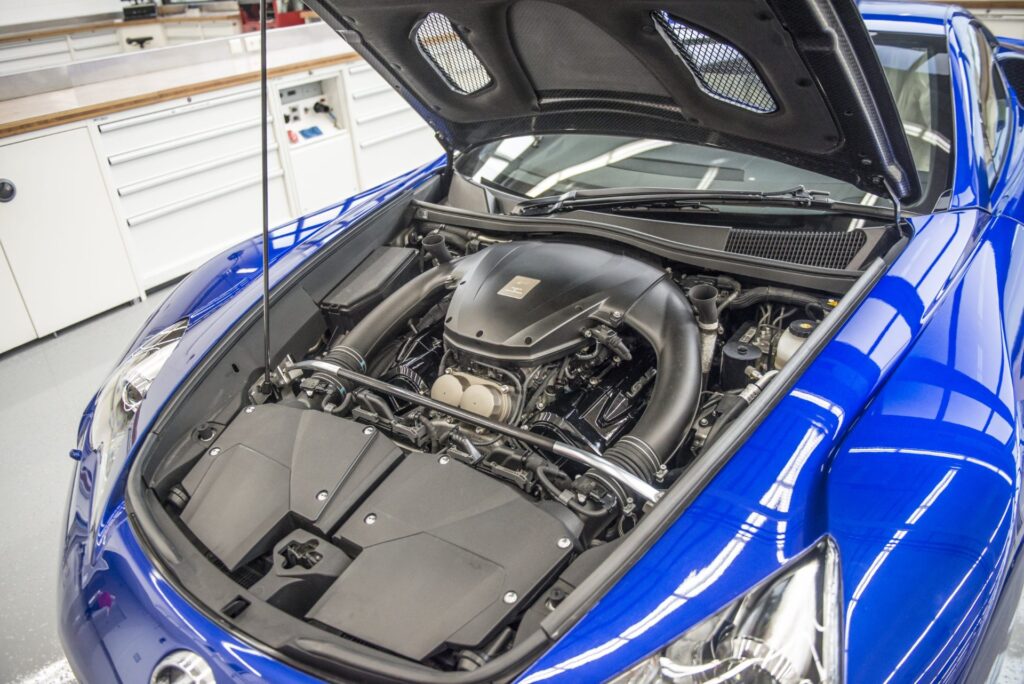
Even the instrument panel became part of the story. The V10 could reportedly sweep from idle to redline in about six-tenths of a second — quickly enough that Lexus used a digital tachometer because a conventional analog needle could not keep pace.
That is what makes the transition difficult. Remove a navigation system and the car remains recognizable. Change the brake supplier and its fundamental identity survives. But remove the element people remember most intensely, and the successor has something to replace.
An electric LFA does not merely lose ten cylinders. It loses one of the primary ways the original car communicated emotion. Electric motors can easily replace the performance. The question is what replaces the experience.
Audi’s R8 Shows How an Engine Becomes Part of a Nameplate
Lexus is not alone. Audi built another modern supercar whose identity became increasingly inseparable from its engine.
The R8 entered production in 2006 and ran until March 2024. Across two generations and 17 years, Audi built 45,949 examples. It was revolutionary for the company: a mid-engine road car capable of competing for attention alongside Porsche, Ferrari and Lamborghini.
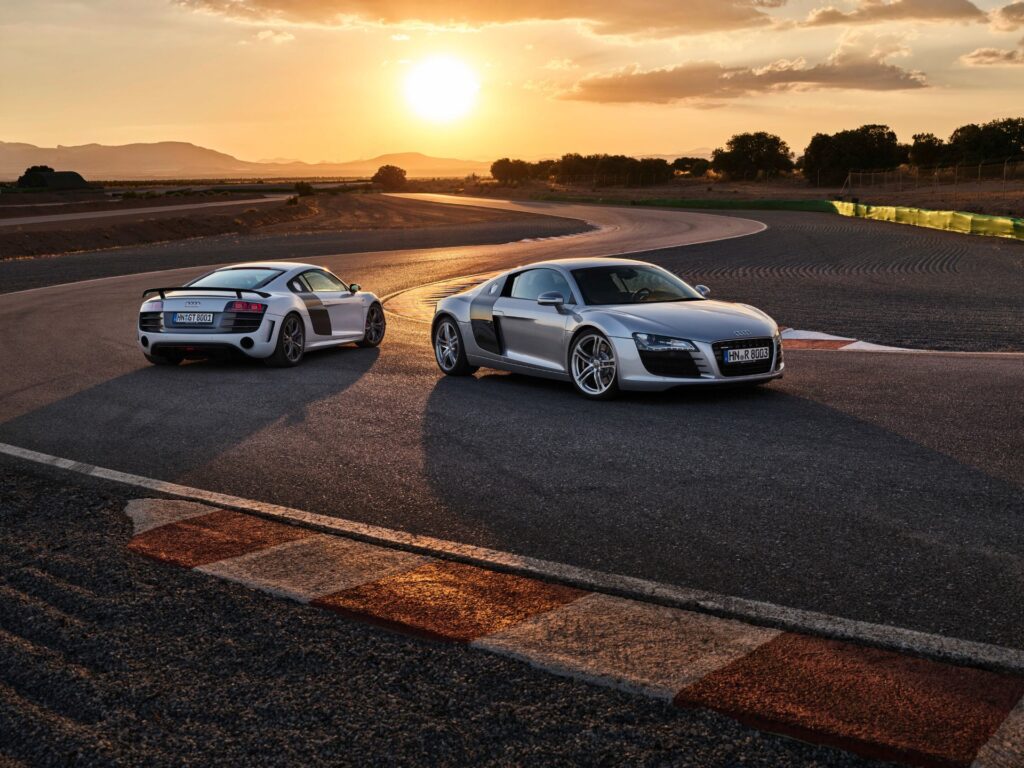
Early versions used a V8, but over time the naturally aspirated V10 became the engine most closely associated with the car. By the end, Audi offered V10 versions producing as much as 620 metric horsepower, including the limited R8 GT. The R8 had become something unusual in the modern market — a naturally aspirated, mid-engine supercar that could be used with remarkable ease. The V10 provided theater. The chassis provided accessibility. The cabin made it livable. The combination became its identity.
Audi has announced no direct successor. But if it ever returns to this part of the market with a fundamentally different powertrain, simply making the next car faster would not necessarily make it feel like an R8. An electric car could beat the V10 R8 on acceleration, power delivery and even lap time while leaving enthusiasts asking whether the thing they loved survived.
Technological superiority does not automatically preserve emotional continuity.
This happens only occasionally. There are cars where the engine is important, and then there are cars where the engine becomes part of the cultural definition of the vehicle. Say LFA, Carrera GT, Ferrari F50 or R8 V10, and the engine immediately enters the conversation. A manufacturer cannot replace something that emotionally important with a better specification sheet and expect the audience to regard the change as irrelevant. It has to create another reason to care.
The challenge facing Lexus is not simply a technological transition. It is identity replacement.
The NSX Offers Another Warning
The Acura NSX provides another useful example. The original was relatively simple by modern standards: naturally aspirated, light by the supercar standards of its day, responsive and famously usable.
The second-generation NSX returned with a completely different philosophy. It paired a twin-turbocharged V6 with three electric motors, all-wheel drive and a nine-speed dual-clutch transmission. The argument made sense — use modern technology to pursue the same broader mission of accessible exotic-car performance — and the car was tremendously sophisticated.
Yet enthusiasts never stopped debating whether it felt like a legitimate continuation of the original. That does not mean Honda built the wrong car. It demonstrates something more important:
A manufacturer can inherit an engineering philosophy without automatically inheriting the emotional identity attached to the original.
This Is Not Really an EV-Versus-V10 Debate
Reducing the new LFA to combustion versus electricity would make the story far less interesting. Automotive icons have always evolved.
The Porsche 911 moved from air cooling to water cooling. Turbocharging became common. Manual transmissions disappeared from many variants. Yet the 911 remained recognizable because Porsche protected enough of the underlying character — the same instinct behind its reluctance to build an electric 911.
The Chevrolet Corvette is an even more dramatic example. For generations, the front-engine layout seemed fundamental to the formula. Then the C8 moved the engine behind the driver — a radical architectural break. Yet enough of the Corvette’s broader mission survived (American performance, relative accessibility against exotic rivals, a relentless pursuit of capability) that the name survived the transformation.
Icons can change dramatically. But there is a condition: the successor must preserve something deeper than individual hardware.
So What Is the LFA’s Deeper Identity?
That may be the central question Lexus must answer.
If the LFA’s identity is a naturally aspirated V10, an electric successor cannot truly be an LFA.
If its identity is Lexus engineers being allowed to push beyond the company’s ordinary boundaries to create an unusually immersive sports car, the story changes.
The original LFA mattered partly because Lexus had never built anything like it. It spent years in development. Its engineers prioritized response and feel over chasing maximum horsepower. It seemed almost irrational next to the luxury sedans and SUVs the brand was better known for.
Notably, the new car walks away from more than the engine. The original LFA’s carbon-fiber body structure — itself a defining part of the legend — gives way to an all-aluminum frame shared with the GR GT. Lexus is not preserving the first car’s hardware anywhere. It is betting entirely on the idea that the spirit transfers.
That may be the true inheritance. The first LFA demonstrated what Lexus could accomplish when its engineers were given permission to create something exceptional. The second will need to do the same with completely different technology.
The New LFA Cannot Win With Acceleration
This is one of the central problems facing modern electric performance cars. Acceleration has become relatively easy to obtain. The sensation can still be extraordinary, but it is no longer enough to define a halo car.
An electric LFA could easily outperform the original in a straight line. It could produce substantially more power and distribute torque with a precision the original could never achieve. None of that would automatically make it memorable.
A halo car has to offer something that cannot be summarized by a spreadsheet. The original LFA did. Its successor has to find its equivalent.
Lexus Is Focusing on the Driver
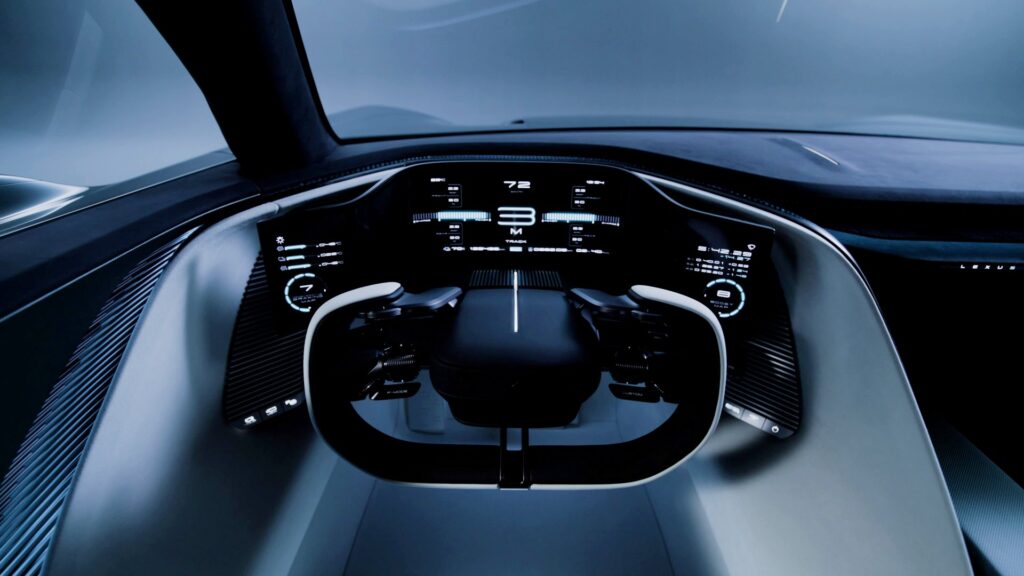
Lexus’s own description suggests it understands the problem. The LFA Concept places heavy emphasis on driving position and on the relationship between the driver and the controls. Its cockpit shares the same ideal seating position as the GR GT and GR GT3. Controls are concentrated around the driver, the steering is designed so the driver never needs to re-grip with a different hand, and switches are laid out to be operated by touch.
Lexus calls the overall objective “Discover Immersion.”
That language matters. Lexus is not leading with range, charging time or a record 0–60 mph figure. It is talking about immersion — which suggests the company knows an LFA must be more than an extremely fast battery-electric car.
The Relationship With the GR GT Makes This More Interesting
Toyota’s wider performance strategy makes the LFA decision even more deliberate. The GR GT and GR GT3 that share the LFA Concept’s development program both use a twin-turbo V8. Toyota is not being forced to make every flagship electric. It can pursue different philosophies at the same time.
That makes the LFA Concept less like a regulatory replacement for the old car and more like an experiment. The question is whether that experiment can create something emotionally persuasive enough to justify the name.
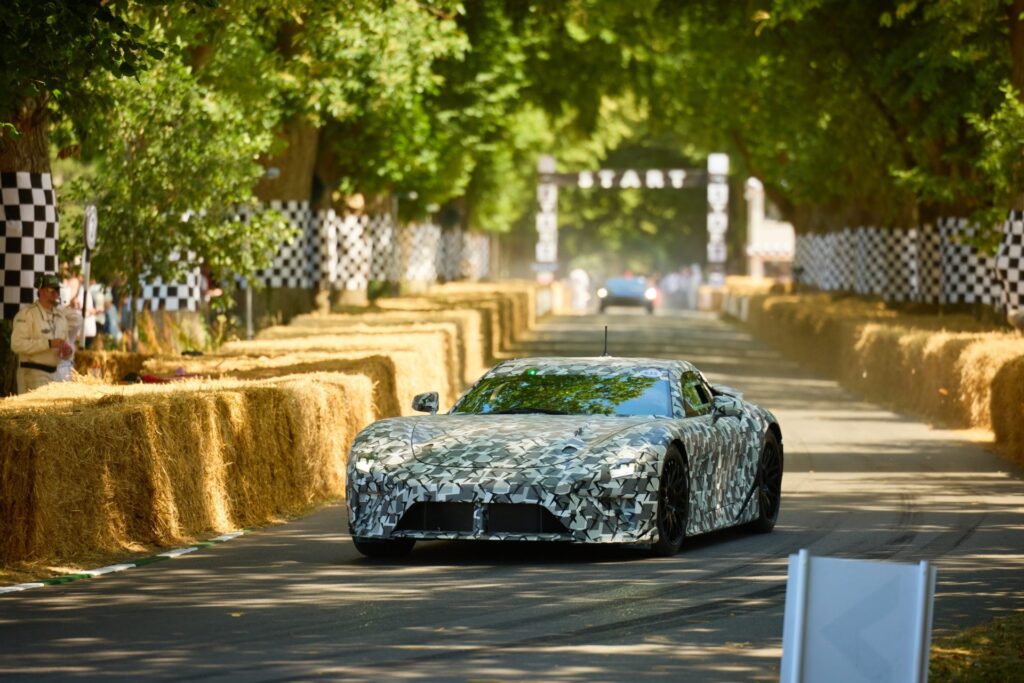
The experiment is no longer purely theoretical, either. At the Goodwood Festival of Speed in July 2026, the camouflaged LFA Concept was scheduled only for static display — then joined the GR GT and GR GT3 prototypes for unannounced high-speed runs up the hill. Lexus project general manager Yukihiro Yukita framed the goal around a “multi-sensory experience unique to Lexus.” The concept is now touring, with its Australian debut scheduled at the Melbourne Cup Carnival.
Sound May Be the Most Difficult Thing to Replace
There is no avoiding this issue. The V10’s soundtrack became one of the LFA’s defining characteristics, and an electric successor will not naturally reproduce it.
Lexus clearly knows it. At the reveal, Toyota chief branding officer Simon Humphries said the goal was for the car to completely redefine what an electric sports car sounds like — a directive he attributed to Akio Toyoda himself.
The worst answer would be imitation: artificial V10 noises played through speakers. If the successor is going to be electric, its most interesting possibility is to establish its own sensory language. Electric motors produce sound. Inverters produce sound. Regenerative braking changes how a car slows. Torque delivery can be shaped. Steering feedback, chassis response, vibration, control weighting and cabin acoustics can all contribute to an emotional experience.
The question is whether Lexus can combine those qualities into something authentic — not something pretending to be the old LFA, but something that could only belong to the new one.
Weight Could Matter More Than Horsepower
Another promising part of Lexus’s philosophy is its emphasis on low weight. Battery-electric performance cars face an obvious challenge: batteries are heavy. More power can mask that mass in a straight line. It cannot hide it when a car changes direction, brakes repeatedly or communicates through its chassis.
Lexus lists a low center of gravity, low weight with high rigidity, and aerodynamic performance as the concept’s three foundations. But it has not announced a curb weight — or, for that matter, any production specification. Power output, battery capacity, range, charging performance, price and timing all remain unconfirmed, even as some reports point to a production version as early as 2027.
That distinction matters. This is still the Lexus LFA Concept. It is not yet a finalized production LFA.
At a Glance: Original LFA vs. LFA Concept
| Lexus LFA (2010–2012) | Lexus LFA Concept | |
|---|---|---|
| Powertrain | 4.8-liter naturally aspirated V10 | Battery-electric (details unannounced) |
| Output | 552 hp, 9,000 rpm redline | Not announced |
| Structure | Carbon-fiber-reinforced body | All-aluminum frame shared with GR GT |
| Size (L × W × H) | — | 4,690 × 2,040 × 1,195 mm (184.6 × 80.3 × 47.0 in) |
| Production | 500 cars | Unconfirmed; timing not announced |
| Status | Out of production since 2012 | Concept; first public runs at Goodwood, July 2026 |
Perhaps the Name Is Supposed to Create Pressure
There is another possibility: maybe Lexus chose the LFA name precisely because it raises expectations.
A completely new model name would be safer. Nobody could complain that an electric sports car failed to sound like the old LFA, or demand that it reproduce an experience created more than a decade ago.
Calling it LFA creates a standard. The name tells Lexus engineers that producing another fast electric car will not be enough. It has to deserve comparison with something exceptional.
Heritage does not require manufacturers to freeze engineering in time. But heritage creates an obligation.
When you remove the thing people loved most, you have to give them something worth loving instead.
The Bottom Line
Can a successor inherit an icon’s identity when it abandons the component that defined the original?
Yes. But inheritance is not automatic.
The C8 Corvette shows that a famous nameplate can survive an architectural revolution. The second-generation NSX shows that technical brilliance alone may not guarantee emotional continuity. And the Audi R8 shows how deeply a particular engine can become intertwined with the identity of a car.
That is the landscape the electric Lexus LFA Concept drives into. It does not need ten cylinders. It does not need to imitate a 9,000-rpm exhaust note. And it should not pretend automotive technology has stood still.
But it does need an answer to the question the original LFA solved so convincingly:
What makes this car impossible to forget?
The original answered with extraordinary engineering, obsessive development and one of the most memorable V10 engines ever installed in a production car. The successor will need to create its own answer.
Because an icon does not survive simply by keeping its name.
It survives when the next generation creates something powerful enough to become part of that name’s meaning.
Frequently Asked Questions
Is the new Lexus LFA electric?
Yes. The Lexus LFA Concept, revealed on December 5, 2025, is a battery-electric sports car concept. It does not use the original LFA’s V10 or any combustion engine.
Will the electric Lexus LFA go into production?
Lexus has not announced production timing, pricing or availability. Some reports point to a production version as early as 2027, but Lexus has not confirmed that.
How much horsepower does the Lexus LFA Concept have?
Lexus has not released power, battery capacity, range, charging or weight figures. The only published specifications are its dimensions: 4,690 mm long, 2,040 mm wide and 1,195 mm tall, with a 2,725 mm wheelbase and two seats.
How is the LFA Concept related to the Toyota GR GT?
It was developed alongside Toyota Gazoo Racing’s GR GT and GR GT3 and is based on the GR GT’s all-aluminum body frame, sharing the same driving position. The GR GT and GR GT3 use a twin-turbo V8; the LFA Concept is electric.
What made the original Lexus LFA special?
Built from 2010 to 2012 and limited to 500 cars, the original LFA combined a carbon-fiber body with a 552-hp, 4.8-liter naturally aspirated V10 that revved to 9,000 rpm. Its engine sound and rapid response became central to its reputation.
Has the Lexus LFA Concept been driven in public?
Yes. A camouflaged LFA Concept made its first public dynamic runs on the hill climb at the Goodwood Festival of Speed in July 2026, alongside GR GT and GR GT3 prototypes.