
Paris’s 50-year-old collector-car show opens its first American edition at the Javits Center on November 19–22. Here is what is confirmed, what a ticket gets you, and what the debut still has to prove.
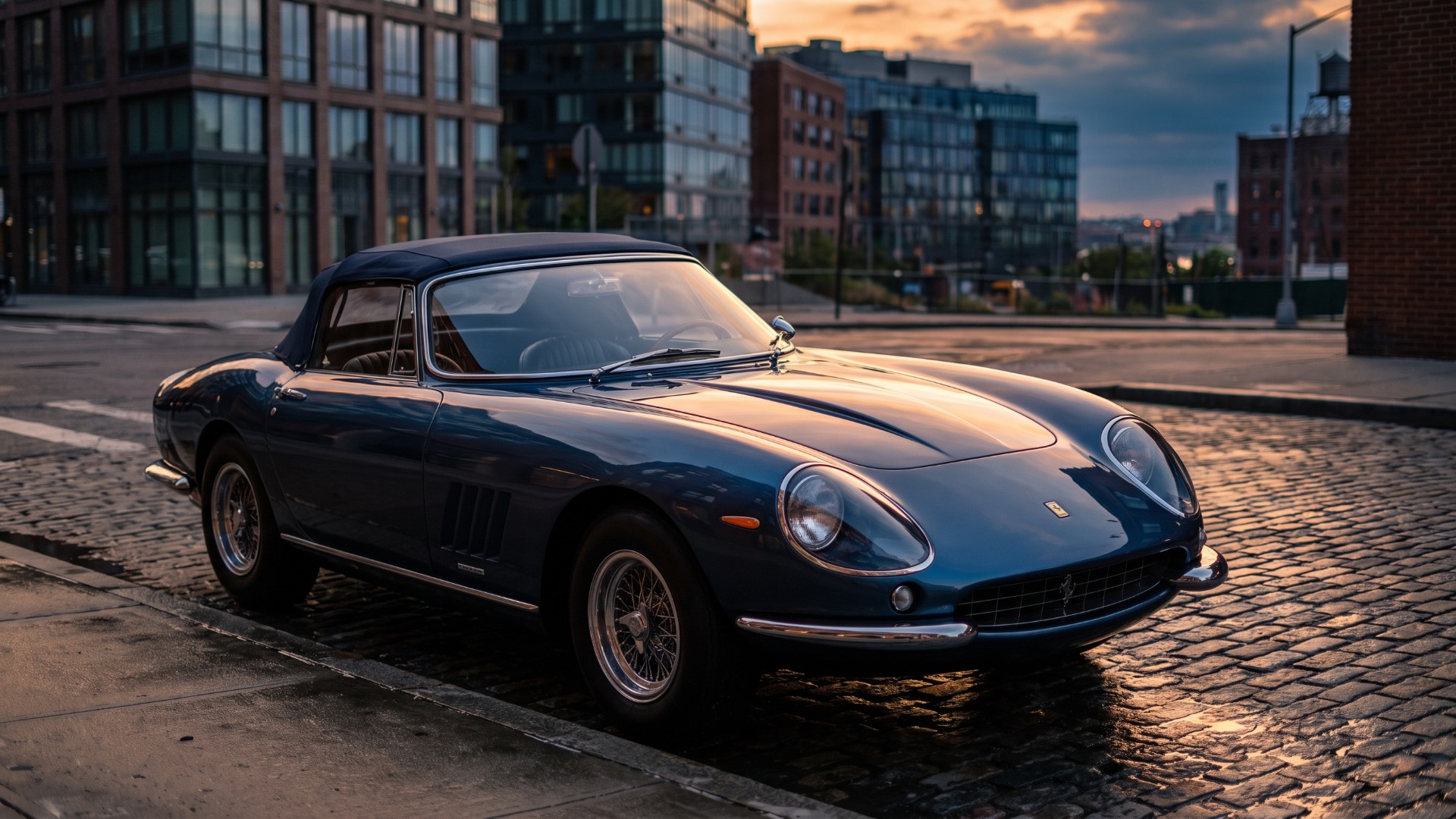
Lead image: editorial illustration of a Ferrari 275 GTB/4 NART Spider, not a photograph of the auction car.
In September 1967, Ferrari completed a 275 GTB/4 NART Spider, the sixth of only 10 built. It was sold new to Steve McQueen, who had it repainted a darker metallic blue almost immediately.
Next month that car, chassis 10453, is due to cross a public auction block for the first time, with an estimate of $15 million to $20 million. The room matters as much as the car. It is the headline lot at Rétromobile New York, the first American edition of the Paris collector-car show, which runs November 19–22 at Manhattan’s Javits Center.
The question for enthusiasts is not whether expensive cars will be there. It is whether a format built in Paris over half a century offers something the American calendar does not already have.
What Rétromobile actually is
Rétromobile began in Paris in 1976 and held its 50th edition this past winter. Organizer Comexposium reported 181,500 visitors over five days, a record and 24% more than in 2025. Before the doors opened, the show listed about 600 exhibitors and more than 2,000 classic cars across roughly 861,000 square feet (80,000 square meters).
It is not a new-car auto show. It is not a concours, where cars are judged on a lawn. And it is more than an auction with a few displays attached.
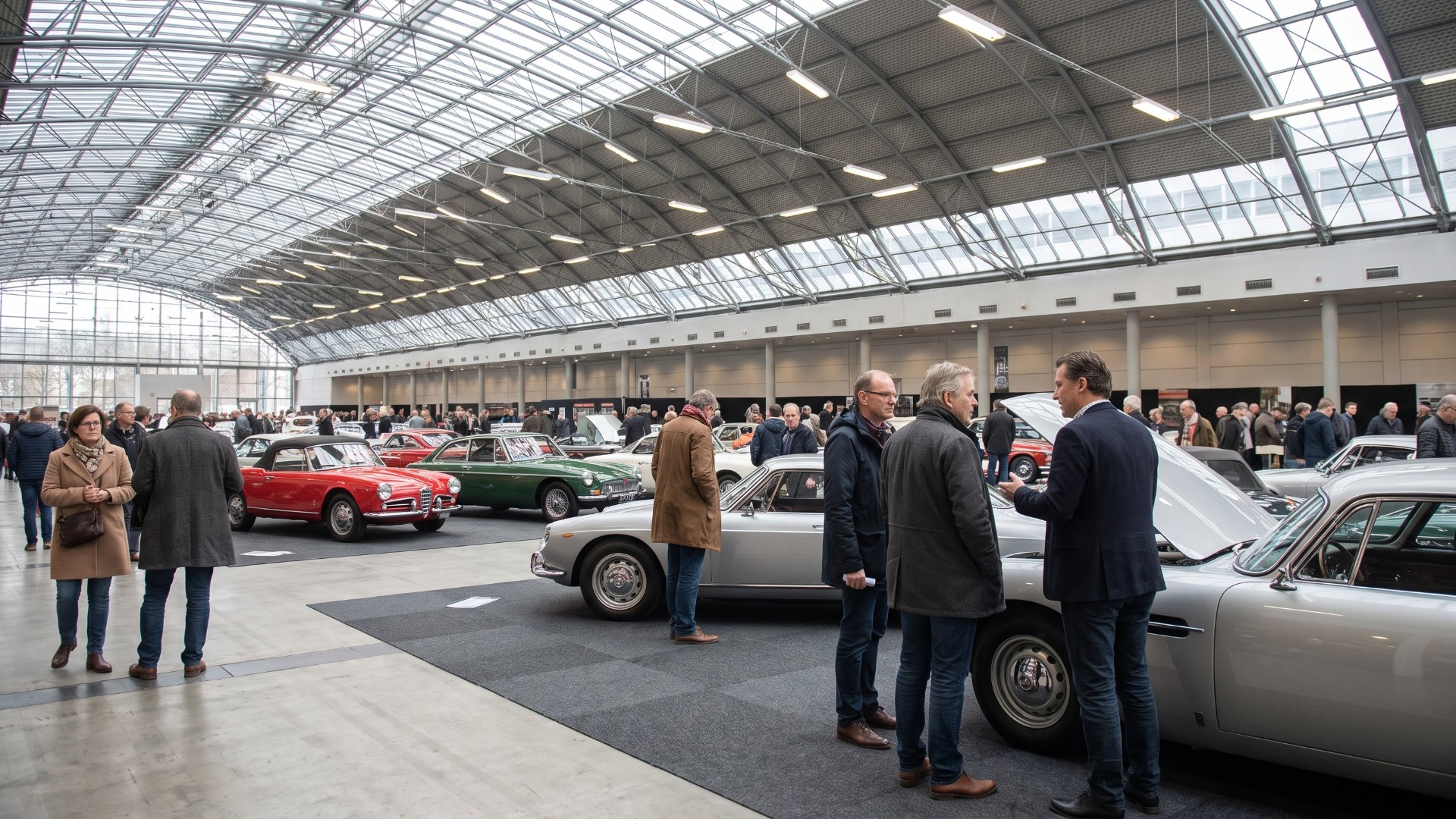
Rétromobile is a trade fair that the public is invited into. Specialist dealers bring cars that are for sale. Restorers, parts sellers, clubs, museums and artists take stands alongside them, and an official auction runs under the same roof. The Paris show keeps a dedicated parts market and an artists’ gallery. The expertise is as much the attraction as the metal.
Why New York, and why November
The American edition is a joint venture between Comexposium, which organizes the Paris show, and a U.S. luxury-automotive media group, according to the organizers’ own description. Gérard Neveu, identified in recent official materials as chief executive of Rétromobile New York, leads it.
The organizers say they want to build one of the country’s most prestigious collector-car salons, and their pitch leans on the city itself. Announcing an art-car exhibition for the show, Neveu said, “New York feels like the perfect place to bring those worlds together.”
There is a practical logic too, and this part is ECN’s reading rather than the organizers’ claim. America’s best-known collector gatherings are outdoor and seasonal: Amelia Island in March, Monterey in August. An indoor show in late November lands in a quiet stretch of the calendar, in a region whose own classics are heading into winter storage. Paris works the same way, running in midwinter.
Geography is not proof of demand, though. The organizers project 70,000 visitors and advertise more than 100 exhibitors. The official directory listed about 50 confirmed names when ECN checked on October 9, with more being added weekly. Even if both targets are met, New York would open at roughly 40% of Paris’s attendance and a fraction of its exhibitor count.
What is confirmed so far
The directory gives a fair picture of the mix. The trade is represented by established names including Fiskens, Girardo & Co., Hyman Ltd., Lukas Hüni and Joe Macari. Autosport Designs, a Long Island sales, service and restoration shop founded in 1989, is the kind of local specialist a New York show needs. Revs Institute and Historic Sportscar Racing add museum and racing weight.
Artcurial is on the list as well. That is a notable detail: the French house held the official Rétromobile sale in Paris before Gooding Christie’s took over in 2026.
The list also runs to watches, luggage, driving gloves, eyewear and jewelry. That is true to the Paris formula, but visitors expecting wall-to-wall cars should know it.
The most distinctive confirmed exhibition comes from CART Department, collector Larry Warsh’s art-car project. Announced works include a 1971 Land Rover Series III decorated by Keith Haring, a BMW that Ai Weiwei covered in LEGO bricks, Shepard Fairey’s 1937 Packard and the cut-down Maybach 57 from the “Otis” video, a car that features in ECN’s history of hip-hop and luxury cars.
What is not confirmed is the schedule. Organizers promise restoration workshops, live demonstrations and a marketplace for parts, automobilia, art and books. But the session-by-session program had not been published as of October 9. No specific workshop, speaker or demonstration should be assumed until it is.
What the headline cars tell you
The auction, held by Gooding Christie’s on November 20 and 21, is where the show’s ambitions are easiest to measure.
McQueen’s Ferrari is a lesson in why originality now outranks shine. After an accident on Pacific Coast Highway, the actor had it repaired, and by 1971 it had moved on. The current owner has had it since 1986. Gooding Christie’s describes it as preserved rather than restored, with its matching-numbers engine and transaxle and its original Scaglietti body.

Two past sales frame the estimate. Another NART Spider, chassis 10709, brought $27.5 million at RM’s Monterey auction in 2013. McQueen’s 275 GTB/4 coupe, chassis 10621, is a different car that is easily confused with this one. He bought it while the Spider was off the road, and it sold for $10,175,000 in 2014. Both figures included fees.
An estimate is not a result, and the hammer price is not the bill. Under Gooding Christie’s published buyer’s premium of 12% on the first $250,000 and 10% above that, a winning bid of $15 million would cost about $16.5 million.

The 1998 RUF Project Dragon makes a different point. It carries a 1998 date because RUF built it on the last unused body shell it had kept from the CTR2 era, yet it was delivered in March 2024. Tony Hatter, who designed the 993-generation Porsche 911, worked on its shape. It makes 621 hp from an air-cooled engine, shows 759 miles and is estimated at $6 million to $8 million.
It is offered without reserve, meaning it sells to the highest bidder whatever the number. A nearly undriven one-off is exactly the kind of car ECN examined in The Worst Thing You Can Do to Some Supercars Is Drive Them.
Not everything is seven figures. More than 70 motorcycles from Billy Joel’s collection will be sold without reserve, with proceeds intended for The Joel Foundation, according to the auction house. A 1978 Triumph Bonneville given to him by Madison Square Garden is estimated at $10,000 to $15,000.
Who gets access to what
This is the part most likely to confuse first-time visitors.
- A show ticket lets you see every auction lot on display, according to Gooding Christie’s.
- Up-close viewing and bidding are for registered bidders only. Registration is handled by the auction house, not the show.
- VIP admission adds early entry, a fast lane, a lounge with lunch, a gift bag and coat check. The show’s FAQ also lists “auction access,” but nothing published says that includes the right to bid. Treat the two as separate.
Viewing is listed for Thursday through Saturday, 9 a.m. to 7 p.m. Nothing is listed for Sunday, after the sale has ended. If the auction cars are your reason to go, do not pick Sunday. Consignments can also be withdrawn, so recheck the full catalog, which is due in late October.
The reality check
America is not short of collector-car events. A respected European name and a few eight-figure consignments do not establish attendance, sales or staying power in a new city. An indoor hall cannot give you cars being driven. And a handful of trophy lots says little about the wider market.
Cost cuts both ways. A $70 day ticket is modest next to the $650 that general admission to the Pebble Beach Concours reached this August. A Manhattan hotel in November is not.
ECN has not interviewed the organizers or exhibitors for this preview. Their positions here come from published materials. The open questions are how many exhibitors arrive, what the program contains and who walks through the door, and those can only be answered on the floor.
Rétromobile New York at a glance
- Dates: Thursday, November 19, to Sunday, November 22, 2026
- Venue: Javits Center, 429 11th Avenue, New York, NY 10001
- Hours: 9 a.m.–7 p.m. Thursday to Saturday; 9 a.m.–5 p.m. Sunday. VIP entry from 8:30 a.m.
- Tickets (online, before tax): $70 per day Friday to Sunday; $95 Thursday; $180 for three days; $280 for four. Door prices are higher, and on-site sales are not guaranteed.
- VIP: $270 per day Friday to Sunday; $320 Thursday. Online only.
- Children: under 6 free with an adult; ages 6–16 $30. No child ticket is listed for Thursday. The FAQ says Saturday and Sunday only, while the checkout page also lists Friday.
- Good to know: single-day tickets do not allow re-entry, and all sales are final.
- Auction: Gooding Christie’s, November 20–21; viewing November 19–21.
- Getting there: 7 train to 34 St–Hudson Yards, one block away. Penn Station is about a 10-minute walk.
Prices and schedules were checked on October 9, 2026, and can change. Confirm on the official show information page and the ticket FAQ before you buy.
What the first edition has to answer
There is a difference between displaying valuable cars and building a place where history, expertise and enthusiasm meet. Paris took 50 years to become the second thing.
The McQueen Ferrari will make the headlines in November. Whether New York becomes a fixture may depend more on the restorers, dealers and curious newcomers standing around it. That is the question the first edition has to answer.
Images: Exotic Car News. All images in this article, including the lead image, are editorial illustrations, not auction-house, organizer, press or event photography.