


The Yangwang U9 Xtreme has already exceeded 300 mph. Now a violent testing accident raises a more important question about the engineering required to reach extraordinary speeds—and what happens when control is lost.
The car is nearly unrecognizable. Its rear assembly has been torn away, body panels are scattered across the track, and what remains of the front end bears little resemblance to the machine that began the run.
Yet the driver reportedly climbed out without serious injuries.
The vehicle is the Yangwang U9 Xtreme, an electric hypercar built by BYD’s luxury performance brand. With nearly 3,000 horsepower and a verified top-speed run exceeding 308 mph, it is already among the fastest production cars ever built.
On November 2, footage emerged showing a U9 Xtreme crashing into a barrier during high-speed testing in China. The impact caused extensive structural damage, including the separation of its rear assembly.
The cause of the accident remains unknown. So does the precise speed at which it occurred.
But the Yangwang U9 Xtreme crash offers a remarkable glimpse into the challenges facing engineers who are pushing road-going automobiles toward the 500-km/h barrier.
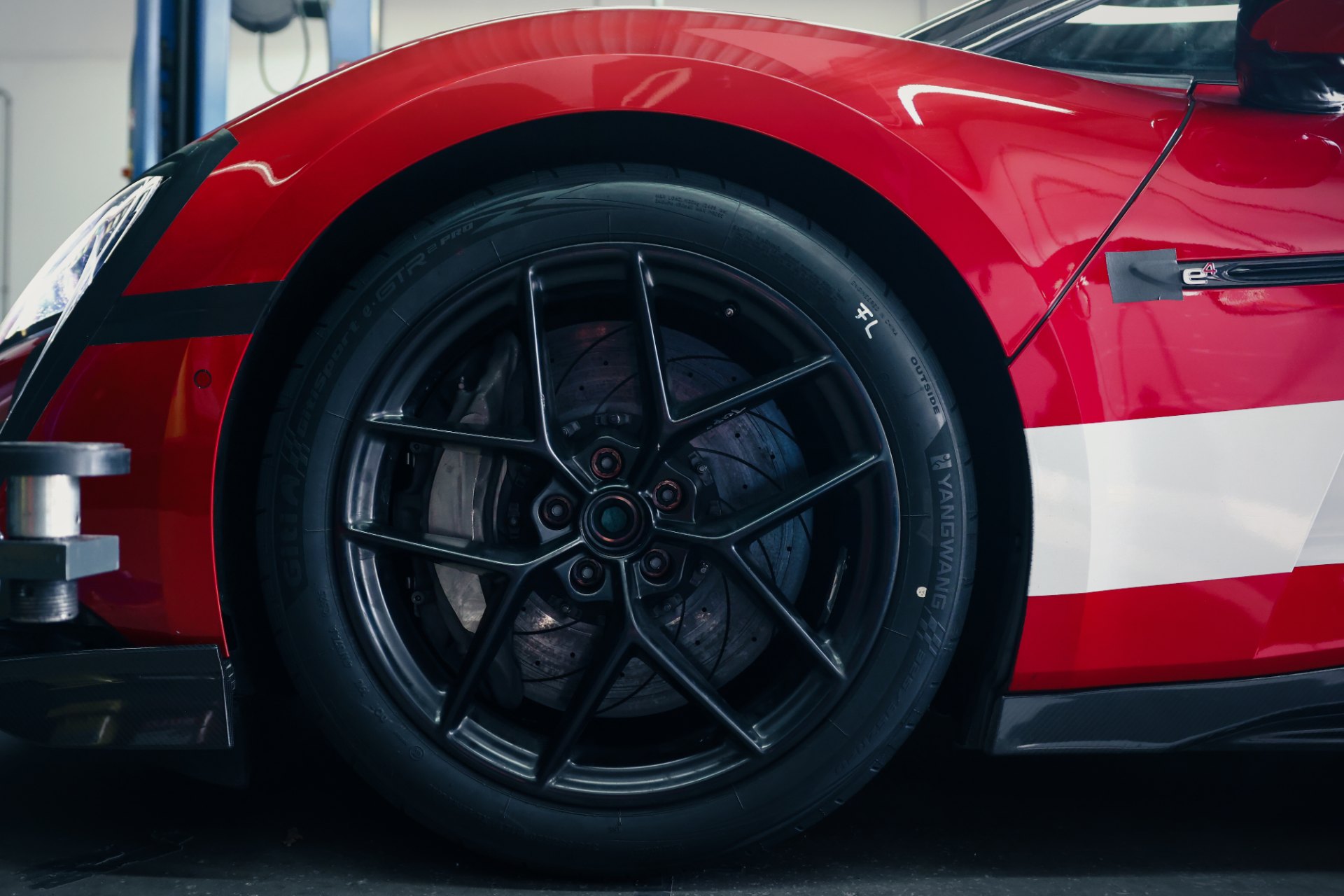
Photographs in this article show the U9 Xtreme during its September 2025 record programme at Papenburg, not the November 2026 testing accident.

The Electric Hypercar That Passed 300 MPH
In September 2025, the Yangwang U9 Xtreme reached 496.22 km/h (308.34 mph) at Germany’s Automotive Testing Papenburg facility.
The achievement was significant for two reasons.
First, it surpassed the previously publicized top-speed benchmark established by the Bugatti Chiron Super Sport 300+.
Second, it demonstrated that electric propulsion could compete at the highest levels of outright automotive speed.
The U9 Xtreme uses four electric motors producing a combined 2,220 kW, equivalent to approximately 2,977 mechanical horsepower. Each motor can operate at up to 30,000 rpm.
Its 1,200-volt electrical architecture works with an advanced lithium iron phosphate battery capable of delivering exceptionally high power.
But producing nearly 3,000 horsepower is only part of the challenge.
At speeds approaching 500 km/h, the forces acting on a vehicle become extraordinary. Aerodynamic stability, tire construction, suspension control, cooling, and the driver’s ability to make precise corrections become just as important as engine output.
The U9 Xtreme uses specially developed high-speed tires, revised aerodynamic bodywork, and an advanced active suspension system to manage those demands.
Even so, no amount of engineering can eliminate every risk involved in high-speed testing.
What the Yangwang U9 Xtreme Crash Footage Shows
The video circulated on Chinese social media before being reported by automotive publications on November 2.
It shows the U9 Xtreme leaving its intended path during a high-speed run and striking a trackside barrier.
The resulting damage is severe.
The rear assembly separates from the main structure, while substantial portions of the front and rear bodywork are destroyed.
What is especially striking is the condition of the central passenger compartment.
Despite the destruction surrounding it, the area containing the driver appears to have retained much of its overall shape.
Reports indicate the driver exited the vehicle without assistance and did not suffer serious injuries.
That is encouraging, but the available footage cannot establish precisely how the vehicle’s safety systems performed.
BYD has not publicly confirmed the crash speed, the sequence of mechanical events, or the cause of the loss of control.
There is also no verified evidence establishing whether a tire problem, aerodynamic instability, mechanical failure, or driver input contributed to the accident.
Those distinctions matter. Dramatic footage can show the consequences of an accident without explaining why it happened.

When the Passenger Compartment Becomes the Priority
One of the fundamental principles of automotive crash engineering is that the entire vehicle does not need to remain intact to protect its occupants.
In fact, controlled deformation is often essential.
Structures surrounding the passenger compartment can absorb and redirect impact energy, reducing the forces transmitted to the people inside.
The challenge becomes considerably more demanding as speed increases.
A vehicle traveling at 300 mph carries four times the kinetic energy it would possess at 150 mph, assuming the same mass.
That energy must go somewhere when the vehicle strikes an obstacle.
Crash severity also depends on the impact angle, the barrier’s construction, the vehicle’s trajectory, and the distance over which it decelerates.
A glancing collision with a barrier is fundamentally different from a direct impact that brings a vehicle to an immediate stop.
This is why the U9 Xtreme’s damaged passenger compartment deserves careful examination rather than an instant declaration that its safety systems performed perfectly.
The visible structure may have helped preserve survival space. But without detailed accident data, it is impossible to determine which components absorbed the greatest loads or how the restraints performed.
The U9’s carbon-fiber-intensive passenger structure is designed to combine rigidity with occupant protection.
The accident may eventually provide BYD’s engineers with valuable information about how that structure behaves under extreme conditions.
For now, the reported condition of the driver is the most important outcome.
The Additional Challenge of an Electric Hypercar
A high-performance electric vehicle introduces engineering considerations that differ from those of a conventional combustion-powered supercar.
The U9 Xtreme’s four-motor layout allows sophisticated control over how driving torque is distributed.
That can provide substantial benefits for traction and stability, particularly when the system is responding to changes in wheel speed and available grip.
However, electronic control cannot overcome the physical limits of a tire.
At extreme speeds, the contact patches connecting the vehicle to the road remain relatively small. The tires must withstand tremendous rotational forces while maintaining grip, resisting heat buildup, and supporting the car’s considerable mass.
Aerodynamics present another challenge.
Even relatively small changes in airflow can influence stability as speed rises. Suspension movement, ride height, and aerodynamic loading must work together rather than against one another.
Electric vehicles also carry high-voltage battery systems that require protection during a collision.
The absence of a reported battery fire following this accident is reassuring, but it does not establish the condition of the battery or prove that every electrical protection system operated as intended.
These are questions that require technical inspection, not conclusions drawn from video footage.

The Unfinished Race to 500 km/h
Before the accident became public, BYD had discussed another attempt to exceed 500 km/h, equivalent to approximately 310.7 mph.
The planned effort was expected to take place in the United Arab Emirates during November 2026.
That target is tantalizingly close to the U9 Xtreme’s existing 496.22-km/h achievement.
Yet the difference between those two numbers is not necessarily small from an engineering perspective.
Aerodynamic resistance rises sharply with speed, and the power required to overcome it increases even faster.
The final few kilometers per hour can demand considerable additional engineering development, even when a vehicle already possesses extraordinary horsepower.
It remains unclear whether the testing accident will affect BYD’s planned record attempt.
The manufacturer has not released a detailed public explanation of the incident or announced how its development schedule might change.
Beyond the Horsepower Numbers
The Yangwang U9 Xtreme has already accomplished something that would have seemed improbable not long ago.
It has demonstrated that an electric hypercar can exceed 300 mph and challenge the fastest combustion-powered road cars ever built.
But the pursuit of outright speed has always involved more than producing enough power to reach a number.
The faster a car travels, the greater the demands placed on its tires, aerodynamics, chassis, braking systems, and occupant protection.
The U9 Xtreme’s accident is a reminder of those limits.
The driver reportedly survived a crash that left the vehicle extensively damaged. That is an outcome worth recognizing without pretending that the available evidence explains exactly how it happened.
Whether BYD returns to pursue 500 km/h this month or later, the challenge remains the same.
Nearly 3,000 horsepower can carry a car beyond 300 mph.
The harder task is keeping everything under control once it gets there.