

What You Need to Know
- The Koenigsegg CCGT1 uses a 5.0-liter twin-turbo V8 making 1,280 hp on pump gasoline and 1,600 hp on E85. Production is capped at 70 cars, all of them allocated before the public reveal at Monterey Car Week in August 2026.
- It is a megacar by Koenigsegg’s own one-megawatt definition — but only on E85. On pump gas it makes roughly 954 kW and falls short of the 1,341 hp bar the company invented.
- This is not a power story. The engine outputs match the Jesko Attack exactly. What changed is aerodynamics, cooling and the driver interface: 800 kg of downforce at 250 km/h against the Jesko Attack’s 700 kg, and an optional gated six-speed manual with a clutch pedal.
Koenigsegg revealed the CCGT1 during Monterey Car Week in August 2026, and by the time the covers came off there was nothing left to sell. All 70 cars had been allocated in advance. The car is built on the CC850’s carbon monocoque — only the doors and the removable roof panel carry over unchanged — and it takes its name and its purpose from the CCGT, the GT1 racer Koenigsegg built in 2006 and 2007 and never got to race.
The specification reads like a homologation special that skipped the homologation. A 5.0-liter twin-turbo V8 with a flat-plane crank and an 8,500 rpm redline. A nine-speed Light Speed Transmission operated through a new sequential shifter or, if you order it that way, through an open gate with a clutch pedal. The largest rear wing the company has ever fitted to a road car, with 30 degrees of active travel. And a factory track package — a first for Koenigsegg — that turns the car into something close to a customer race entry.
What Koenigsegg has not published is a weight figure. That omission matters more than it looks, and we will come back to it.

Supercar, hypercar, or megacar?
The honest answer is that the CCGT1 sits in a category Koenigsegg largely built for itself, and the label depends on which measuring stick you pick up.
By any conventional reading it is a hypercar: two seats, a mid-mounted twin-turbo V8, a carbon tub, a seven-figure price and production measured in dozens. The line between supercar and hypercar stopped being a useful question about anything Koenigsegg makes somewhere around the CCR.
The megawatt test
The megacar question is more interesting, because Koenigsegg coined the term itself. When the One:1 arrived in 2014 the argument was simple — a car making one megawatt deserved its own word. One megawatt is 1,341 hp. That is the bar.
On E85 the CCGT1 makes 1,600 hp, about 1.19 MW. Megacar, comfortably. On the pump fuel most owners will actually buy it makes 1,280 hp, roughly 954 kW, and misses by a margin too wide to round away. The CCGT1 is a megacar in the same conditional way the Jesko is: the classification lives in the fuel tank, not the engine bay.
ECN’s read: none of the three labels is the useful one. The CCGT1 is a road-legal GT1 car, and that is a category with almost nothing in it. Koenigsegg says it laps faster than anything else it has built — a company claim, not an independently verified one, and worth treating as such until someone puts a timing beacon on it. But the design intent is unambiguous. This is a circuit car that happens to be registerable, not a road car with a wing bolted on.
At a Glance: Koenigsegg CCGT1
| Engine | 5.0L twin-turbo V8, aluminum, flat-plane crank, four valves per cylinder |
| Power | 1,280 hp @ 7,800 rpm (gasoline) / 1,600 hp (E85) |
| Torque | 1,000 Nm (738 lb-ft) from 2,700–6,170 rpm; 1,500 Nm (1,106 lb-ft) peak @ 5,100 rpm |
| Redline | 8,500 rpm |
| Transmission | Nine-speed Koenigsegg Light Speed Transmission; Koenigsegg Sequential Shift standard, Engage Shift System six-speed gated manual optional |
| Chassis | Carbon fiber monocoque with aluminum honeycomb; 65,000 Nm/degree |
| Body | Ghost Fibre white aramid/carbon composite |
| Downforce | 800 kg (1,764 lb) at 250 km/h (155 mph) |
| Suspension | Double wishbones front and rear, electronically adjustable dampers, active rear-wheel steering |
| Brakes | 408 mm ceramic front, six-piston; 390 mm ceramic rear, four-piston |
| Wheels / tires | 20 x 9.5 in, 275/35-20 front; 21 x 12.5 in, 335/30-21 rear, Pirelli P Zero R |
| Dimensions | 4,478 mm long, 2,058 mm wide, 1,160 mm tall; 2,700 mm wheelbase |
| Fuel capacity | 72 liters |
| Weight | TBD — not published by Koenigsegg |
| Production | 70 units, all allocated |
| Price | Not officially disclosed; reported at approximately $4 million |
The aero is the story, not the power
Put the CCGT1 next to the Jesko Attack and the engine numbers are identical: 1,280 hp on pump gas, 1,600 on E85, the same nine-speed LST. Koenigsegg did not chase a bigger headline figure here, which tells you what the project was actually about.
The difference is in the air. Koenigsegg quotes 800 kg of downforce at 250 km/h for the CCGT1. The Jesko Attack — a car sold explicitly as the track-biased Jesko — is quoted at 700 kg at the same speed. That is a 14 percent gain at a speed you genuinely see on a circuit, and it comes from a reprofiled underfloor with active flaps, a front splitter, a new diffuser and the biggest wing the company has built, hung on swan-neck mounts and swinging through 30 degrees between low-drag, high-downforce and air-brake settings.

Worth noting for context: the Jesko Attack still claims a higher maximum, 1,400 kg, because it keeps generating downforce at speeds the CCGT1 is not built to spend time at. These are cars for different jobs. The CCGT1 is optimized for the speed band where lap time is actually won.
The cooling changes are less glamorous and probably more consequential for anyone planning consecutive sessions. There is a roof scoop feeding the engine, NACA ducts cut into the bodywork, an enlarged oil cooler and — unusually — a dedicated cooling circuit for the dampers. Damper fade is the kind of problem that only appears on lap eight, and manufacturers do not engineer around it unless they expect customers to get there.
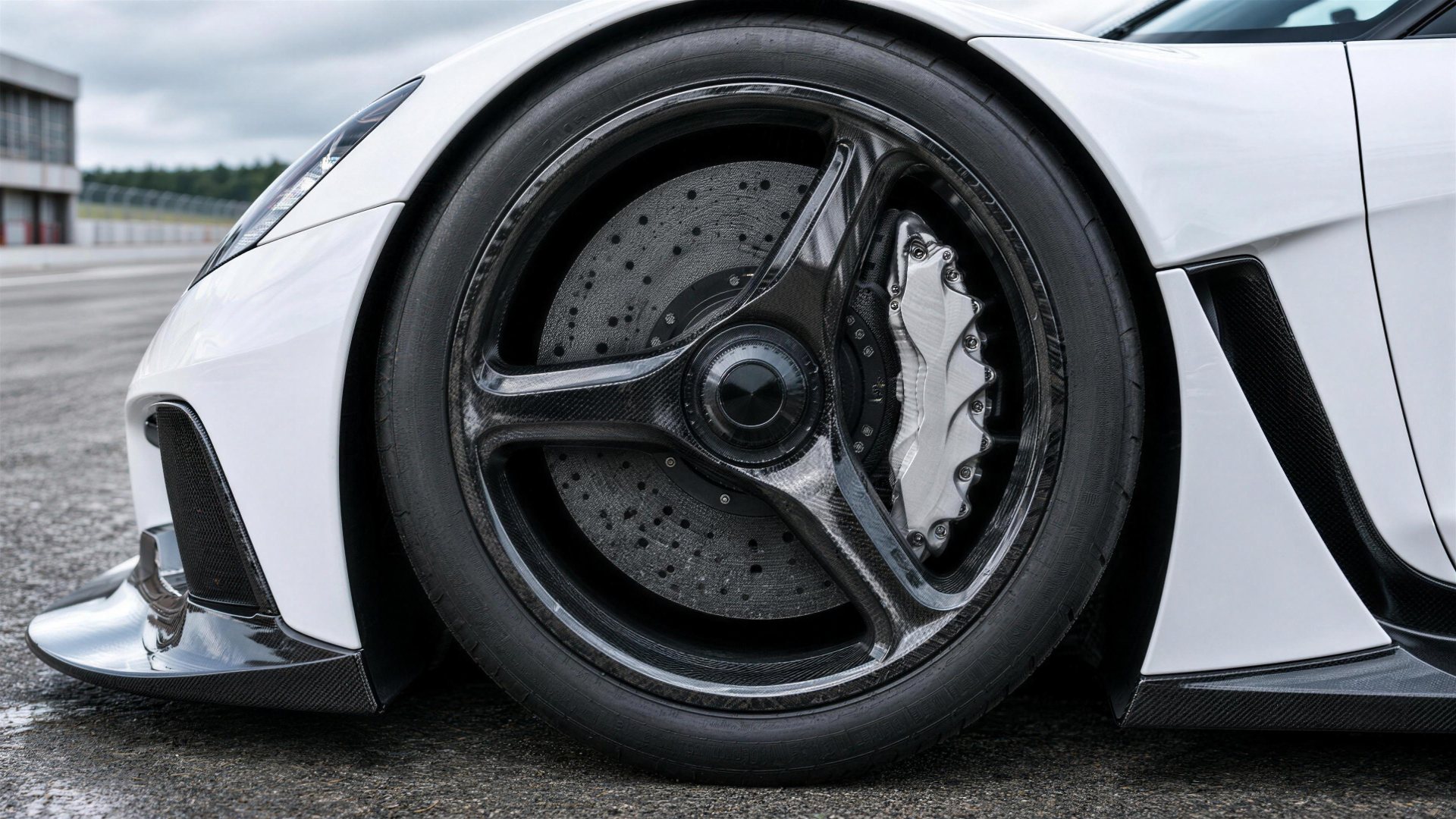
Underneath sit 408 mm ceramic discs with six-piston calipers at the front and 390 mm four-piston units at the rear, on 20-inch front and 21-inch rear wheels wearing Pirelli P Zero R rubber. Christian von Koenigsegg has said the company pushed its Aircore hollow-carbon wheel technology to its limit for the car, producing a three-spoke design that deliberately echoes period racing wheels.
A clutch pedal, in 2026
The transmission is where the CCGT1 stops behaving like a modern hypercar.
Standard fitment is the new Koenigsegg Sequential Shift, which runs the nine-speed LST through a mechanical-feeling sequential lever. There is a clutch pedal, but it is only for standing starts; once moving, the car uses ignition cuts to swap ratios. A rotary selector offers automatic, sequential, manual and reverse. The alternative is the Engage Shift System first seen on the CC850: an open-gate six-speed with a real clutch pedal, layered over the same automatic hardware.
Every direct rival went the other way. The Ferrari F80, McLaren W1, Aston Martin Valkyrie and Mercedes-AMG One are all hybrids with paddle-shifted automated gearboxes and no clutch pedal at all. Koenigsegg’s most track-focused car is the only one in the class you can row yourself, and it joins a list of manual supercars you can still buy new that gets shorter every year. In a segment that has spent a decade arguing that driver involvement and lap time are opposed, that is a position, not a nostalgia option.
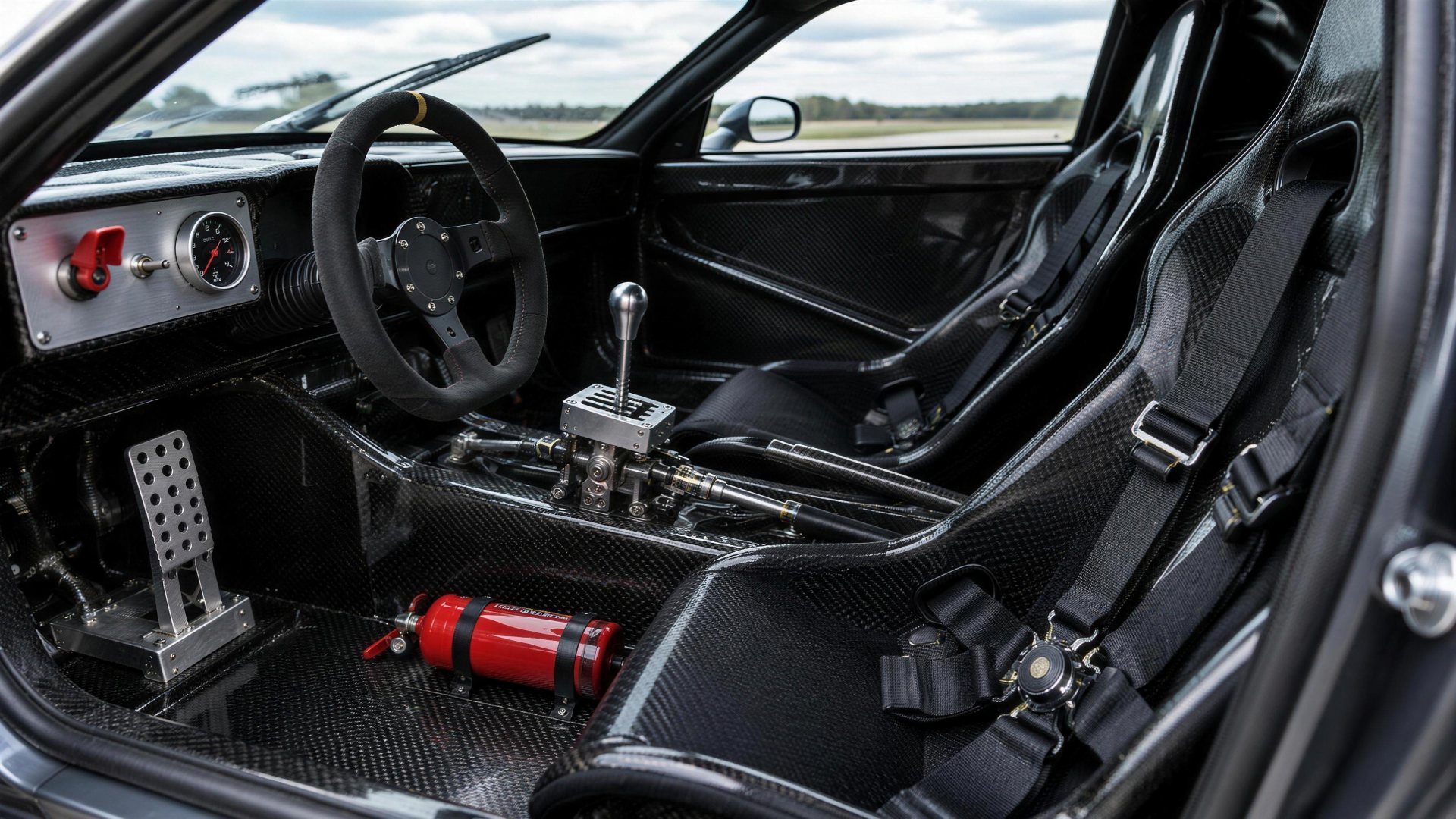
The cabin follows the same logic: exposed carbon, six-point harnesses, a toggle fuel primer, a covered ignition switch, an analog G-meter and a fire extinguisher on the floor. It reads like a car built by people who expect it to be scrutineered.
The track package is the real news for owners
Koenigsegg has never offered a factory track conversion before. The CCGT1 package adds a full carbon roll cage, HANS-compatible racing seats, a fire suppression system, a race exhaust, track-specific suspension and brake settings, additional aerodynamic parts, pneumatic air jacks and a second set of wheels on track tires. It is designed to be fitted and removed, and it comes with factory-supported track days.
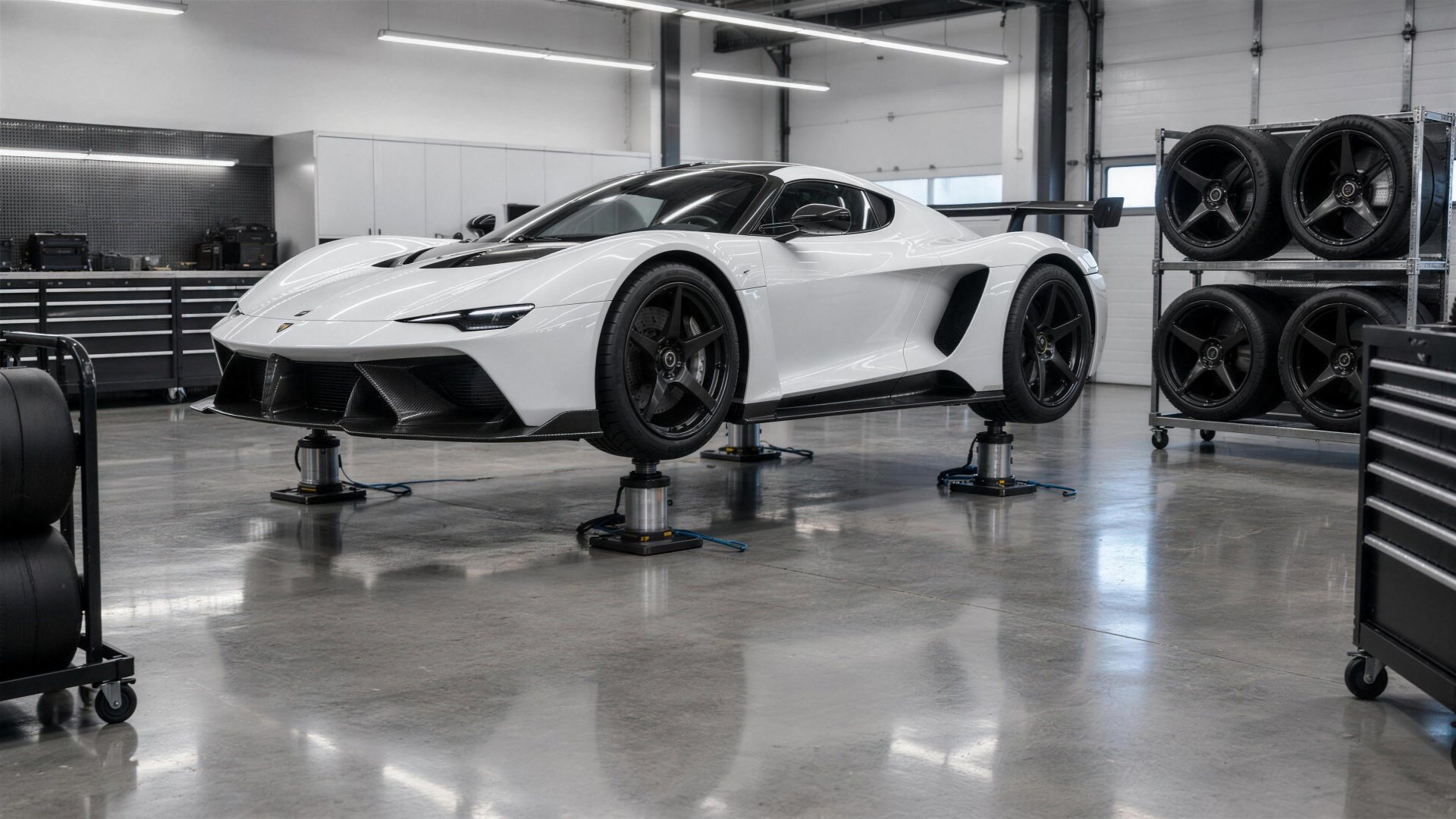
That last detail is the one that changes ownership. Air jacks and a spare set of wheels are not accessories; they are the equipment of a car that is expected to run sessions, not attend concours.
The race car that never raced
The original CCGT appeared at the 2007 Geneva Motor Show: a 5.0-liter naturally aspirated V8 making around 600 hp, weighing roughly 1,000 kg before ballast, built to contest GT1. It never made a race start. Two months into its shakedown program the FIA revised GT1’s production-volume requirements, and a manufacturer building a few dozen cars a year had no route to homologation.
That chassis was refurbished, and by Christian von Koenigsegg’s account it became the reference point for this project. “The original idea I had when I wanted to create my first car was to also prove it on a race track,” he said. “So the original CCGT was very much a skunkworks Koenigsegg project.” On the new car’s aerodynamics he noted that “the downforce numbers are really up there with the highest we’ve ever achieved” and that, unlike the 2007 car, “it’s actually active.”
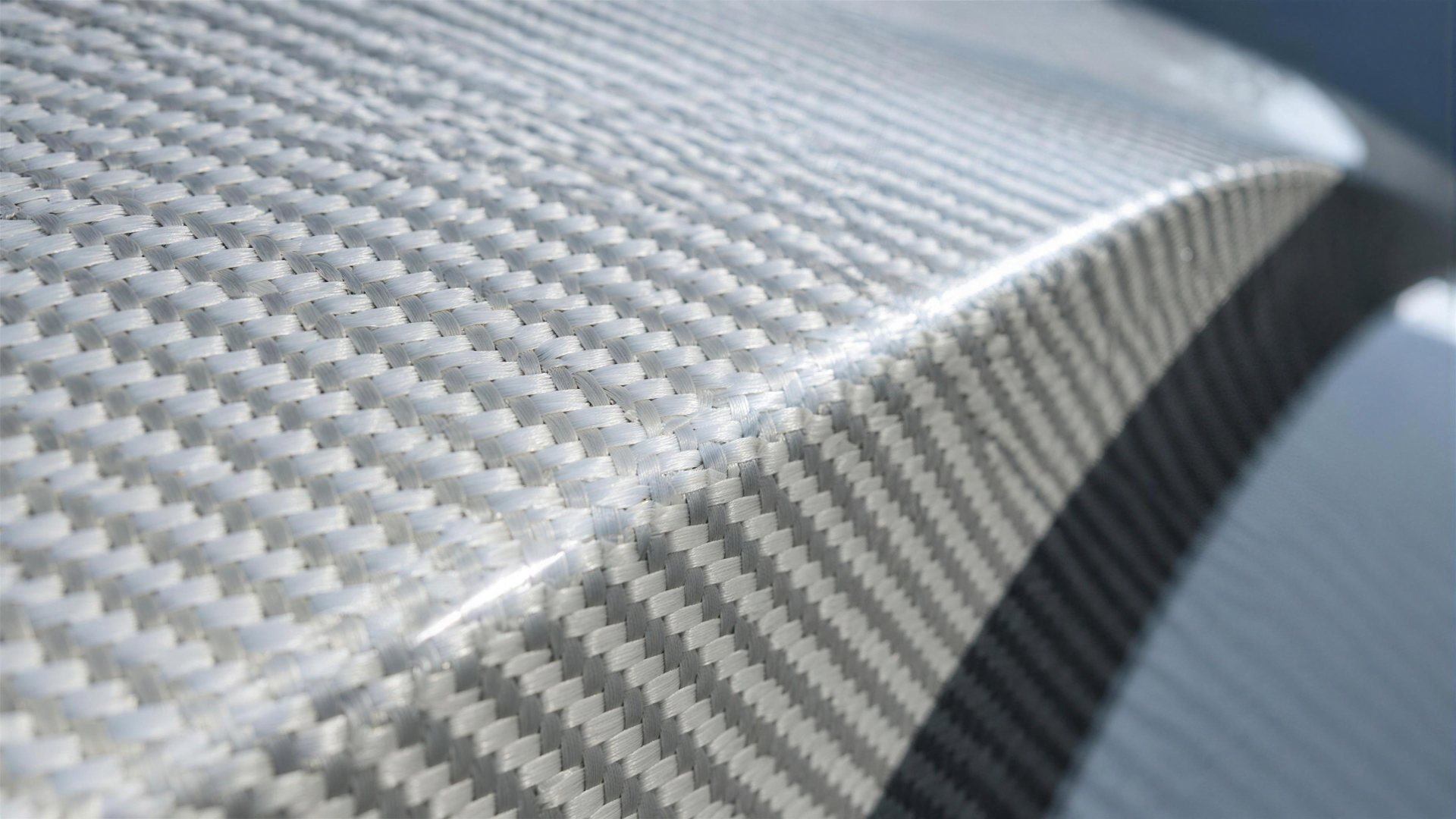
The body is where the tribute becomes literal. Ghost Fibre — a white aramid and carbon matrix Koenigsegg says adds ballistic strength and sound damping while cutting weight — gives the CCGT1 the pale, unpainted look of a car that has not yet been liveried. There is a neat symmetry in the numbers, too: Koenigsegg built 70 CC850s, and the CCGT1, which shares that car’s tub, is also capped at 70.
Does the CCGT1 have rivals?
Sort of. The problem is that the obvious comparisons all answer a slightly different question.
- Ferrari F80 — 1,183 hp from a hybrid twin-turbo V6, around 1,050 kg of downforce, 1,525 kg, 799 cars. More downforce, considerably less power, and built in more than ten times the volume. The F80 is a halo car with a production run; the CCGT1 is a specialist batch.
- McLaren W1 — 1,258 hp hybrid V8, roughly 1,000 kg of downforce, 1,399 kg, 399 cars. The best power-to-weight of the mainstream group and the sharpest of them, but again a hybrid with paddles only.
- Aston Martin Valkyrie — 1,139 hp from a naturally aspirated 6.5-liter V12 with hybrid assistance, roughly 150 coupes. Philosophically the nearest thing to the CCGT1: an uncompromised, aero-led road car with a race program behind it. It is also the only car here that has actually gone endurance racing, which cuts both ways.
- Mercedes-AMG One — 1,049 hp from an F1-derived 1.6-liter V6 hybrid, 275 units. The most extreme engineering premise in the class and the most compromised road car.
- Pagani Huayra R Evo and Gordon Murray’s T.50s Niki Lauda — arguably the truest rivals on intent, and both disqualified on the same technicality: neither is road legal. If you want the CCGT1’s exact brief minus a license plate, these are the cars.
- Koenigsegg Jesko Attack — the honest answer. The CCGT1’s nearest competitor comes from the same factory, shares its engine outputs and gearbox, and gives up 100 kg of downforce at 250 km/h. For a buyer, the choice between the two is the clearest decision in the segment.
One caution on the downforce figures above: manufacturers measure at different speeds and in different configurations, and rarely publish the methodology. Treat them as indicative of intent rather than a league table.
What Koenigsegg has not said
The missing weight figure is the one gap that keeps the CCGT1 from being fully assessable. Koenigsegg publishes monocoque rigidity to the newton-meter and engine mass to the kilogram, so the absence is a choice, not an oversight.
For scale: the CC850 that donates the tub has a 1,385 kg curb weight, and the Jesko Attack is quoted at 1,320 kg dry and 1,420 kg curb. A car carrying a larger wing, a bigger diffuser, more cooling hardware and an optional roll cage is not going to undercut either by much. That is an ECN inference, not a manufacturer figure — but until Koenigsegg publishes a number, any power-to-weight claim about the CCGT1 is arithmetic performed on a blank.
Price is similarly unofficial. Reports around the reveal put it near $4 million. Koenigsegg has not confirmed a figure, and with all 70 cars allocated it has no commercial reason to.
Why It Matters
The CCGT1 is a bet that the top of the market still wants a combustion engine and a mechanical connection to it. Every other manufacturer building a seven-figure track car in 2026 reached the opposite conclusion — that the fastest route to lap time runs through hybrid torque fill and automated shifting. Koenigsegg ran the sums, kept the V8, offered a clutch pedal, and sold all 70 cars before anyone outside the allocation list saw one.
For collectors, the interesting variable is the track package. A factory-supported, removable race conversion is unusual at this level, and cars that are actually used tend to develop a different market history than cars that are stored. Expect the split between package and non-package examples to matter at resale in a way that optional paint never does.
And there is the tidier point. Koenigsegg spent nineteen years with an unraced GT1 car in the corner of the workshop. This is the second attempt, and this time there is no sanctioning body that can change the rules underneath it.
Related ECN coverage
- Monterey Car Week 2026: Every Reveal, Record and Result
- Manual Supercars 2026: Every One You Can Actually Still Buy New
- What’s the Difference Between a Supercar and a Hypercar?
- Inside Koenigsegg’s Quiet Move Toward Wall Street
Specifications sourced from Koenigsegg’s published CCGT1 technical data, the official CCGT1 model page and the company’s Jesko Attack technical data. Rival figures are manufacturer specifications. Weight and price for the CCGT1 remain unconfirmed by Koenigsegg at the time of publication. Vehicle images accompanying this article are editorial visualizations produced by Exotic Car News, not photographs of the CCGT1.