

Michelin, Pirelli, Bridgestone and Goodyear spend years developing tires for individual supercars and hypercars. Here is what that engineering does — and what it means when it’s time to replace yours.
Michelin spent 15 months developing a single tire for the Ferrari F80. The result is a version of the Pilot Sport Cup 2 R with a new rubber mixture derived from motorsport, a twin-layer radial casing and reinforced shoulder belts. Its size was validated in virtual trials on Ferrari’s own dynamic simulator, and that simulation work cut the number of physical prototypes by roughly 20 to 30 percent. The sidewall carries Ferrari’s “K1” approval mark. And Michelin’s F80 page states something unusual for a tire maker: these tires “are specially developed for the Ferrari F80 and are not intended for other vehicles.”
That sentence sums up how the world’s most extraordinary cars are built. At this level the tire is not a commodity bolted on at the end. It is engineered alongside the suspension, aerodynamics and stability-control software, often from early in the car’s development, and it is the only part of a supercar that actually touches the road.
Why this matters when you’re the one buying tires
For an owner, the engineering behind supercar tires stops being abstract the first time the car needs new ones. Replacements for a supercar are an expensive, infrequent purchase, often in sizes few shops stock. The choice affects more than grip. It changes how the steering responds, how the car behaves near the limit, how much noise reaches the cabin, and how the car’s electronic safety systems interpret what the tires are doing.
Pirelli puts the last point plainly in its explanation of marked tires: “Control systems, like ABS, EPC and TPMS, are based on original equipment tyre characteristics.” Mercedes-Benz owner’s manuals tell drivers to “only use tyres, wheels and accessories which have been specially approved by Mercedes-Benz,” and warn that other choices can affect “handling characteristics.”
None of this means every replacement must be the exact tire the car left the factory on. It does mean the decision should start with what the car was engineered and approved to wear, and only then move to brand, price or reviews.
How a bespoke tire is born
Developing a tire for a specific car is a long process. Pirelli, whose marked-tire program began with Porsche in the 1980s, describes three phases on its marked-tire page:
- two to three months of co-design with the automaker;
- two to three years of prototype development and testing;
- two to six months of industrialization before production.
Much of that work now starts in software.
- Pagani Utopia: Pirelli says its P Zero Corsa tires were developed virtually before physical prototypes were built.
- Lamborghini Temerario: Bridgestone says its Virtual Tyre Development process eliminates around 200 physical prototypes and can cut development time by up to half.
- Bugatti Tourbillon: Bugatti says its engineers spent more than three years working in simulation before final tire validation at Michelin’s Ladoux test center in France, which followed earlier testing in Sweden and at Nardò in Italy.
What changes in a bespoke tire varies, and makers rarely publish a full comparison. The documented examples cover compound, construction, profile and tread pattern:
- Ferrari F80: new rubber mixture, casing and belts.
- Mercedes-AMG MO1 tires: MBUSA says these have “a rubber mixture and carcass structure that match the vehicle’s suspension.”
- Mercedes-AMG GT 63: Michelin says its Pilot Sport S 5 for the car “features a tailor-made compound, tyre profile and tread pattern.”
Sometimes the difference is dramatic, sometimes fine-tuning. Either way, it was developed and tested on that car.
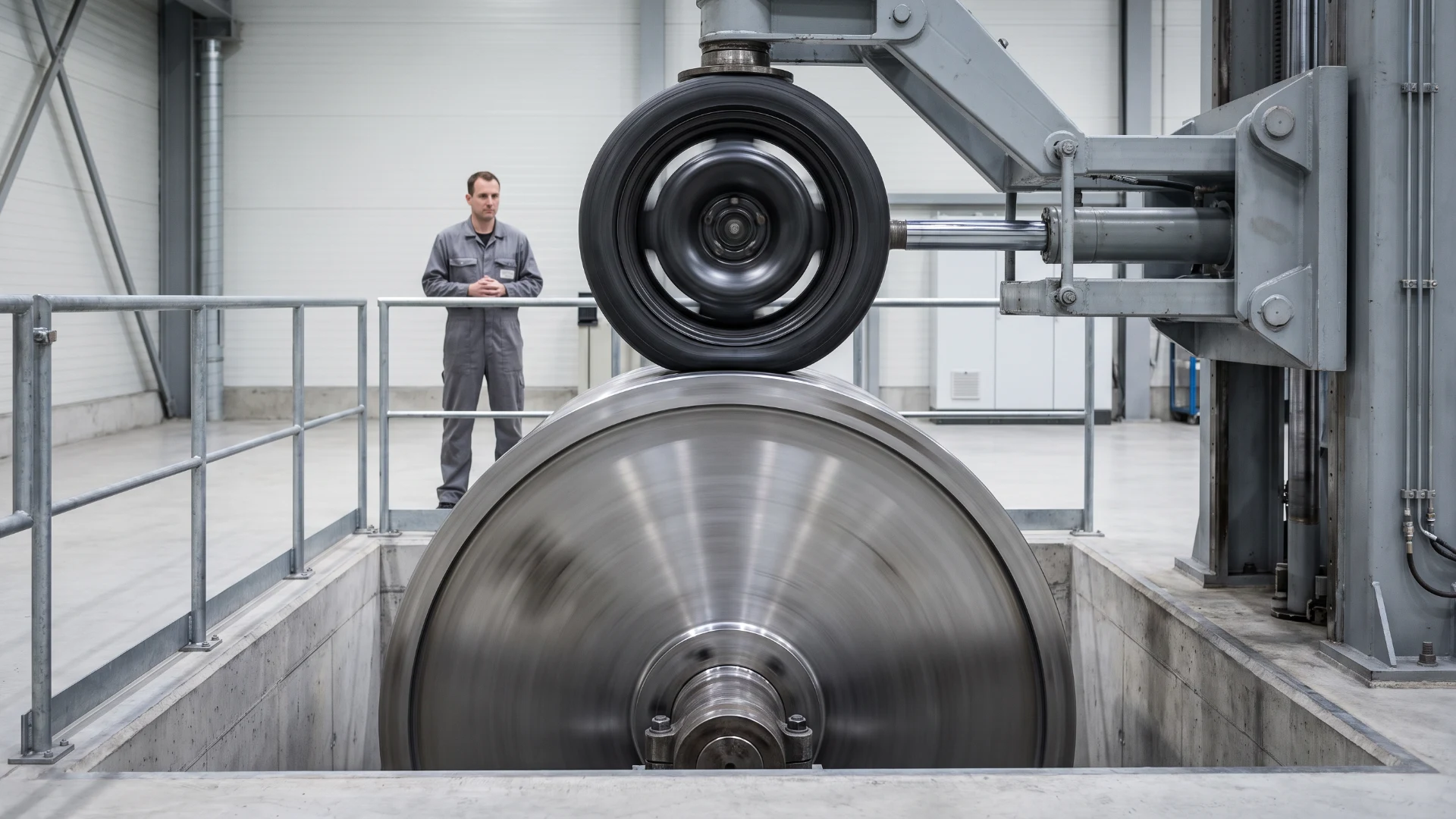
At the extreme end of the market, the testing goes well beyond normal road use. For the Bugatti Chiron, Michelin developed a BG-marked Pilot Sport Cup 2 in 285/30 R20 front and 355/25 R21 rear sizes. It was validated on a test rig originally built for Space Shuttle tires, at speeds up to 511 km/h (about 317 mph), and every tire is individually x-rayed.
The partnerships behind the world’s fastest cars
Michelin has the broadest documented hypercar portfolio we found. Beyond the Ferrari F80 and the Bugatti Chiron, Michelin says Koenigsegg has fitted its cars exclusively with Michelin high-speed tires since production began in 2002. At its launch, Koenigsegg’s Jesko came on Pilot Sport Cup 2 tires as standard. Michelin also supplies a wide range of Porsche N-marked fitments.
Pirelli calls its automaker collaborations “Perfect Fit.” Its work for Pagani is especially well documented:
- A P Zero Trofeo R for the Huayra Roadster BC that Pirelli says improved traction by up to 7 percent.
- Bespoke P Zero Corsa tires for the Utopia, in 265/35ZR21 front and 325/30ZR22 rear, plus a tailor-made winter tire.
- The Utopia was later the first car to request a specific version of Pirelli’s P Zero Trofeo RS, which Pirelli calls “the most sporting tyre in the road car range.”
For the McLaren W1, Pirelli and McLaren developed three bespoke tires: a P Zero R for everyday driving, a P Zero Trofeo RS and a P Zero Winter 2. They were tested in simulation before moving to Nardò, Spain’s Idiada proving ground and Pirelli’s winter center in Sweden.
Bridgestone is the Lamborghini Temerario’s exclusive tire partner, with bespoke tires in eight sizes across 20- and 21-inch wheels:
- a Potenza Sport road tire, also offered as a run-flat;
- a Potenza Race track tire, whose “bespoke compound” Bridgestone says was “developed for track usage and then transferred to road application”;
- a Blizzak winter tire.
Goodyear and Dunlop are best documented in this segment, in our research, for their Porsche GT work. Goodyear’s Eagle F1 SuperSport R and RS were approved for the 911 GT3 RS, and Dunlop’s Sport Maxx Race 2 was approved for the 911 GT3 in 2017.
Continental had fewer documented supercar and hypercar fitments in our research than the makers above. Its strengths in this story lie elsewhere: ultra-high-performance road tires such as the SportContact 7, and self-sealing technology, covered below. Yokohama (ADVAN) and Hankook (Ventus) also make track-capable and OE-replacement performance tires, but we found far less published supercar-specific development work from either.
Factory, approved, recommended or compatible: know the difference
Owners often treat all “OEM tires” as one category. At replacement time, the distinctions matter.
- Factory-installed (original equipment): the tire the car wore when it left the factory.
- OEM-approved (marked): a tire the automaker has tested and approved for the model, identified by a code on the sidewall. A car can have several. The Porsche 911 GT3 RS is a good example. Michelin’s Pilot Sport Cup 2 R and Goodyear’s Eagle F1 SuperSport R and RS are all N0-approved for it in the same sizes: two manufacturers and three different tires, all carrying Porsche’s mark.
- OEM-recommended: what the automaker tells owners to fit. For Porsche and Mercedes-Benz, that means their approved tires. “Only N-marked tyres are tested and approved by Porsche for their performance, handling and safety characteristics,” says Porsche’s tire page. Check your own owner’s manual for your brand’s wording.
- Technically compatible aftermarket: a tire of the correct size, load index and speed rating that the automaker has not tested on the car. It is not automatically unsafe. Many such tires are excellent, and for older or rare cars they may be the only option. But the car’s chassis and electronics were not validated on it, so it may feel and behave differently.
Michelin’s advice is to replace marked tires “with tires carrying the same approved marking whenever applicable.” Where no marked tire is available, ECN’s advice is to fit a technically compatible tire as a matched axle set at minimum, ideally all four, and to expect the car to feel somewhat different.
Reading the approval codes
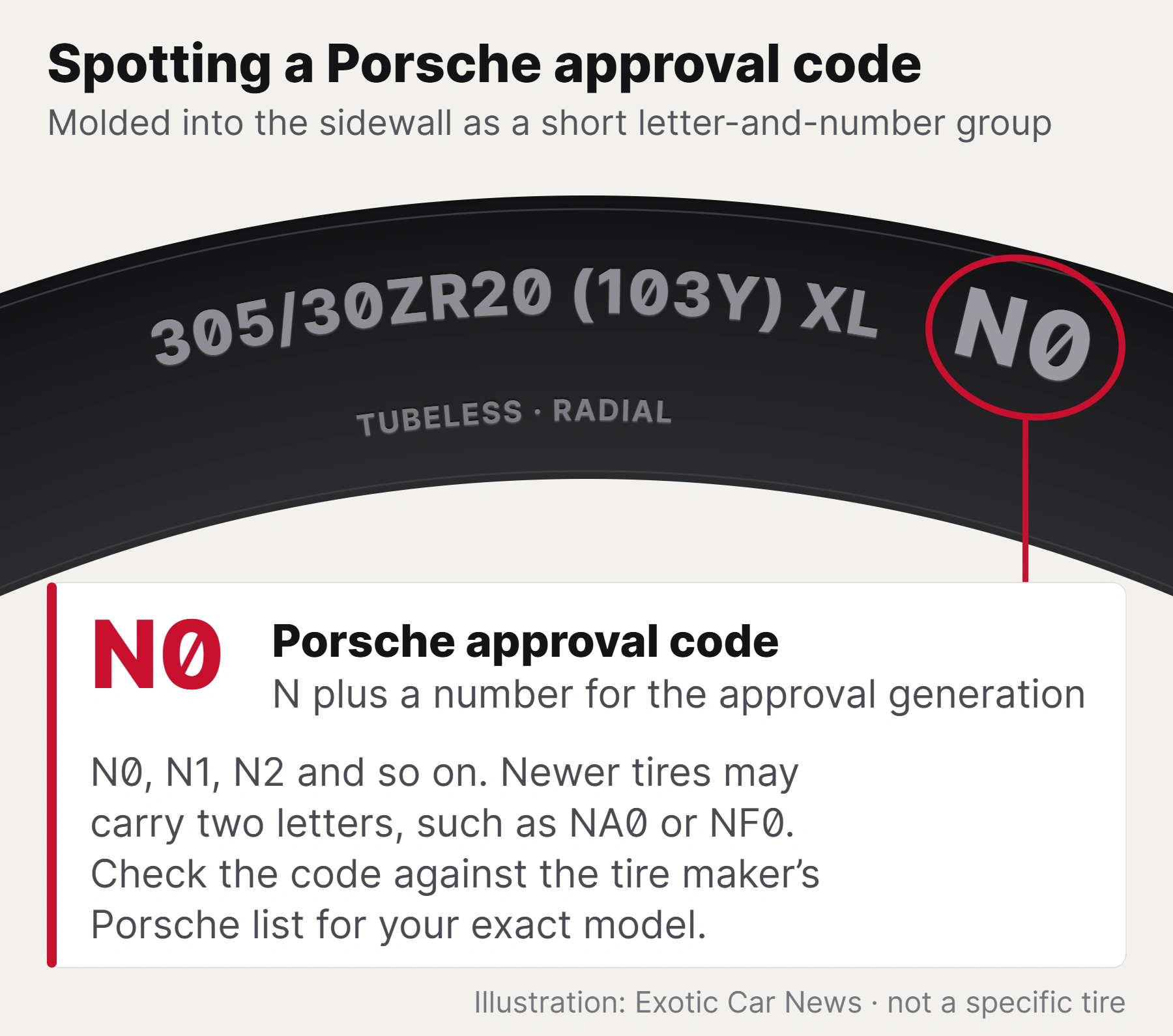
Approval codes are molded into the sidewall, usually as a short letter-and-number group. Different tire makers can use different codes for the same automaker, so check the code against the tire maker’s own list.
| Automaker & marking | What it means / documented example |
|---|---|
| Porsche N0, N1… / NA0, NF0… |
Tested and approved by Porsche. Newer codes add a second letter; the number reflects the approval generation. Check the tire maker’s list for your exact model. Example: 911 GT3 RS on N0 Michelin and Goodyear tires. |
| Ferrari F, F01–F04 (Pirelli); K1–K3 (Michelin) |
The code depends on the tire maker. Example: Ferrari F80 on Michelin Pilot Sport Cup 2 R K1. |
| Mercedes-Benz / AMG MO, MO1, MOE, MOS |
MO: developed for Mercedes models. MO1: AMG-specific. MOE: reinforced sidewalls for limited mobility after pressure loss. MOS: foam insert for noise, on select S-Class models. |
| BMW ★ |
BMW says star tires are assessed on up to 50 quality criteria. |
| Bugatti BG (Michelin) |
Example: Bugatti Chiron on Michelin Pilot Sport Cup 2. |
| Lamborghini, McLaren, Aston Martin, Pagani L/L1; MC–MC2; A- and AM-codes (Pirelli), AML (Michelin); HP |
Listed in Pirelli’s and Michelin’s marking guides. Confirm the code for your exact model with the dealer or tire maker. |
Two cautions. First, an approval code is not a quality grade. It means “validated for this car,” and a tire marked for one model may be a poor match for another. Second, model-specific rules stay model-specific. A Porsche technical bulletin for the Cayenne, for example, says to use the same make, type and specification code on each axle, and warns that a replacement tire’s tread depth should not differ from the other tire on that axle by more than 30 percent. That limit is documented for the Cayenne. Other Porsche models can list different limits, and other brands set their own rules, so check the documentation for your exact car.
Inside the tire: what the sidewall is really doing
A modern radial is a layered structure. Continental’s component guide describes the main parts:
- a textile carcass ply of rayon or polyester;
- steel belt plies beneath the tread for rigidity;
- a nylon cap ply wound around the circumference for high-speed stability;
- steel bead cores with a rubber apex that anchor the tire to the wheel.
A rim protector, where fitted, is a raised rubber rib that helps shield the wheel lip from curb scuffs. It is not a measure of impact strength.
“Sidewall strength” is really several separate qualities: ride compliance, lateral stiffness (which shapes steering response), impact resilience and puncture resistance. A stiff, low-profile sidewall can feel razor-sharp and still be vulnerable to a pothole edge. We found no tire maker that publishes comparable, controlled data on pothole or blowout resistance, so claims that one brand is “tougher” than another are anecdote, not evidence.
Load and speed ratings: what the code actually says
The GT3 RS’s rear tire, 335/30ZR21 (109Y) XL, makes a useful worked example:

- 335: section width in millimeters.
- 30: aspect ratio. The sidewall height is 30 percent of the width.
- ZR: radial construction rated for speeds above 149 mph.
- 21: wheel diameter in inches.
- 109: load index. On standard load-index tables this is 1,030 kg, about 2,270 lb, per tire at the specified pressure.
- (Y): the parentheses matter. A plain Y is rated to 186 mph (300 km/h). A Y in parentheses means the tire is rated above that. Ask the tire maker for the actual limit. Goodyear notes that ZR must appear in the size for tires rated above 186 mph.
- XL: Extra Load.
XL is widely misunderstood. Federal standard FMVSS 139 defines an extra-load tire as one “designed to operate at higher loads and higher inflation pressure than the corresponding standard tire.” The extra capacity comes only with higher pressure.
Under the industry load-inflation tables that tire makers follow, an XL tire and a standard-load tire of the same size are rated for the same load at the same pressure. The XL tire reaches its maximum load at up to 42 psi (290 kPa) in a Euro-metric size, against 36 psi (250 kPa) for a standard-load tire, as Tire Rack’s load-and-inflation guide shows. The right pressures for your car are on its door-jamb placard or in the owner’s manual, not the sidewall maximum. XL is not a pothole rating, and it does not, on its own, tell you anything about ply count, which is printed separately on the sidewall.
The practical rules:
- Never fit a tire with a lower load index or speed rating than your car’s specification.
- Use the inflation pressures on the car’s door-jamb placard or in the owner’s manual, not the maximum printed on the tire.
- Check the four-digit date code at the end of the DOT number. NHTSA explains that “0308” means the third week of 2008. The full code may appear on only one side.
Potholes: why low profiles raise the stakes
Short sidewalls leave little rubber between a pothole edge and the wheel. A sharp impact can pinch the tire against the rim and break internal cords. Michelin says a bulge or bubble on the sidewall “generally indicates damaged cords caused by a severe impact.” That tire cannot be repaired and must be replaced. Underinflation makes this damage more likely, and the same hit can bend or crack a wheel. AAA estimated U.S. drivers spent $26.5 billion on pothole-related repairs in 2021, almost $600 per repair, across all kinds of vehicles.
After a hard hit, inspect both sidewalls and the inner wheel lip, and have anything doubtful checked properly. “I hit one last year and the tire was fine” proves nothing about the next impact, at a different speed or pressure.
Noise, irregular wear and alignment
Performance tires often get louder as they wear. The usual cause is irregular wear, not age:
- Feathered tread ribs are commonly linked to toe misalignment.
- Wear on one edge points to camber and toe.
- Firestone ties cupping to worn shocks or struts, imbalance and misalignment, and notes it brings “increased noise over time, especially at highway speeds.”
Two services are often confused. A Hunter Road Force balancer presses a load roller against the spinning tire to simulate the road, and it can find tire non-uniformity and bent wheels that a conventional balancer misses. It is a diagnostic tool for vibration. It is not an alignment. If tires are wearing unevenly, ask for a four-wheel alignment and keep the before-and-after printout, so you know what was actually out of specification.
Most supercars run staggered fitments, with wider rear tires than fronts, which means tires can’t be rotated front to rear. Rears wear faster, and tire makers’ warranties reflect that. Michelin’s and Continental’s U.S. limited warranties, for example, both cut the treadwear mileage coverage in half for rear tires on staggered cars, and both require documented rotations where rotation is possible. Treadwear coverage, defect coverage and road-hazard coverage are three different things. Read which ones your tires actually carry.
Track tires, cold weather and the collector’s problem
Many supercars offer a track-focused option, and the makers are candid about what those tires are for:
- Michelin describes the Pilot Sport Cup 2 as an 80 percent track, 20 percent road tire, and the Cup 2 R as 90/10.
- Pirelli says the P Zero Trofeo R is “intended mainly for track use on dry surfaces.”
- Koenigsegg offered the Jesko’s optional Cup 2 R “for dry weather use only.”
These tires are road-legal, but on a cold, wet morning they are not the best choice.
Cold affects ordinary summer performance tires too. A GM service bulletin for its summer-tire-equipped performance models, such as the Corvette and Camaro ZL1, warns of reduced traction below about 40°F and advises against driving, moving or test-driving them below about 20°F, because the tread can crack. Store summer tires indoors through the winter.
For collectors and low-mileage owners, age is often the real limit. NHTSA notes that some vehicle and tire makers recommend replacing tires six to 10 years old regardless of tread, and that you cannot detect tire aging simply by looking. Maker guidance varies. Michelin, for example, calls for annual professional inspection after five years of service and replacement ten years after manufacture. The longer a car sits, the more this matters (see our look at why some supercars are rewarded for not being driven).
Bespoke tires also bring a supply risk. Limited production runs and discontinued fitments can leave an owner choosing between an unmarked substitute and a car that waits for stock. For concours-level cars, factory-correct tires can matter for originality as well. Confirm availability before you need tires, but don’t stockpile sets that will age out before they’re used.
No spare: plan the flat before it happens
Few supercars carry a spare wheel. The alternatives each have limits:
- Run-flat and extended-mobility tires use reinforced sidewalls to carry the car after pressure loss, and they require tire-pressure monitoring.
- Michelin and Bridgestone rate their run-flats for up to 50 miles at up to 50 mph.
- Bridgestone’s run-flat Potenza Sport for the Temerario is homologated for 80 km at up to 80 km/h.
- Mercedes’ MOE tires use the same reinforced-sidewall principle.
- Expect a firmer ride, and know that repair policies after zero-pressure running vary by maker.
- Sealant-and-compressor kits handle only small tread punctures. Continental’s kit instructions cover holes up to about 6 mm in the visible tread, limit speed to 50 mph and distance to 120 miles, and exclude other damage. No sealant fixes a sidewall cut, a structural failure or a blowout.
- Roadside assistance and recovery may come from the automaker, your insurer, a card benefit or a tire warranty. Know which you have. Check that it can send equipment suited to a low, valuable car, and read your owner’s manual’s towing instructions before you need them. Recovering a hypercar is its own specialty, as we explored in what happens when a Pagani needs a tow truck.
Whatever the setup, never keep driving on a flat conventional tire. It destroys the tire, can damage the wheel, and compromises control. U.S. rules have required TPMS on light vehicles built since September 2007, with a warning when pressure falls 25 percent below the recommended level. Treat that light as a reason to slow down and stop safely.
What’s next in tire technology?
In production: tires that talk to the car. Pirelli’s Cyber Tyre sends data from sensors in the tread to the car’s electronics. Sensor-equipped tires were first fitted as standard on the McLaren Artura, monitoring pressure and temperature for the driver. Self-sealing tires are on sale too: Continental’s ContiSeal seals tread punctures up to 5 mm, but not sidewall damage.
Early and announced applications: Pirelli and Bosch have demonstrated tire data feeding the stability-control unit on the Pagani Utopia Roadster. Aston Martin plans to use it for ESP, ABS and traction control on future models, and Pirelli has announced Cyber Tyre production in Rome, Georgia. The tire itself never changes shape; the car’s electronics use what it reports.
Prototypes and concepts: Michelin still calls its airless UPTIS a prototype. It has run only in limited delivery-van pilots, including DHL Express in Singapore and La Poste in France. It is not sold to consumers or fitted to any production car, and its once-targeted 2024 passenger-car debut has passed. Tires that physically reshape their tread for the weather, such as Goodyear’s Eagle 360 Urban, remain concepts.
Before you buy: the supercar tire checklist
- Start with the car: the door-jamb placard, the owner’s manual and the approval code on your current tires.
- Price the approved version first: the same marking (N, K, MO1, ★ and so on) in the exact size.
- If you go unmarked: match the size, meet or exceed the load index and speed rating, and fit at least a matched axle set.
- Choose the use case honestly: road, mixed or track, and the climate you actually drive in.
- Inspect the wheels: look for bends, cracks and curb damage before mounting.
- Get an alignment: a four-wheel alignment, with the before-and-after readings kept.
- Check the date code: on delivery.
- Read the warranty: staggered-fitment terms, rotation requirements and road-hazard coverage.
- Confirm availability: stock and lead times for rare sizes.
- Know your flat-tire plan: run-flat, sealant kit or recovery, and what each covers.
The tires on a modern supercar were engineered as part of the car. When you replace them, start with what the car was built and approved to wear, then decide what you are willing to change.
Images: diagram by Exotic Car News; other images are editorial illustrations, not manufacturer, press or event photography, and do not depict any specific manufacturer’s tire engineering.