

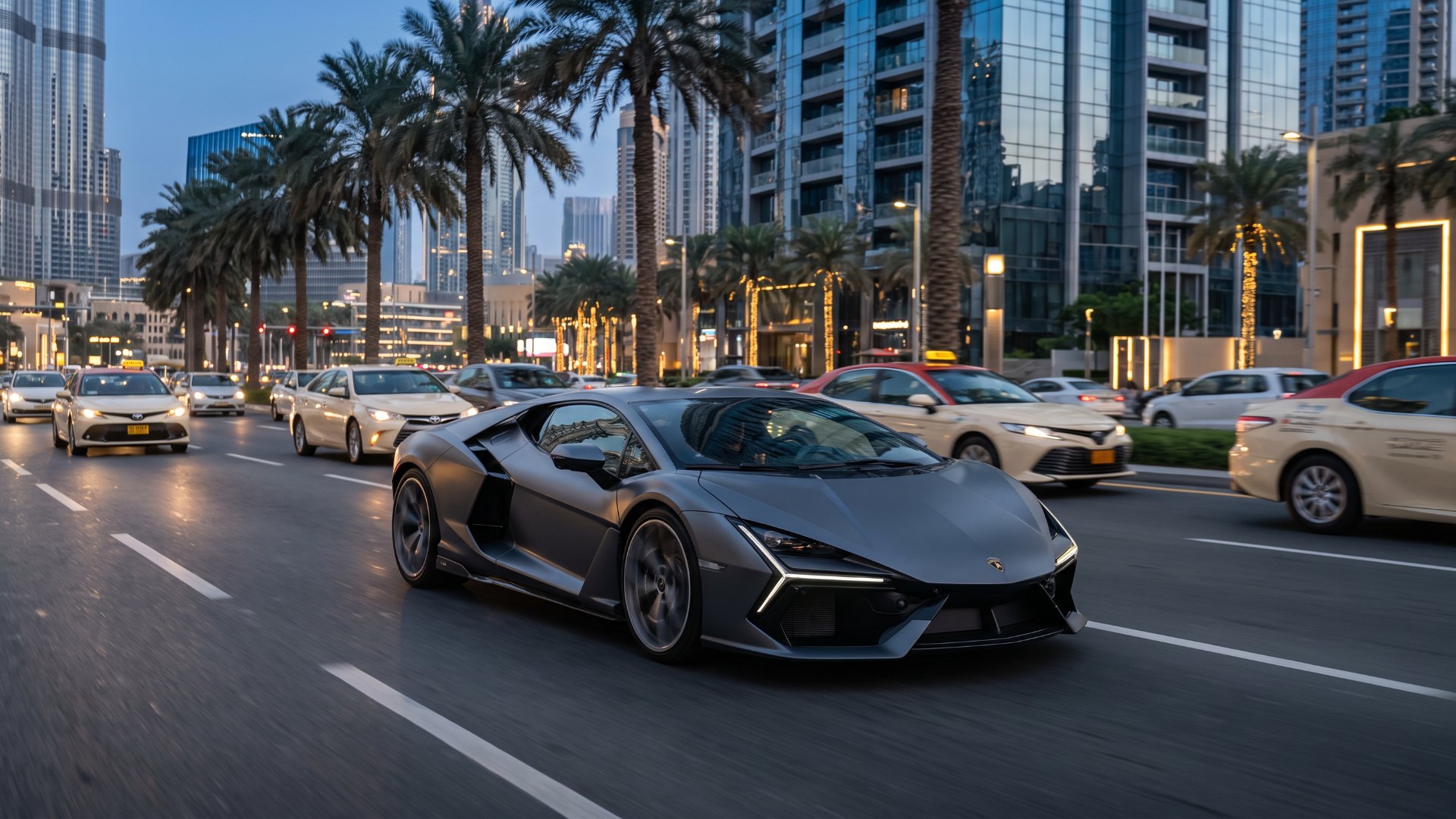
Lead image: editorial illustration, not a photograph of the Dubai Police Lamborghini Temerario.
Picture yourself in a rented Ferrari, rolling down Mohammed bin Rashid Boulevard in Downtown Dubai with the Burj Khalifa filling the windshield. A Lamborghini slides into the next lane wearing the green-and-white livery of Dubai Police.
Instinct says check the speedometer. Good instinct, but not because of the Lamborghini. That car is far more likely to be posing for photos than chasing anyone. The things that should actually concern a visiting enthusiast are quieter, and a great deal more expensive.
The Dubai Police Lamborghini Temerario: a supercar with a badge
Dubai Police has added a Lamborghini Temerario to its luxury patrol fleet, introduced in partnership with Lamborghini Abu Dhabi and Dubai, Gulf News reported on October 14. Lamborghini rates the Temerario’s 4.0-liter twin-turbocharged V8 and three electric motors at a combined 920 CV, about 907 horsepower by the U.S. measure, and quotes 0–62 mph in 2.7 seconds and a 213-mph (343 km/h) top speed.
Its job description is less dramatic. Brig. Saeed Al Hajri, who directs Dubai Police’s General Department of Criminal Investigation, called the luxury fleet “an innovative approach to policing” that pairs a visible security presence with outreach to residents and tourists. Col. Mohammad Abdulrahman Abdulwahid, head of the Tourist Police Department, said the patrols work popular destinations and busy areas where people can meet officers.
Who is Dubai’s supercar fleet actually chasing?
Dubai began putting supercars in police livery in 2013 with a Lamborghini Aventador. A Ferrari FF, a Bentley Continental GT, a Mercedes-Benz SLS AMG and an Aston Martin One-77, one of only 77 built, followed within weeks, and a Bugatti Veyron arrived that May. Since then the lineup has kept evolving: a Lamborghini Urus Performante was unveiled at the 2023 Dubai Airshow, and a Mercedes-AMG SL 55, Mercedes-AMG GT 63 and an electric EQS 580 joined on World Tourism Day 2025, according to the Government of Dubai Media Office. Not every car from those early photo calls is still in service, and we found no current published roster of the full fleet.
The purpose has been stated openly from the start. When the Aventador arrived, a senior officer said it would mostly be sent to tourist areas rather than after lawbreakers, the Associated Press reported at the time. The Media Office’s 2025 framing is the same idea, updated: luxury patrols at landmarks such as the Burj Khalifa, the Boulevard and JBR, where officers hand out directions, information and assistance.
So what does a city need a Bugatti police car for? Mostly to be seen. A two-seat hypercar with nowhere to put a suspect is not a pursuit tool; it is a rolling ambassador, and one exotic that visitors are actively encouraged to photograph up close. It is good marketing for the partners, too. The Temerario came through Lamborghini’s local dealer; the Mercedes trio came through Gargash Enterprises, the official Mercedes-Benz dealer.
Speeding in Dubai vs. speeding in America
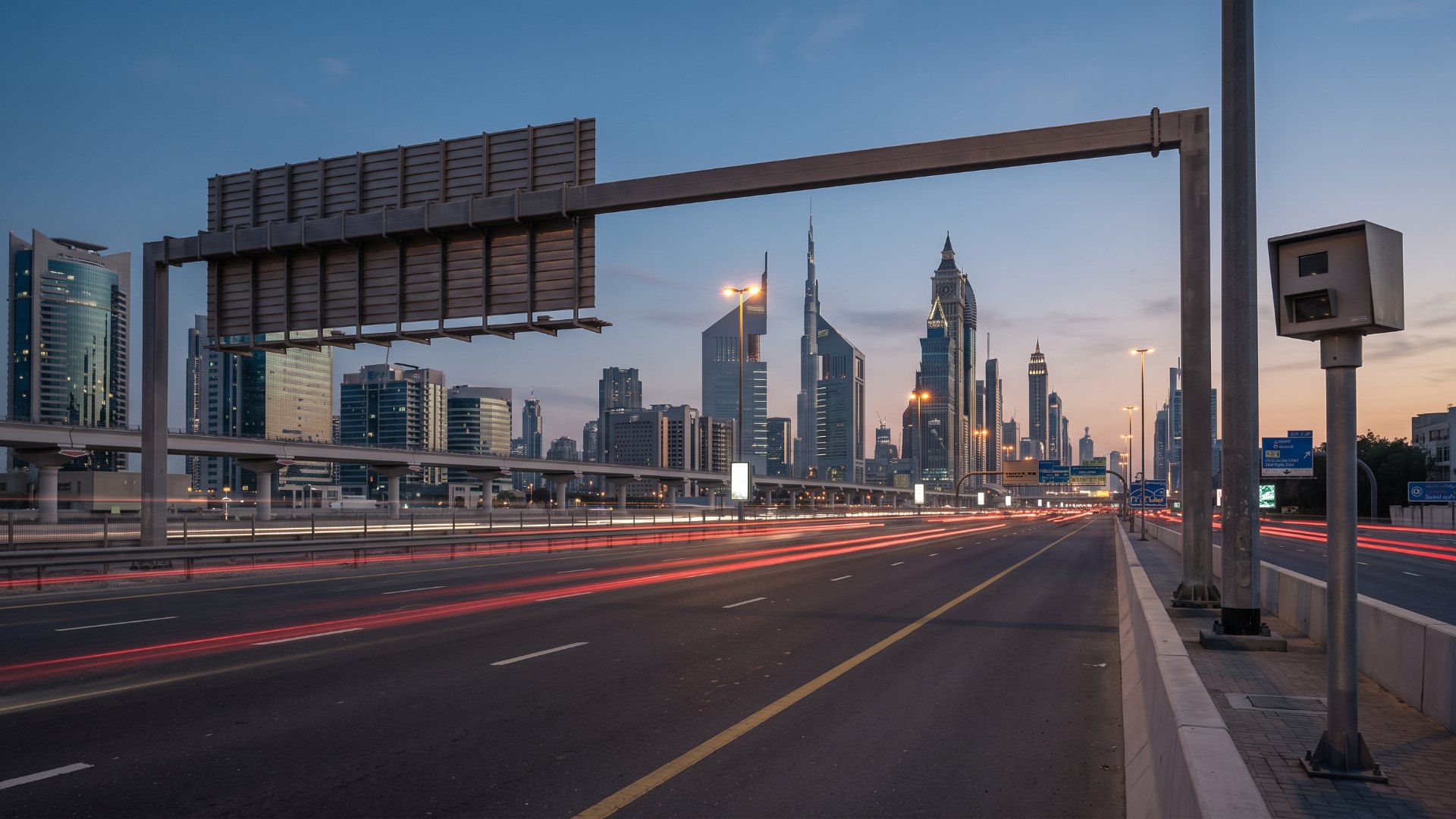
Imagine bringing your Miami or Las Vegas habits to Sheikh Zayed Road. The first difference is that enforcement is largely automatic. In March 2025, Dubai Police detailed the violations its AI-enabled radar systems record, from speeding and red lights to phone use and excessive vehicle noise, Gulf News reported.
The second is what happens at the top of the scale. Exceed the limit by more than 80 km/h (about 50 mph) and Dubai Police lists a fine of AED 3,000 (about $820), a 60-day impoundment and 23 black points. Under the UAE’s black-points system, 24 points within 12 months suspends a license. One extreme speeding violation, in other words, leaves a driver a single point from losing it.
Florida now treats the comparable act as a crime. Since July 1, 2025, driving 50 mph or more over the limit, or at 100 mph or more in a way that endangers others, has been “dangerous excessive speeding” under section 316.1922, punishable on a first conviction by up to 30 days in jail, a $500 fine or both. California still treats driving over 100 mph as an infraction under Vehicle Code 22348: a base fine of up to $500 for a first offense, and a possible license suspension of up to 30 days.
The third difference is aimed squarely at enthusiasts. Dubai’s 2023 impoundment decree allows police to impound a car that has been substantially modified to make it faster or louder, with AED 10,000 (about $2,700) required to release it. Separately, Dubai Police lists excessive vehicle noise at AED 2,000 and 12 black points. Straight-pipe owners, take note.
The number that makes Americans reread the sentence
Under Decree No. 30 of 2023, a car impounded for taking part in a road race without a police permit is released only after its owner pays AED 100,000, about $27,200. Reckless driving that endangers lives or property, running a red light and several other serious violations carry an AED 50,000 (about $13,600) release payment. Get the same car impounded again within a year and the payment doubles, capped at AED 200,000, about $54,500.
Those are not speeding tickets. When the decree took effect in July 2023, Maj. Gen. Abdullah Ali Al Ghaithi of Dubai Police stressed that the payments are the price of releasing the vehicle and sit apart from the traffic fine for the violation itself, according to the Government of Dubai Media Office. They apply only to the violations the decree lists.
American street-racing penalties are serious, but structured differently, as the comparison below shows. Neither Florida nor California attaches a fixed five-figure price tag to getting the car back.
At a glance: Dubai vs. Florida vs. California
Extreme speeding
Dubai: More than 80 km/h (about 50 mph) over the limit: AED 3,000 (about $820), 23 black points, 60-day impoundment.
Florida: 50+ mph over, or 100+ mph in a dangerous manner: criminal offense; first conviction up to 30 days in jail, a $500 fine or both.
California: Over 100 mph: infraction; base fine up to $500 and possible license suspension up to 30 days (first offense).
Unauthorized street racing
Dubai: Impoundment; AED 100,000 (about $27,200) to release the car, doubled to a maximum of AED 200,000 (about $54,500) for a repeat within a year.
Florida: First-degree misdemeanor under the state’s racing statute; $500–$2,000 fine, one-year license revocation; car may be impounded for 30 business days after an arrest.
California: Car used in a speed contest may be impounded for up to 30 days under Vehicle Code 23109.2.
Where an impounded car can wait
Dubai: Police yard, or a private location under Smart Impound for eligible cases (AED 420, about $115).
Florida and California: Typically a tow or storage yard, with towing and storage costs paid by the owner.
Sources: Dubai Police; Dubai Decree No. 30 of 2023; Fla. Stat. 316.1922 and 316.191; Cal. Veh. Code 22348 and 23109.2. Penalties depend on the circumstances of each case.
The twist: serving an impoundment in your own garage
Here is where Dubai gets genuinely unusual. Through its Smart Impound service, Dubai Police lets the owner of a vehicle due for impoundment keep it at a designated location, such as a home garage or private parking, instead of a police yard. A device linked to the force’s operations room is fitted to the car, which may be moved only in an emergency. Dubai Police lists the fee at AED 420 (about $115), plus AED 100 for each additional month, requires every fine on the owner’s traffic file to be paid first, and does not allow the car to be kept in a public area.
Move it anyway and the system notices. A senior Dubai Police traffic official has explained that the device alerts police if the car moves, after which the owner is fined and the car goes to the police yard after all, Gulf News reported.
So yes, a qualifying supercar owner could spend an impoundment with the car parked in a private garage rather than a police lot. Two caveats. Dubai Police’s public service listing does not spell out which impoundment cases qualify, so an owner facing one of the decree’s big-ticket violations should confirm eligibility rather than assume the garage is an option. And a garage-bound impoundment still means not driving the car, which for most readers of this site may be the real punishment.

Who tows a million-dollar supercar in Dubai?
If a supercar does go to the yard, someone has to load it. We found no public evidence that Dubai Police operates a dedicated supercar recovery unit, and no published police procedure specific to low-clearance exotics. Towing for impoundment is handled through contracts: Dubai’s Roads and Transport Authority, for example, has contracted Emirates Parkings to tow and impound vehicles that break federal and local rules, Arabian Business reported. Private recovery firms across the city advertise flatbed service for high-end cars, but an advertisement is not a standard.
That matters more than it sounds. A car that reaches 62 mph in under three seconds can be remarkably awkward to move at walking pace. And when the car in question is worth several million dollars, getting it onto a recovery truck becomes an engineering challenge of its own, as we explored in our look at what it takes to tow a Pagani Huayra.
Why Dubai puts supercars in uniform
An American police department that bought a Lamborghini would face pointed questions at its next budget hearing. Dubai’s fleet is built differently: new cars arrive through partnerships with local dealers, and the force presents them as tourism and community policing. The result is a police car that doubles as a landmark, parked where visitors gather, photographed constantly, and carrying a quiet reminder about the rules that apply to everyone else’s supercar.
That is the real contrast with American supercar culture. In Miami or Los Angeles, an exotic on the street is the spectacle. In Dubai, exotic cars are woven so deeply into the city’s luxury image that the government puts one in uniform.
In most American cities, spotting a Lamborghini in traffic is the event. In Dubai, the Lamborghini might be the police car, and the more important question is whether you have been following the rules.
Images in this article are editorial illustrations, not Dubai Police, manufacturer or press photography. Dollar figures are converted at the UAE dirham’s fixed rate of AED 3.6725 per U.S. dollar.