

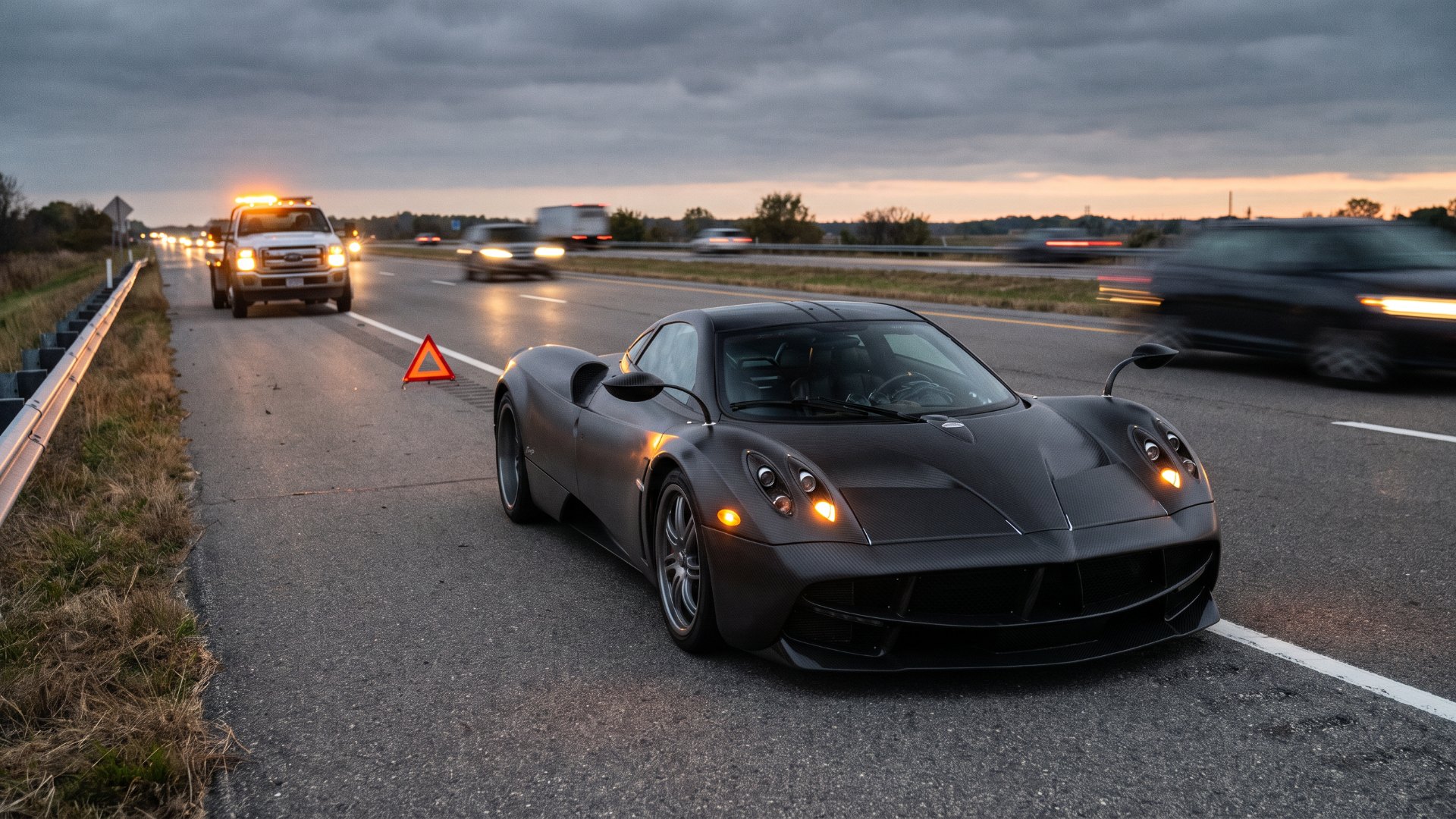
Lead image: editorial illustration, not a photograph of an actual vehicle or incident.
Picture it — hypothetically, but plausibly. A Pagani Huayra coasts onto the shoulder of an American interstate. The twin-turbo V12 has gone quiet, and the driver stands beside one of only 100 Huayra coupés ever built, watching tractor-trailers thunder past. Roadside assistance is on the way.
Then comes the question nobody asks about an ordinary car: how, exactly, do you tow a Pagani?
The $3 million in the headline is not hyperbole. In April 2026, a 2016 Huayra coupé showing about 2,300 miles sold for $3.19 million at Barrett-Jackson’s Palm Beach auction, the highest result in that sale’s history. Not every Huayra would bring that figure, but it is a fair measure of what is sitting on the shoulder.
Why it’s so hard to tow a Pagani
Start with the shape. Pagani’s specifications put the coupé at 1,169 mm (46 inches) tall and 1,350 kg (about 2,976 lb) dry, and Horacio Pagani describes the whole car as a wing, with active front suspension and four flaps trimming drag and downforce. That elegance lives close to the pavement, and the long front overhang is where recovery trouble starts.
A conventional rollback tilts its bed into a ramp. An angle a pickup never notices can drive a low splitter into the deck edge before the front wheels begin to climb. Hagerty’s guide to transporting collector cars warns that ramp angles can be too steep for low-clearance cars, lists modern spoilers among the parts at risk, and notes that wet ramps and torque-rich cars on performance tires make a dangerous combination.
Some Huayras were ordered with a front vehicle lifting system — Bonhams listed one among the options on a 2016 UK-delivered coupé — but not every car has it, and any system that depends on power may not help a car that has none.
The equipment that actually matters
Before anyone can tow a Pagani properly, it helps to separate two jobs that are often blurred together.
Emergency recovery gets the car off the roadside safely. The baseline is a flatbed, not a wheel-lift that hoists one axle and drags the other; specialist operators reduce the loading angle with low-angle beds or ramp extensions and secure the car through its wheels. Some roadside plans put this in writing: Hagerty Drivers Club, for example, guarantees flatbed towing with soft nylon straps for members, with up to 100 miles of towing per incident at the time of publication.
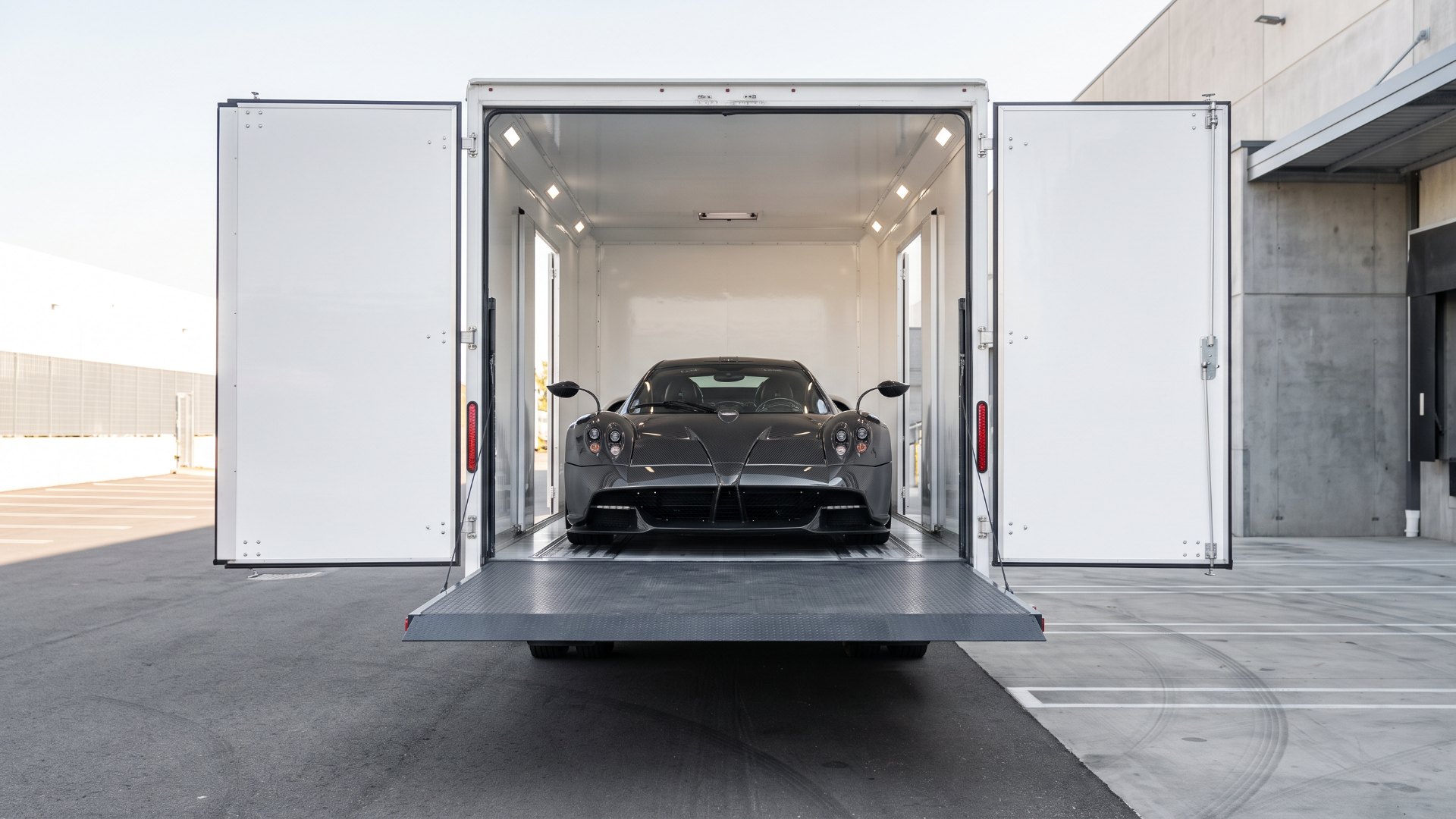
Transportation moves the car between cities, and the standard is higher. Hagerty says vehicles with limited ground clearance should always travel on a liftgate-equipped enclosed trailer, which raises the car level like an elevator instead of asking it to climb. It also cautions that “enclosed” does not guarantee a liftgate: soft-sided trailers typically load by ramp, just like open haulers. Intercity Lines, an enclosed carrier, says its nylon straps touch only the tires, never chains hooked beneath the car.
Wheel dollies, skates and winches are situational, not universal. Whether a Huayra needs them depends on whether it can still roll.
When the hypercar cannot move
A dead battery, electrical fault, damaged suspension or seized wheel turns a loading job into a recovery job. The Huayra complicates that further. Pagani lists its gearbox as a transverse seven-speed sequential unit with an AMT robotized system — there is no clutch pedal and no conventional automatic “Park” lever to override.
As of October 2026, we found no publicly available Pagani procedure for putting a Huayra in neutral without power, jump-starting it or locating approved recovery points. A 2016 example shown in a walk-through video, as HotCars reported, keeps a tow hook in a door compartment, but where it attaches and what load it can carry belong in the owner’s documentation, not a roadside guess. Get those answers from Pagani’s authorized service network before they are needed. Hagerty adds that most open trailers have no winch, so agree in writing on any fee for loading an inoperable car.
The financial risk of getting it wrong
On a 100-car production run, carbon-fiber bodywork is not a parts-counter item, and Pagani does not publish replacement-part prices. (For how repairs play out on the rarest cars, see what happens when you crash a one-of-one supercar.) The more useful question is who pays.
Hagerty explains that a carrier is generally liable only for its own negligence, that the bill of lading governs how a claim is handled, and that owners should never sign a waiver releasing a carrier from its own carelessness. Its guidance suggests looking for liability limits of at least $100,000 per vehicle for enclosed transport, with the option to buy more. That benchmark dates to 2007; against a $3.19 million car it covers roughly 3% of the value. Agreed-value collector insurance, confirmed before the car moves, is what closes that gap.
The problem doesn’t end at the flatbed
In a December 2025 statement, Pagani said only its official dealers, Pagani S.p.A. and Pagani Automobili America Inc. are authorized to provide after-sales service, and directed owners to its dealer and service network. Break down hours from one of those locations, and the realistic plan is a short flatbed run to secure storage, followed by enclosed transport. Hagerty notes that carriers quote pickup windows of several days and may charge more for guaranteed dates.
The practical takeaway
- Before a breakdown: keep your owner’s documentation on recovery handy, know where the towing eye, battery access and any nose-lift control are, and identify your nearest authorized service point and a liftgate-equipped enclosed carrier.
- Read your roadside plan: confirm guaranteed flatbed service, soft straps and the towing-distance limit.
- At the roadside: insist on tire-only soft straps, photograph the car before loading and stop any operator who reaches for chains.
- For transport: check the carrier’s operating authority and insurance on the FMCSA SAFER system, read the liability limit on the bill of lading and inspect the car in good light on delivery.
The other side of hypercar ownership
The Huayra was engineered to manage air at speeds most drivers will never see. Yet its most delicate moment may come at walking pace, on a sloped steel deck, in the hands of a stranger with a strap. The best hypercar owners plan for that moment long before it arrives.
Images in this article are editorial illustrations, not manufacturer, press or event photography, and do not depict an actual vehicle or incident.