
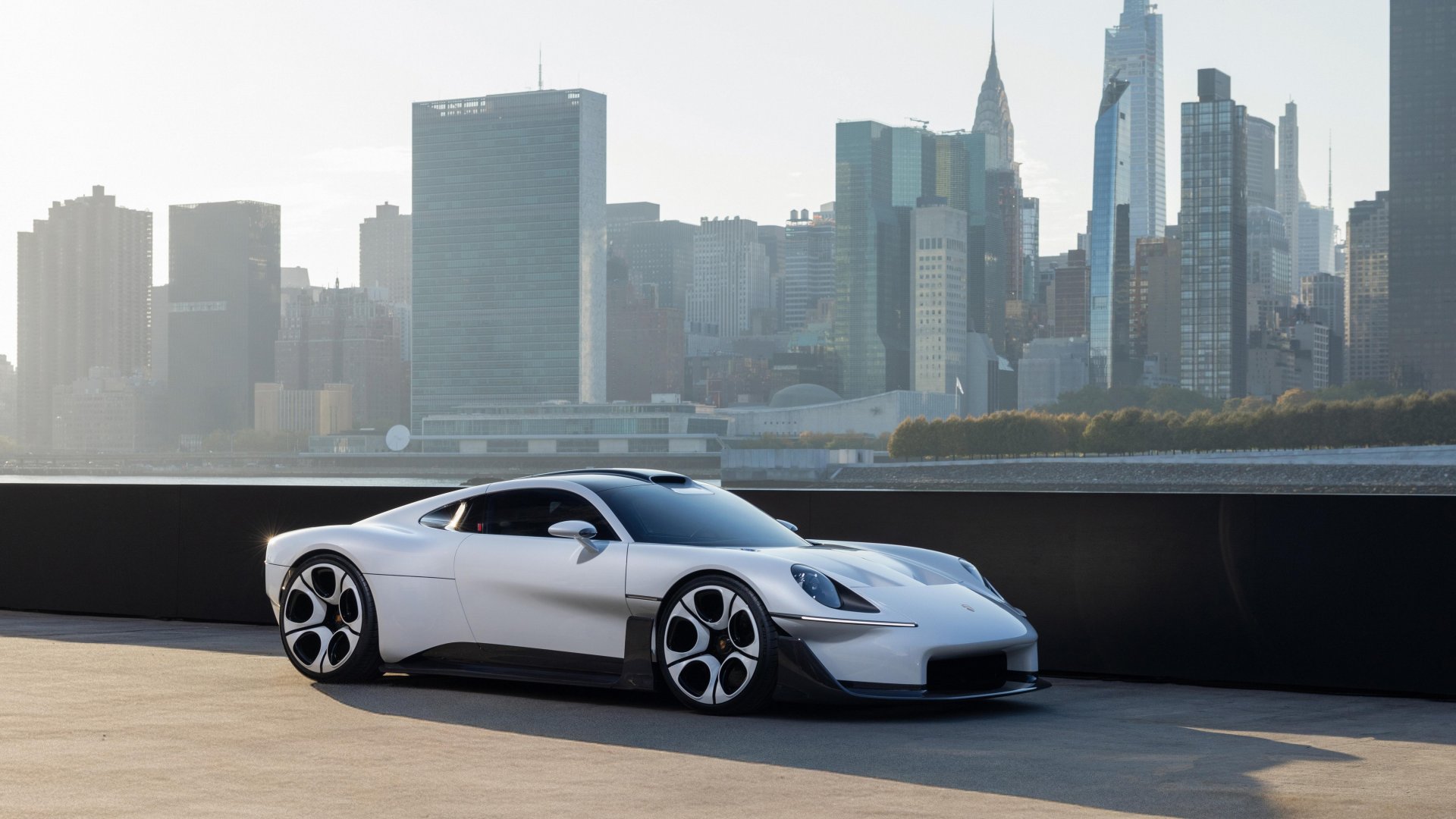
Porsche’s new vision model isn’t a one-off hypercar. It previews a permanent super sports car line above the 911, and that is a much harder thing to get right.
For six decades the 911 has done something no other sports car has managed. It is Porsche’s way in, its everyday hero and its ultimate statement, all at once. A 911 Carrera and a 911 GT3 RS share a silhouette and a name, and that continuity is the most valuable thing Porsche owns. Anything placed above it has to answer an awkward question: what can a Porsche be that a 911 isn’t?
On October 15, Porsche gave its first answer. The Porsche Mission S, revealed on a Queens pier with the Manhattan skyline behind it, is what the company calls a “vision model” for a new mid-engined super sports car platform positioned above the 911. Porsche has not disclosed an engine, an output figure, a price or a launch date. What it did disclose matters more. CEO Michael Leiters describes the coming car “not as a one-off hypercar, but as a permanent and versatile addition to our customer offering.”
That sentence changes the story. Porsche has built supercars before: the 959, the Carrera GT, the 918 Spyder. It has never kept selling one.
What Porsche confirmed, and what it didn’t
Confirmed by Porsche: A show car previewing a permanent mid-engined super sports car line above the 911, with five round instruments, no fixed central screen, a height-adjustable gear lever and a red “On your own” button.
Said at the reveal and in interviews (not specifications): Leiters has said the platform can take combustion, hybrid or plug-in hybrid power but not a fully electric one, and could accept a manual or an automatic gearbox.
Not disclosed: Production engine, power, performance, weight, transmission, price, timing and volume.
A design built from Porsche’s own archive
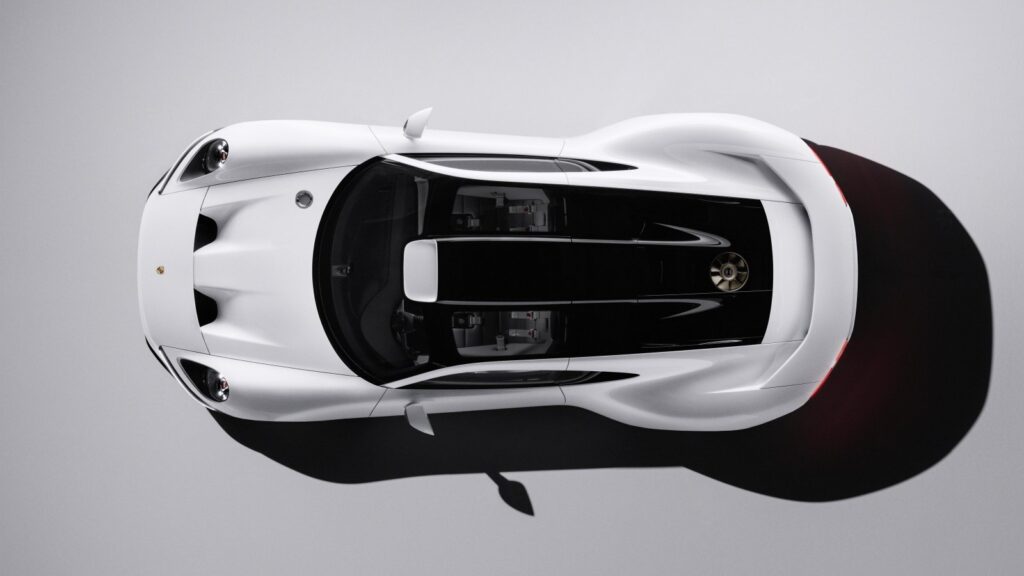
In Porsche’s photos, the Mission S looks lower and wider than its 911-like face suggests. Round headlights sit above a flat nose, torpedo fenders rise over the front wheels, and a long tail wraps around the engine. Pale bodywork rides above a continuous line from headlights to taillights, with darker technical surfaces below, so the body seems to float over the mechanicals. Design chief Tobias Sühlmann told Auto Express that is deliberate: “I also like openness on these kind of cars, so you see the technical details.”
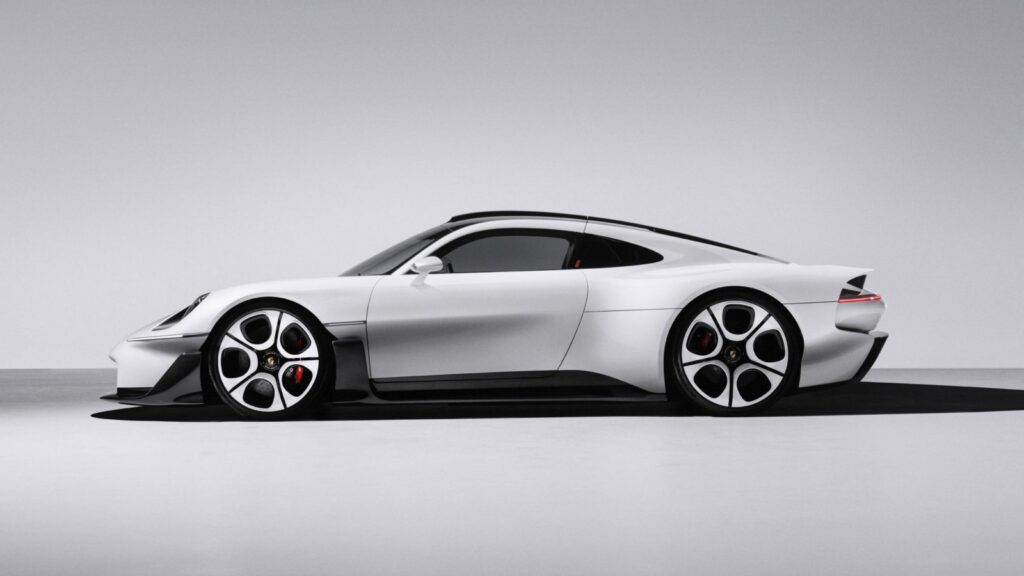
The references are Porsche’s own, and they tell a story rather than fill a checklist. The flat nose and “car-in-car” rear come from the 911 GT1, the mid-engined racer that wore a 911 face and won Le Mans outright in 1998. The roofline running beneath the fully integrated active rear wing recalls the 959, the 1980s technology flagship with a 450-hp twin-turbo flat-six, electronically controlled all-wheel drive and a 196-mph top speed. Shut lines flow into the lights like a G-model 911’s, and the wheels rework the 928’s dial design.
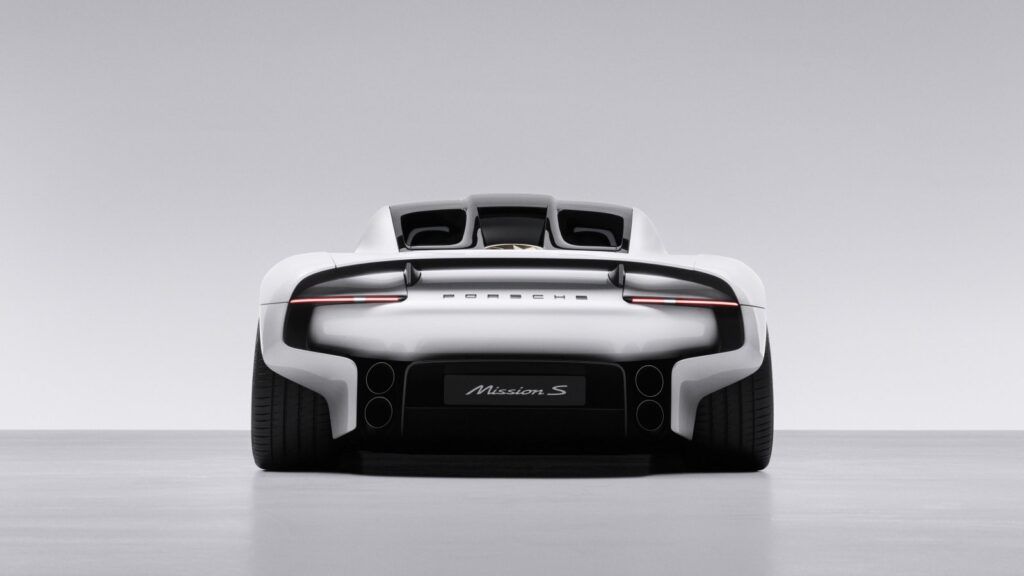
The boldest detail is at the back: a visible, lightweight fan wheel that Porsche says helps cool the car. It quotes the 917, whose air-cooled flat-twelve breathed through a large horizontal fan mounted on top of the engine, and a 917 KH gave Porsche its first overall Le Mans win in 1970. Whether the fan survives into production is anyone’s guess.
One omission is telling. In its design story, Porsche does not mention the Carrera GT or the 918 Spyder. It reaches past its last two flagships to its racing cars and to the 911’s own lineage. In our reading, that frames the Mission S as part of the 911’s family tree rather than as the next collectible hypercar, and it fits the company’s own language about permanence.
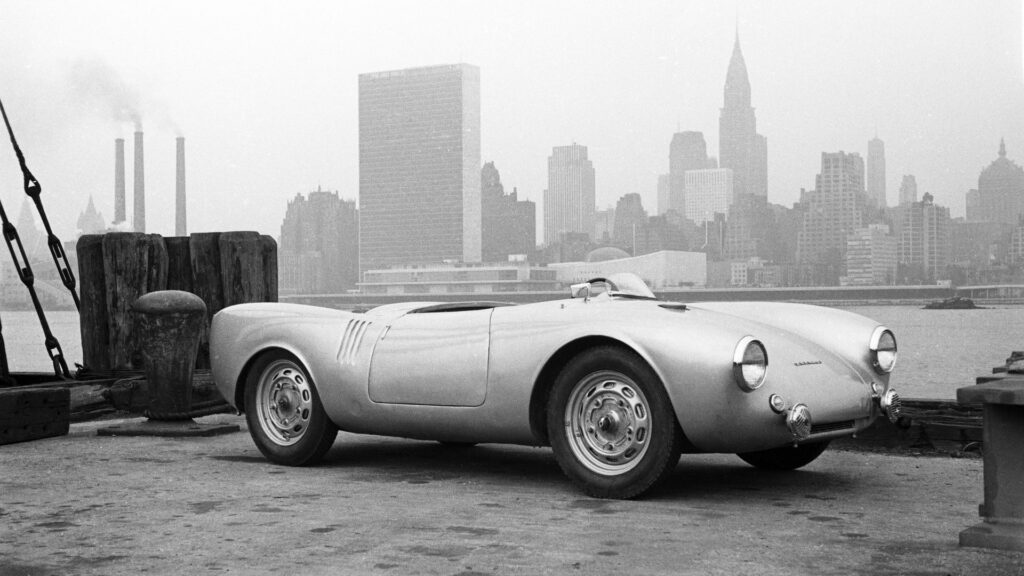
From Mission X to Mission S: a change of mind
Porsche’s last two flagships each made one argument. The Carrera GT, with its 612-hp naturally aspirated V10, carbon tub and six-speed manual, was racing hardware with few filters; 1,270 were built. The 918 Spyder, limited to 918 cars, paired a V8 with two electric motors for 887 hp and showed that electrification could make a Porsche faster.
The 2023 Mission X pushed further: an all-electric concept sharing the Carrera GT and 918’s 2.73-meter wheelbase, with performance targets tied to a production decision Porsche never made.
The Mission S keeps the ambition and drops the battery-only premise. Leiters told Auto Express the new platform can take pure combustion, hybrid and plug-in hybrid powertrains: “There won’t be a BEV on that platform: there is no demand.” R&D chief Michael Steiner described options from “a very pure, lightweight” combustion car to “performance hybridisation.” The Mission X was always a study, not a failure. But in three years Porsche’s flagship thinking has moved from an electric hypercar concept to a combustion-based platform, and Leiters frames that as listening to customers.
The bigger shift is commercial. A limited halo car sells out once and then goes quiet; Porsche has had nothing above the 911 since 918 production ended in 2015. A permanent line has to win new buyers every year, survive comparison tests and hold its value without the help of artificial scarcity.
The real rivals
Its rivals already work this way. Ferrari’s 849 Testarossa, a plug-in hybrid V8, replaced the SF90 Stradale at the top of its range; Lamborghini’s hybrid V8 Temerario succeeded the Huracán; and McLaren’s 750S is due to end production in 2027. Porsche hasn’t priced the Mission S. Car and Driver estimates a starting price around $500,000, which would put a production version between the Temerario and the 849 Testarossa. Leiters knows this territory from inside, as Ferrari’s former chief technology officer and McLaren Automotive’s former CEO.
Raw performance won’t settle the contest; every serious rival has more than enough. What matters is identity, community and personalization, the territory where Ferrari has built its real advantage.
Porsche brings a Le Mans record no rival matches, a new Home of Sports Cars division combining Manthey, Sonderwunsch personalization and Porsche Heritage, and a reputation for performance cars owners actually use. In our view, a super sports car buyers can genuinely live with, rather than merely store, could be its most credible point of difference, though Porsche hasn’t said that is its aim. The risk is asking customers to spend supercar money on a badge many still associate with the 911.
A cockpit built for the driver
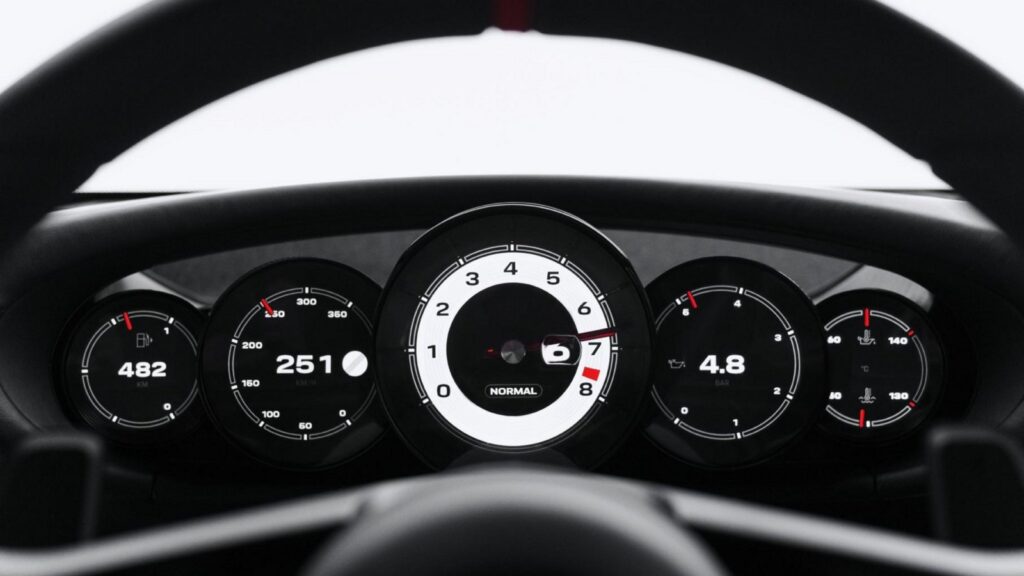
The interior speaks most directly to drivers. An aluminum key sits left of the steering wheel. Five round instruments frame a central rev counter with a physical needle that moves toward the driver in sportier modes; “the rev counter comes to you,” as Sühlmann put it. There is no fixed central or passenger screen, just a retractable MagSafe holder for the owner’s phone and push-pull controls on the dash.
Two details on Porsche’s Mission S model page say even more. A red button on the steering wheel engages a mode called “On your own,” which switches off the driver assistance systems. And the gear lever is height-adjustable, designed to be tactile. Neither feature is confirmed for production. At the reveal, Leiters said the platform could take either a manual or a PDK-style automatic, according to Road & Track, adding: “Customer demand will define what we build on this platform.” Anyone following the fight to keep naturally aspirated manual 911s alive will be watching.
The screenless cabin has ownership logic too. Fixed screens date a car faster than almost anything, while gauges and a phone holder age well, because the phone keeps updating itself. For a model meant to be kept for decades, that is a sensible bet.
It also exposes a tension. Limited-run supercars tend to become garage assets, where every mile can feel like a withdrawal from the investment. A permanent line could ease that pressure and put more of these cars on the road, though that is our reading rather than a certainty. And Porsche’s plan to increase personalization sales sixfold points toward one-of-a-kind cars that owners guard more closely, not less.
Value over volume, in car form
The Mission S is the most visible part of Sportwagenschmiede ’35, the strategy Porsche presented on October 7 under the banner “Value over Volume.” A super sports car is that principle in its purest form: few units, high prices and a halo over the whole showroom.
But a permanent line also needs the discipline of a volume product, a platform that can be amortized, updated and stretched into variants. That is why Porsche keeps saying “platform” rather than “car,” and why it extends a familiar bargain in which the practical models help pay for the impractical ones.
What Porsche has to get right
Porsche has shown the shape and the intent. It still owes the essentials: the engine, the gearbox, the price and the timeline. Leiters set his own test in Porsche’s reveal announcement, saying a Porsche must be recognizable as a Porsche at first glance. On design, the Mission S passes.
The harder tests come later. The production car has to be driven rather than stored. It has to be strong enough on its own terms that nobody calls it a 911 with ambitions. And it has to leave the 911 exactly where it is, as the car that Porsche protects above all else. A new Porsche can sit above the 911 without replacing it, as long as the 911 remains the car people dream about first.
The 959, the Carrera GT and the 918 were moments. The Mission S is asking for something harder: permanence. Porsche is no longer asking whether it can build a supercar. It is asking whether it can keep building one.
Photos: Porsche AG. The Mission S is a show car. Porsche has not announced specifications, pricing or timing for a production model.