

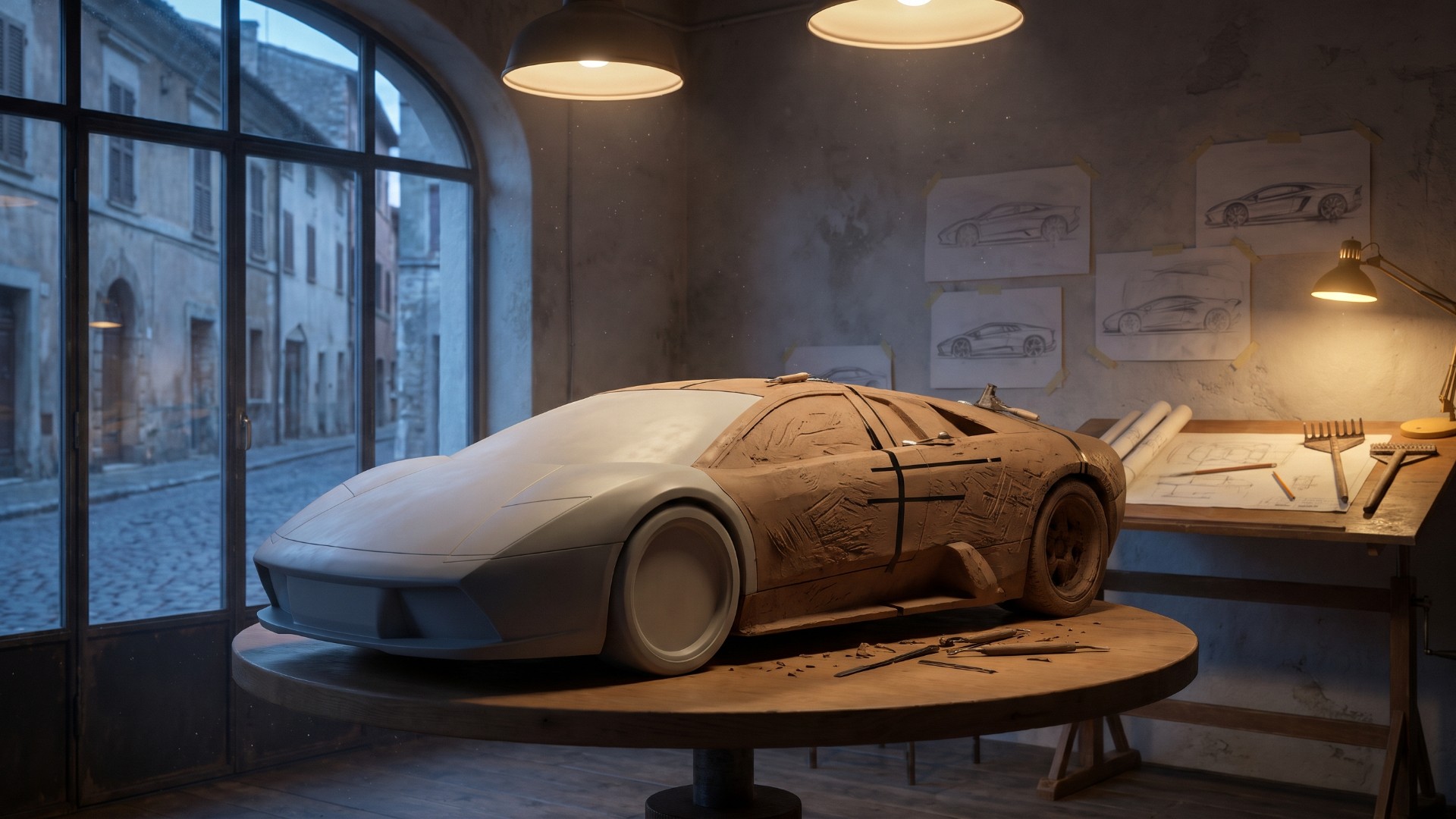
Start with the windshield. On the CAVËN HOMMAGE 26, the glass is what Fabrizio Giugiaro left alone. The windshield, side windows and roof come straight off a first-generation Lamborghini Gallardo, along with the door mirrors and their bases. Almost everything wrapped around that cabin is new carbon fiber. Keep the eyes, redraw the face: it is an unusual brief for any designer, and the clearest way to understand what this car is.
Revealed October 31 at the Concours at Wynn Las Vegas, the CAVËN HOMMAGE 26 is the first project from the atelier, a newly formed studio based in Marbella, Spain, and the opening chapter of what it calls its Designer Series. The premise is simple and hard to resist: invite the person who shaped a significant car to return to it with hindsight, newer materials and greater freedom to revisit the original design. For the Gallardo, that person is Giugiaro, who managed Italdesign’s original proposal for the car and now revisits it through GFG Style, the studio he co-founded.
Two authors, one Gallardo
The Gallardo’s design story has always had more than one name in it. In the late 1990s, Lamborghini asked Italdesign Giugiaro how it imagined a new, smaller Lamborghini. Giugiaro’s team answered with a full-size model and an interior mock-up. Lamborghini’s own design team, led by Luc Donckerwolke, then reshaped the proposal for production. Speaking to Auto&Design in 2003, Donckerwolke said the tail and sides ended up looking rather different from Italdesign’s model, partly because the car had to meet Audi quality standards and absorb carry-over components. “A brand has to manage its own image,” he said.
The car that debuted at Geneva in 2003 was therefore a genuine collaboration: an Italdesign concept, refined into production in Sant’Agata. It became the most successful Lamborghini of its era, with more than 14,000 built before production ended in 2013.
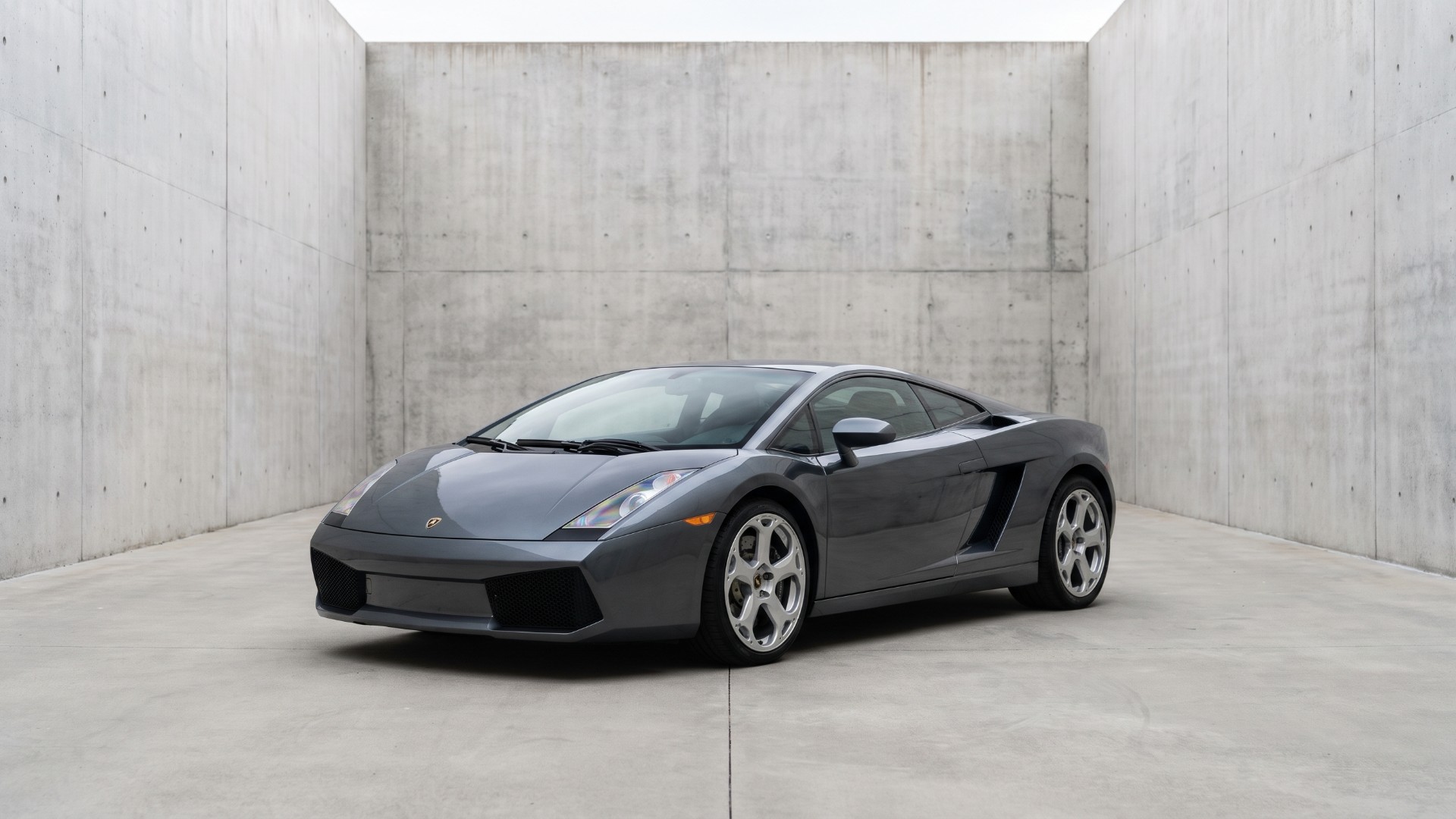
That history is what makes HOMMAGE 26 more interesting than a rebody. According to CAVËN and GFG Style, the new front stays close to Giugiaro’s original concept, while the rear is entirely new. The new rear is particularly interesting given how substantially Lamborghini revised the sides and tail for production. HOMMAGE 26 is not a factory Lamborghini, and it is not framed as a rebuttal to anyone. But it is hard to study the new tail without wondering what the first draft looked like before production had its say.
A familiar shape, almost entirely new surfaces
Because the roof and glass carry over, the silhouette is instantly Gallardo: the cabin pushed well forward, the short nose, the compact wedge of the whole car. Viewed side-on, it could pass for a well-kept original at a glance. The differences arrive when you walk to either end.
Up front, the production car’s fixed headlights are gone. In their place are pop-down headlights above slim light strips, flanked by two large mesh intakes that angle outward from a flat central nose. Where the 2003 car looks taut and production-ready, this face feels closer to a late-1990s concept car, graphic and slightly theatrical. That is not a criticism. It looks like a design allowed to finish its original thought.
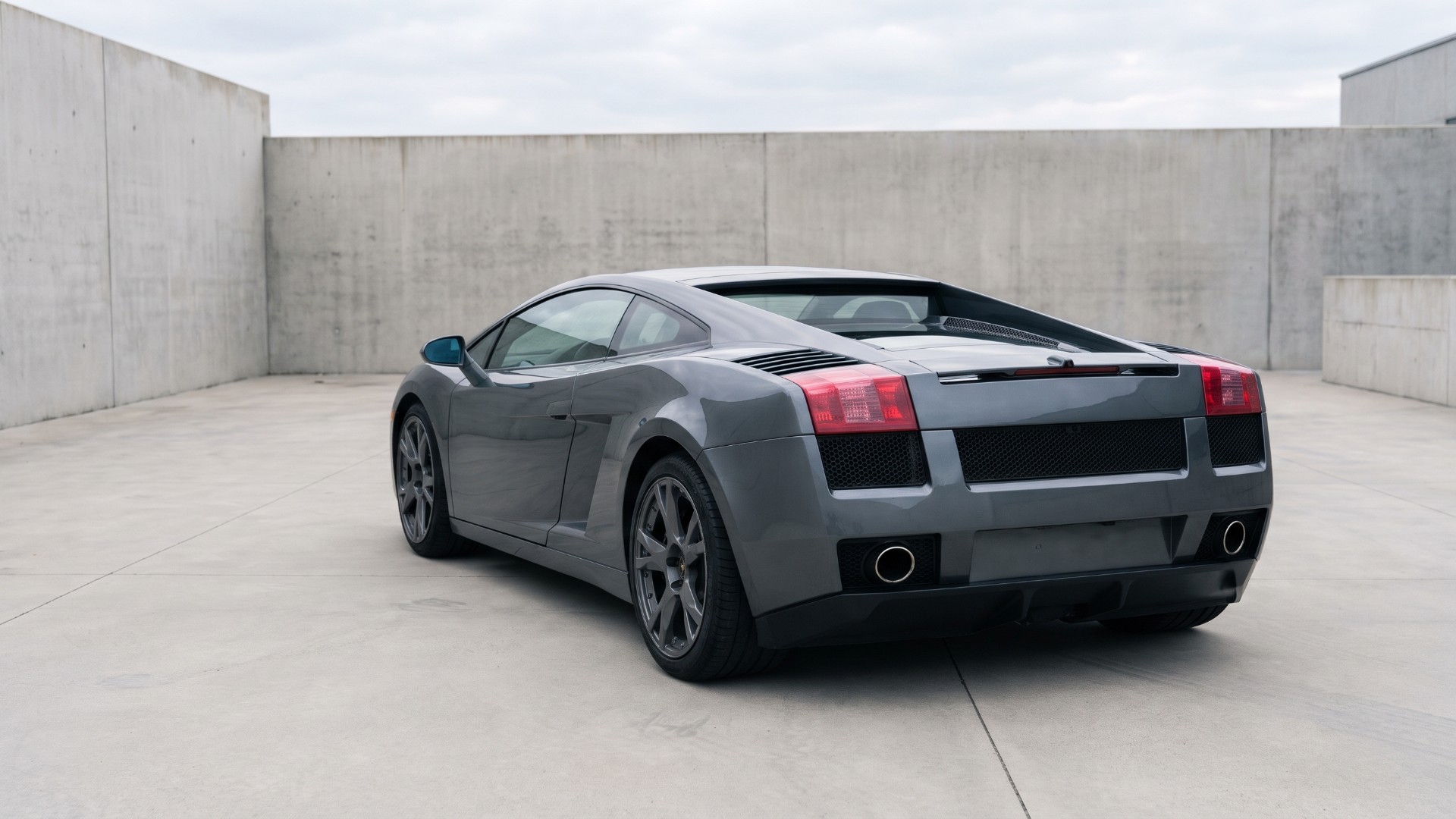
The rear is the bigger departure. The production Gallardo’s horizontal taillights give way to pairs of vertical light bars set into a dark mesh panel, with a spoiler above. CAVËN also lists active aerodynamic flaps and an opening rear window above the engine bay. It is the most contemporary part of the car and, to our eyes, the most successful. It reads as a fresh idea rather than a retro pastiche. The car itself is pictured on CAVËN Atelier’s website.
Ten cylinders, three pedals
The mechanical recipe is the part enthusiasts will circle first. Italian specialist Italtecnica has reworked the Gallardo’s naturally aspirated 5.0-liter V10, which now revs to 8,500 rpm, and every HOMMAGE 26 uses a manual gearbox. Launch figures put output at 540 horsepower for the GT version and 560 for the Performance version, and CAVËN says those numbers may still change during prototype development.
The first Gallardo offered that choice too: a six-speed manual through an open gate, alongside the E-gear automated manual. HOMMAGE 26 keeps only the pedal-and-lever version.
Those are not hypercar numbers, and they do not need to be. The appeal is the combination: an engine that breathes freely to 8,500 rpm, a clutch pedal and a lever you move yourself. That pairing has become one of the rarest and most coveted formulas in the high-end market, as we explored in our look at the naturally aspirated manual 911 GT3. The chassis gets two-mode suspension with Comfort and Sport settings, upgraded brakes and 20-inch wheels. CAVËN’s stated aim is a car its owner reaches for, not one kept under a cover.
Twenty-five commissions
CAVËN plans 25 examples, each built from a first-generation Gallardo that the owner supplies or the atelier sources. The conversion starts at €900,000, about $1.01 million at the European Central Bank’s October 30, 2026 reference rate, before taxes and before the cost of the donor car. Buyers also receive priority access to later Designer Series projects, the next of which is expected in 2027. CURATED will represent CAVËN in the United States. CAVËN says parts of the interior have been reworked as well, and launch materials give no delivery date.
That price places HOMMAGE 26 among the growing group of analog, coachbuilt cars sold as much on authorship as on performance, alongside projects such as the JAS Tensei. It also says something about how quickly the 2000s generation is maturing into collector territory, a shift we examined in our look at the next collector-car boom. The donor Gallardo is no longer just a used supercar. It is raw material for a designer’s second draft.
Giugiaro has described the project as a chance to show that many things can become “better and better if we continue working on them with care,” in remarks published by Classic Driver. It is a gentle way of describing something rare. Most car designers hand their work to engineers, accountants and regulators, then watch it change from a distance.
From the driver’s seat, HOMMAGE 26 should look almost exactly like a Gallardo: the same windshield, the same pillars, the same view down the road. Everything that changed sits outside that frame. The view stays familiar. Around it, one of the Gallardo’s original creators has found something new to say.