

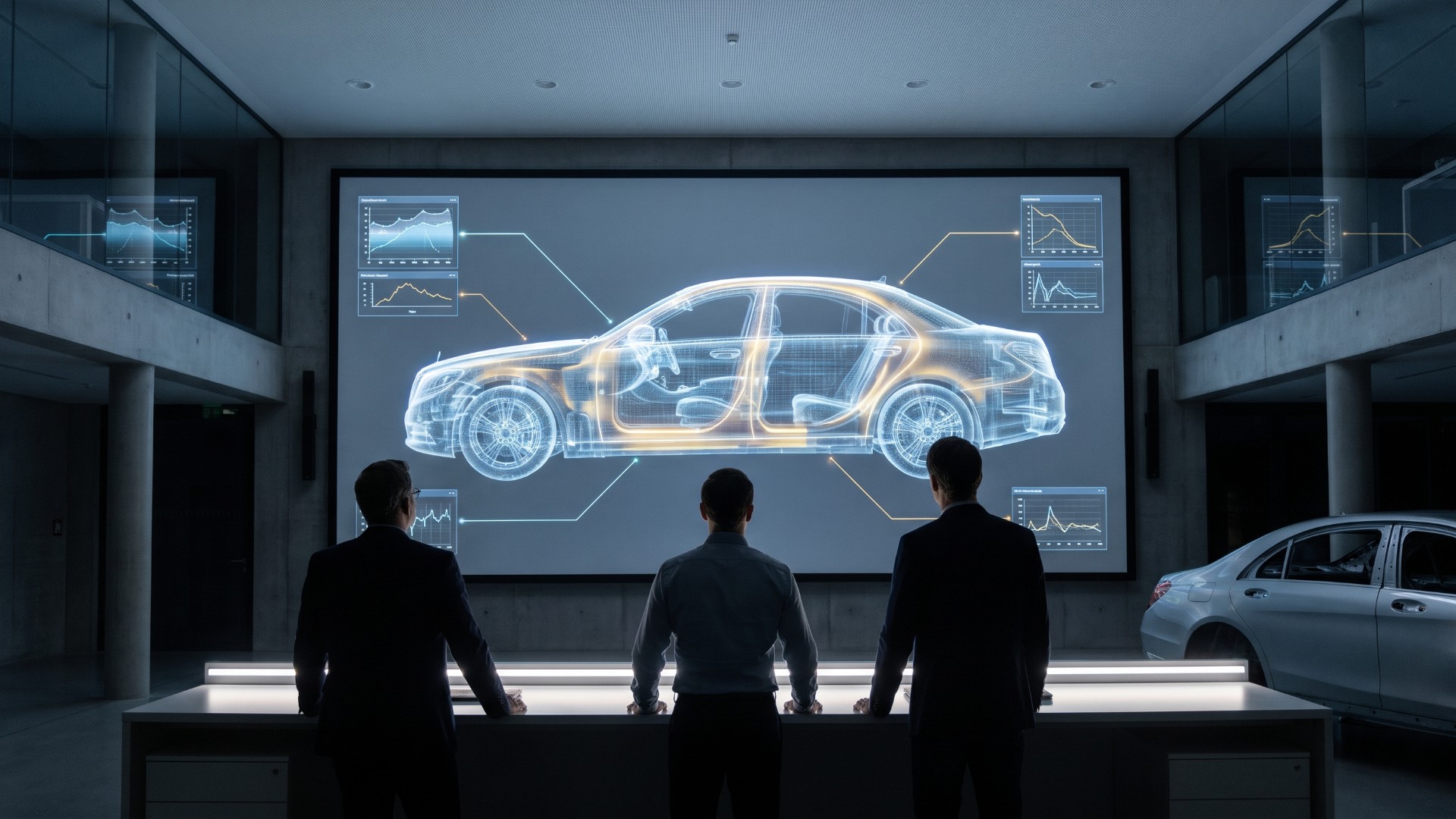
Mercedes’ new technology chief calls Chinese development speed “outstanding.” The company’s answer, Mercedes-Benz PLM.AI, is a half-billion-euro AI backbone meant to cut development time by nearly a third. Here is where the AI actually goes, what engineers keep, and why the timing is not a coincidence.
Mercedes-Benz has said out loud what its benchmarking has been telling it for a while: Chinese automakers develop cars faster. Speaking to Australian media including Drive and CarsGuide at the company’s 140 Years Festival, new Chief Technology Officer Jörg Burzer described the pace of development at rivals such as Zeekr and Denza as “outstanding,” while insisting Mercedes can compete with them in China and in Europe.
The answer he is pointing to is not a new car. It is a new way of building one, and it arrives in the same quarter that Mercedes cut its profit outlook, reported a 31 percent sales drop in China and reopened a severance programme aimed at the very departments that develop its cars.
What Mercedes-Benz actually announced with PLM.AI
On October 16 the company unveiled Mercedes-Benz PLM.AI, an AI-based product lifecycle management system it calls the “digital backbone” of future development. Product lifecycle management is the unglamorous software layer that holds every part number, drawing, test result and supplier record a car accumulates over its life. Mercedes’ version has grown up alongside the company for decades; PLM.AI rebuilds it so that data is standardized end to end and, in the company’s words, “100 percent AI-ready.”
Mercedes is investing around €500 million (roughly $570 million at early-November exchange rates) and working with two partners: CONTACT Software, which supplies the open core data platform, and Siemens, which brings design, simulation and digital-twin validation tools. Mercedes says it keeps ownership of the architecture, the data models and the AI models trained on them, which matters when two outside vendors sit at the heart of your engineering process.
The targets are specific. Mercedes says PLM.AI could shorten development time by up to 30 percent, a figure CONTACT Software’s version of the announcement puts at around 17 months per program, with efficiency gains of up to 50 percent in individual engineering processes and physical testing potentially cut in half over time. Those are company projections, not results measured on a finished car.
Where the AI goes
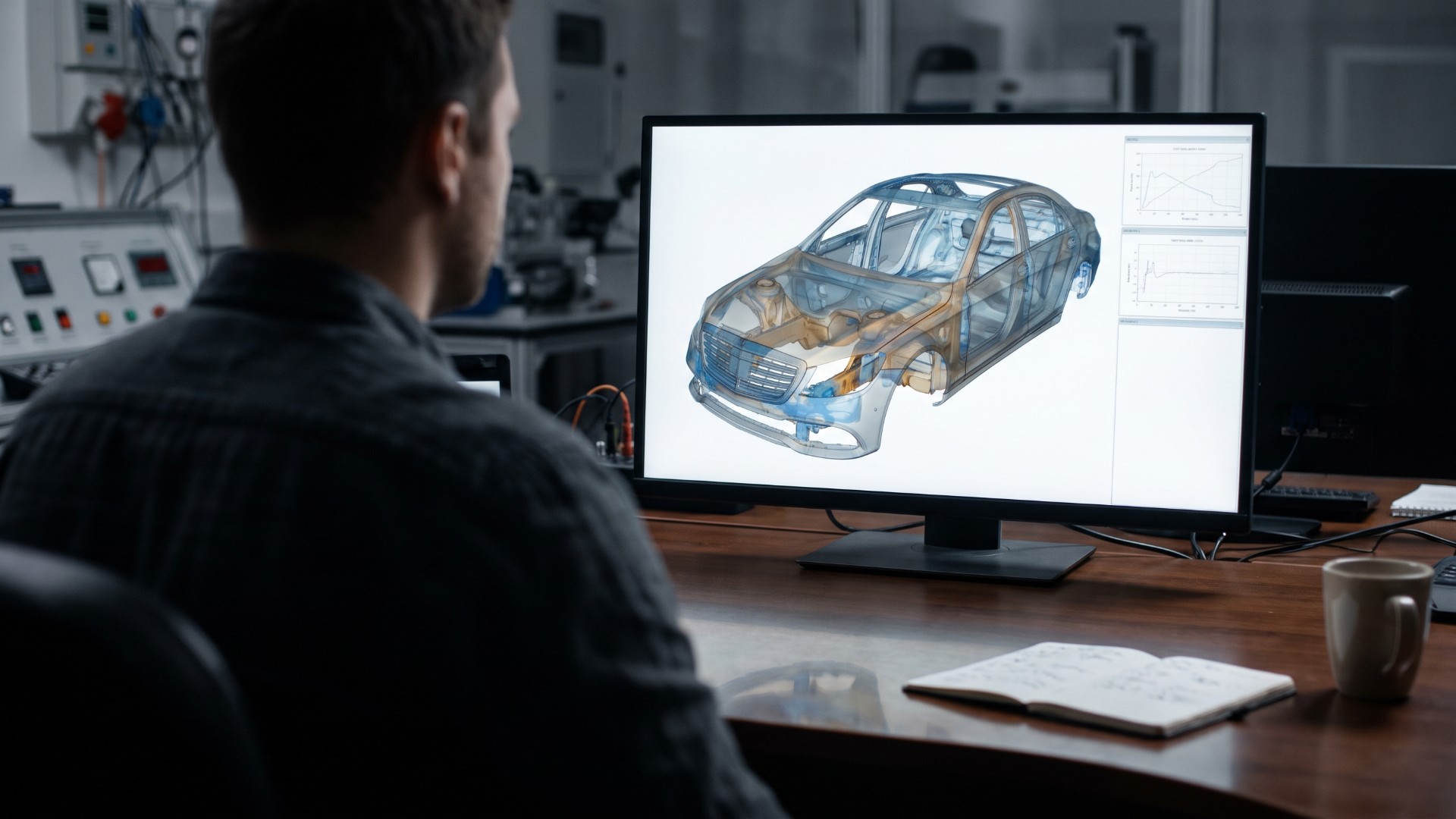
The clearest example comes from Burzer himself. After a crash test, the impact analysis that once took engineers two or three weeks now takes two or three hours. The AI is not deciding whether the car is safe. It is assembling and connecting the data so the engineers can.
Mercedes already uses AI agents for material-cost optimization, homologation paperwork, fault detection and software development, but mostly inside single process steps. PLM.AI links them. The company’s own illustration is weight reduction: change one component to save a few kilograms, and the change ripples into cost, crash behavior, hardware and software functions and the production line. Today those consequences are chased down one department at a time. Under PLM.AI, specialized agents are meant to analyze them simultaneously and hand the team a complete picture, so the trade-off between safety, quality and cost is made once, early, with everything on the table.
Simulation is the other lever. If the digital twin is good enough, Mercedes can aim physical prototypes and track time at the questions simulation cannot answer, rather than at everything. That is where the Mercedes-Benz PLM.AI ambition of halving physical testing comes from, and it is also the claim that deserves the most scrutiny, because it is the one that touches the car a customer eventually drives.
PLM.AI is not a one-off, either. In May Mercedes rolled out the German low-code platform n8n company-wide so that employees can build their own AI workflows, after a hackathon in which more than 1,500 staff pitched automation ideas. The company describes a three-tier model of AI users, workflow makers and builders. PLM.AI is the engineering-side anchor of that strategy.
Why now: the China problem
The speed Burzer admires is being measured against Mercedes’ own sales sheet. In the third quarter the core car business delivered 407,200 vehicles, down 8 percent year on year. China fell 31 percent to 86,800 cars, and the Top-End segment that includes the S-Class, Maybach and AMG fell 21 percent. Over nine months, China is down 29 percent. In late October the company lowered its full-year car-division margin outlook to 2 to 3 percent, from 3 to 5 percent, citing China and rising costs.
Burzer’s other comments to the Australian press fit the same picture. He talked about bringing EV and combustion designs closer together, trimming body variants (the next electric C-Class will share the sedan’s shape rather than get its own four-door coupe silhouette), right-sizing batteries around an 800 to 900 km range rather than chasing the largest pack, and maintaining volume because cars on the road supply the data that trains driver-assistance software.
He also pointed to the Level 2++ system Mercedes developed with Chinese partner Momenta as proof the company can compete on tech in China. Fewer variants, faster programs and less physical testing are all the same sentence written three ways: do more with the engineering hours you have.
What changes for engineers
Mercedes says responsibility for product decisions stays with its teams, and that its quality and safety standards are unchanged. In the company’s announcement, Burzer said the system should make Mercedes “faster, more connected and more capable of learning.”
The fair reading is that the engineer’s job shifts rather than shrinks: less time gathering and reconciling data from five departments, more time weighing the trade-offs that data reveals. The crash-test example is the Mercedes-Benz PLM.AI template. Nobody is being replaced by the agent that assembles the post-test analysis; the engineer who used to spend three weeks building it now spends three hours reading it and the rest of the month acting on it.
Headcount is the harder question, and Mercedes has not connected the two publicly. Under its “Next Level Performance” plan the company is targeting about €5 billion in savings by 2027, and the voluntary severance programme it ran from April 2025 to March 2026 was aimed at indirect functions, including engineering, IT and administration; press reports put departures in Germany at around 5,500. On October 29 Mercedes said it would reopen the programme in December.
Mercedes’ German workforce has job-security protection through 2034, so these are offers, not layoffs. But if Mercedes-Benz PLM.AI delivers a 30 percent shorter development cycle and physical testing halves, the engineering organization that results is smaller per program than the one that exists today, whether or not anyone says so in a press release.
ECN’s take
Thirty percent is roughly the difference between a seven-year model cycle and a five-year one. If Mercedes delivers it, the cadence of new S-Classes, AMGs and Maybachs could start to resemble the Chinese pace the company is now openly measuring itself against. For enthusiasts the interesting question is not whether AI shows up in the development process; it already has, at every major manufacturer. It is which parts of a Mercedes stay human-verified. Crash structures, brake and tire validation, hot-weather and cold-weather durability and the thousand-kilometer shakedowns that find the rattle no simulation predicted are where “testing halved” either means smarter testing or less of it.
Mercedes says it is the former. The first cars developed end to end on PLM.AI are still years away, so the proof will arrive in the showroom, not the press release. Until then, the honest summary is this: Mercedes has admitted the gap, named the tool it intends to close it with, and attached numbers it can be held to. That is more than most legacy automakers have offered.
Mercedes-Benz PLM.AI: quick answers
What is Mercedes-Benz PLM.AI?
An AI-based product lifecycle management system announced October 16, 2026 that connects development, procurement, production, sales and after-sales data so AI agents and engineers can work from one standardized source. Mercedes is investing about €500 million with partners CONTACT Software and Siemens.
How much faster will Mercedes develop cars?
Mercedes targets up to 30 percent shorter development time, roughly 17 months per program by its partner’s estimate, with up to 50 percent efficiency gains in individual engineering steps and physical testing potentially halved. These are targets, not measured results.
Is AI replacing Mercedes engineers?
Mercedes says product decisions remain with its teams and that quality and safety standards are unchanged. It has not linked PLM.AI to headcount, though it is separately running a voluntary severance programme for indirect functions including engineering as part of a €5 billion savings plan.