

Temerario vs Revuelto was supposed to be a mismatch. One is Lamborghini’s V12 flagship, a 1,001-hp, carbon-tubbed monument to excess. The other is the “entry-level” model, if you can call a 907-hp supercar with a 10,000-rpm twin-turbo V8 entry-level with a straight face.
Then Car and Driver’s separate instrumented tests produced an unexpected result: the Temerario posted the quicker standing-start times. It hit 60 mph in 2.1 seconds, a tenth ahead of the Revuelto, and ran the quarter-mile in 9.4 seconds at 150 mph. The big bull managed 9.7 seconds at 148 mph.
That’s awkward, because the 2027 Temerario lists from $386,649, roughly $282,000 less than the 2027 Revuelto. So if the junior Lambo is quicker, what exactly is the flagship for?
Short answer: the Temerario wins the launch, not the argument. The long answer is more interesting.
Temerario vs Revuelto, by the numbers
Bold marks the winner of each test. Spoiler: it’s closer to a split decision than the standing-start result suggests.
| Test result | Temerario | Revuelto |
|---|---|---|
| Engine | Twin-turbo 4.0L V8 | Nat.-aspirated 6.5L V12 |
| Combined output | 907 hp | 1,001 hp |
| Curb weight (tested) | 4,199 lb | 4,290 lb |
| 0–60 mph | 2.1 sec | 2.2 sec |
| 0–100 mph | 4.4 sec | 4.6 sec |
| Quarter-mile | 9.4 sec @ 150 mph | 9.7 sec @ 148 mph |
| Rolling start, 5–60 mph | 3.0 sec | 2.8 sec |
| Braking, 70–0 mph | 143 ft | 154 ft |
| Skidpad (300 ft) | 1.08 g | 1.10 g |
| VIR Lightning Lap | 2:41.7 | 0.4 sec quicker |
Same muscles, different body
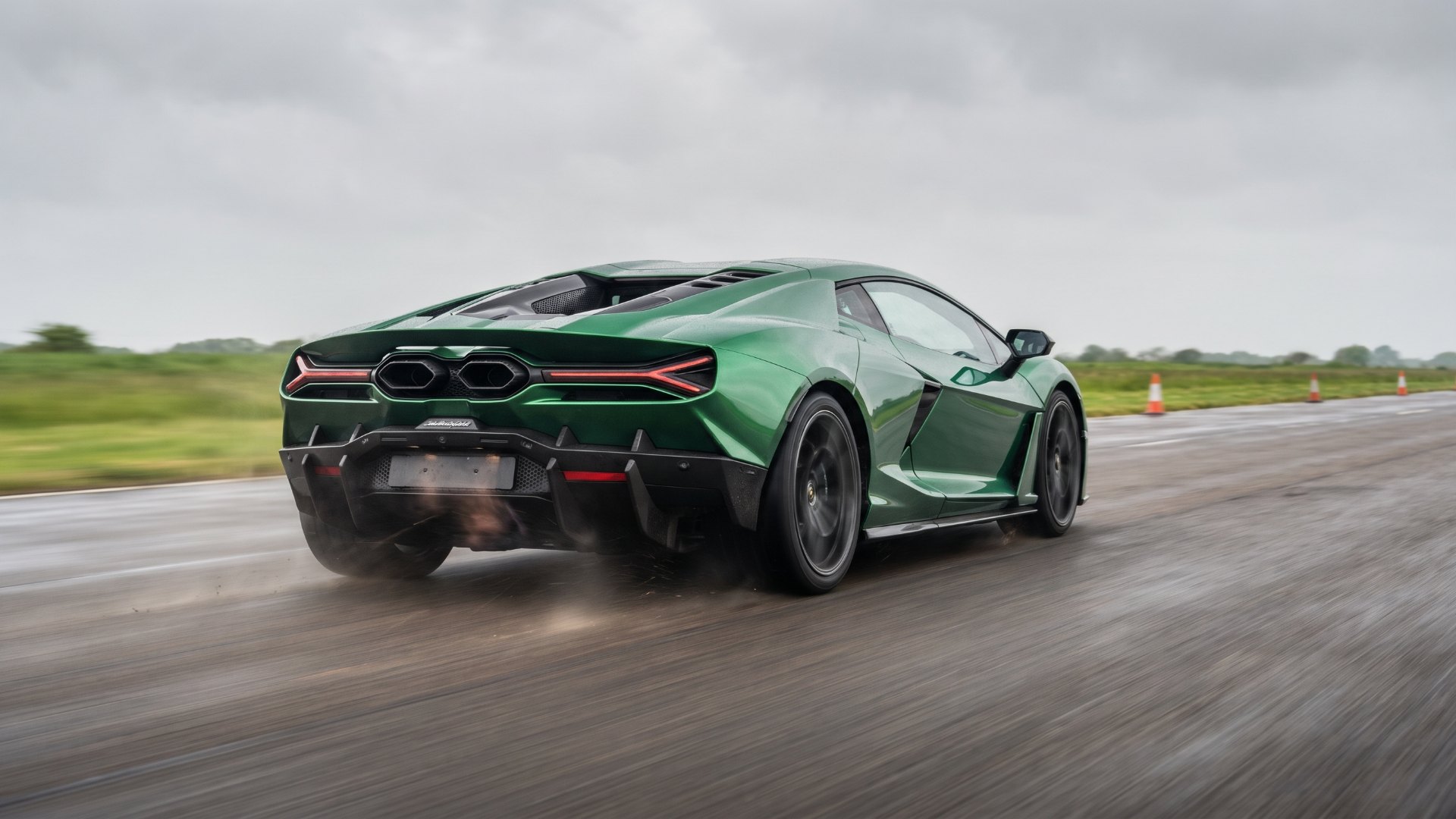
Here’s the twist: under the skin, these two are closer relatives than their prices suggest. Both use the same trio of 147-hp electric motors, one at the rear and one at each front wheel, and both stop with identically sized carbon-ceramic rotors, according to the published test specifications. The junior car got the flagship’s electric all-wheel-drive and torque-vectoring hardware more or less wholesale.
And the Temerario isn’t the featherweight you might expect. It’s about 9.5 inches shorter than the Revuelto, yet only 91 pounds separated them on the test scales. Run the numbers (an ECN estimate based on those tested weights) and the Revuelto hauls 4.29 pounds per horsepower to the Temerario’s 4.63, about 7 percent less mass for every horse. On paper, the V12 should walk it.
It does, once you take the launch away. In the 5–60 mph rolling-start test, which strips out most of the standing-start drama, the Revuelto was quicker, 2.8 seconds to 3.0. The Temerario’s magic happens in the first few feet, where tires, traction and launch software count for more than peak power.
The fine print
Before anyone declares a coup, a few asterisks. The cars weren’t tested side by side. The Temerario wore Bridgestone Potenza Race tires and the $84,100 Alleggerita lightweight package; the Revuelto rolled on Potenza Sport rubber, and its test was published more than a year earlier. The engines deliver differently, too: the V8’s peak 538 lb-ft lands between 4,000 and 7,000 rpm, while the V12 saves its 814 hp for 9,250 rpm. Any of that could sharpen a launch, and as our look at bespoke supercar tires explains, rubber alone can move these numbers.
It’s also the opposite of what Lamborghini’s own figures predict. The company’s spec sheet ranks the cars the other way: 2.5 seconds to 100 km/h for the Revuelto, 2.7 seconds for the Temerario. One set of instrumented tests isn’t the final word, but it’s a striking reversal of the factory’s own pecking order.
Where the big bull still rules
Take them to a racetrack and the order flips back. In the Lightning Lap results at Virginia International Raceway’s Grand Course, the Revuelto was 0.4 second quicker, taking three of five sectors. It also held more grip on the skidpad and pulled harder from a rolling start.
Then there’s everything a stopwatch can’t measure. The Revuelto is built around a carbon-fiber center section made in Sant’Agata Bolognese; the Temerario rides on an aluminum spaceframe co-developed with Audi and built at its Neckarsulm plant. The Revuelto’s naturally aspirated V12 howls to 9,400 rpm. The Temerario counters with a twin-turbo V8 that revs even higher, to 10,000 rpm.
And Lamborghini isn’t sitting still. The new Revuelto SV is rated at 1,065 CV (1,050 hp) with a claimed 2.4 seconds to 100 km/h, and the few-off Fenomeno sits above even that.
So, has the pecking order changed?
Not the way the 0–60 numbers suggest. At this level, standing starts appear to be running into a traction ceiling. Below about 2.2 seconds, a launch says more about tires, software and front-axle torque than about horsepower. The same test data makes the point: the Revuelto’s 2.2-second run tied a Corvette ZR1, and the quickest 60-mph time in that testing record belongs to a Corvette ZR1X, at 1.8 seconds. When a Chevrolet can match your flagship’s sprint, 0–60 stops being a ranking system.
What the Temerario really changed is the floor. Lamborghini’s least expensive supercar now beats the Revuelto off the line and finishes within half a second of it around VIR. That leaves the flagship to earn its keep the old-fashioned way: the V12, the carbon structure, the rarity and the feeling of owning the top rung. It’s the same shift we described in the end of the horsepower war, when emotion replaced output as the battleground.
In the Temerario vs Revuelto debate, the stopwatch picks the junior car. Almost everything else still picks the V12.
The hierarchy stands. It just doesn’t start from a standstill anymore.