

When we wrote about the Ferrari hypercar auction surge in June, we ended on an open question: the next major sales, led by Monterey in August, would be the real stress test for whether early-2026 numbers were a new baseline or a peak.
Monterey has now happened, and it is the first clean read on the Ferrari hypercar auction market since January. Here is the verdict, and it is more nuanced than either camp expected.
The Ferrari hypercar auction verdict
- The baseline held. Every car in the modern Ferrari halo lineage traded at or above its early-2026 level at Monterey. This was not a peak that collapsed.
- The single most extreme print did not repeat. January’s $17.875 million Enzo now looks like an outlier rather than a market rate. Monterey’s Enzo made $9.41 million.
- LaFerrari was the strongest mover, up roughly 59 percent from its January Arizona result in seven months.
- A current-era car joined the top table. A 2023 Daytona SP3 made $17.825 million — effectively matching January’s outlier Enzo, on a car still within its warranty period.
- The thesis broadened. A 1996 McLaren F1 GTR at $34.655 million confirmed this is not a Ferrari story so much as an analogue-hypercar story.
How we got here: a $6 million ceiling becomes an $18 million print
The Ferrari hypercar auction market did not drift higher in early 2026 — it broke containment.
The signal flare came at Mecum’s Kissimmee sale in January, where a yellow 2003 Enzo from the Bachman Collection sold for $17,875,000, roughly three times the model’s previous public-auction record. A second Enzo crossed the block at the same event for $11,110,000, and a 1995 F50 set a model record of $12,210,000.
To understand how violent that move was, start with the old benchmark. The Enzo record had stood for more than a decade at $6,050,000, for the example once owned by Pope John Paul II.
A week later, RM Sotheby’s Arizona auction confirmed the pattern was not confined to one room. The 28th annual sale posted $63 million with a 94 percent sell-through and bidders from 23 countries — the house’s strongest Arizona result of the decade. Six world records fell in a day. The Enzo on offer there made $9,300,000 against a $5–6 million estimate, despite carrying no special options or notable ownership history. A 1995 F50 brought $8,805,000 and a 2015 LaFerrari $5,477,500.
The Monterey verdict, model by model

| Model | Kissimmee, Jan | Arizona, Jan | Monterey, Aug |
|---|---|---|---|
| 2003 Ferrari Enzo | $17,875,000 | $9,300,000 | $9,410,000 |
| 1995 Ferrari F50 | $12,210,000 | $8,805,000 | $12,105,000 |
| 2015 Ferrari LaFerrari | — | $5,477,500 | $8,695,000 |
| 1991 Ferrari F40 | — | — | $8,365,000 |
| 1985 Ferrari 288 GTO | — | — | $11,555,000 |
| 2023 Ferrari Daytona SP3 | — | — | $17,825,000 |
Read across the Enzo row and the picture resolves. Two independent sales seven months apart, in different rooms with different bidders, landed within $110,000 of each other at around $9.3–9.4 million. That is what a market rate looks like. The $17.875 million Kissimmee car was a specific yellow example from a named collection, and it now reads as a provenance premium rather than a repricing of the model.
The F50 row is the cleaner bull case. It recovered from $8.805 million in Arizona back to $12.105 million at Monterey, essentially matching its January high. The LaFerrari row is the strongest of all — $5.4775 million to $8.695 million in seven months, with no change in the car.
The new entrant nobody had modelled
The most consequential Ferrari result at Monterey was not one of the old halo cars. It was a 2023 Daytona SP3 at $17,825,000.
That is a car barely three years old, effectively matching January’s outlier Enzo. And it fits the thesis precisely: the Daytona SP3 is naturally aspirated, V12, non-hybrid, and built in a run small enough that it was spoken for before most buyers saw one. It is the last of the analogue lineage rather than the first of something new, and the market has priced it accordingly.
The presence of the 1985 288 GTO at $11,555,000 and the 1991 F40 at $8,365,000 alongside it completes the set. The entire lineage — 288 GTO, F40, F50, Enzo, LaFerrari, Daytona SP3 — now trades in eight figures or close to it, in the same room, on the same weekend.
It is not only Ferrari
In June, the most telling result was not a Ferrari at all: a 2005 Porsche Carrera GT at $3,085,000 in Arizona, a model record by a wide margin against roughly $2.2 million at Mecum Glendale in 2022. Naturally aspirated, carbon-tubbed and famously demanding, the Carrera GT had become shorthand for the same thing buyers were chasing at Maranello.
Monterey made the point far more loudly. A 1996 McLaren F1 GTR sold for $34,655,000, setting a public auction record for the most expensive British car. That result sits above every Ferrari on this page except the charity lot.
On the charity lot: a 2026 Ferrari Luce ‘Tailor Made’ made $40,000,000 at Monterey, a record for a new car. The buyer’s premium was waived and Ferrari donated the proceeds to The Ferrari Foundation. It says a great deal about the temperature around the brand and nothing usable about valuations. We covered the full week in the Monterey 2026 auction results.
What is driving the Ferrari hypercar auction surge

Generational handover. The buyers who grew up with posters of the F40 and Enzo now control the balance sheets. Nostalgia has always driven the collector market; what is different is the size of the money now attached to it.
The analogue premium. As the supercar mainstream shifted to hybrid and electric powertrains, the last generation of high-revving, naturally aspirated, mechanically engaging cars is being repriced as a finite resource. You can still buy speed. You can no longer buy a new Enzo-style experience, and scarcity of experience is proving as bankable as scarcity of metal. The same force is visible in new-car showrooms — see every manual supercar you can still buy new in 2026 and where exotic car technology actually went in 2026.
Macroeconomics. Hagerty’s team has plotted the annual collector-car auction record against the mean wealth of the US top one percent going back to 1989 and found a close correlation. When equities and alternative assets inflate the very top of the wealth distribution, a slice of that capital reliably flows into passion assets, and 2026 maps neatly onto a strong run in those balance sheets.
The bubble question, revisited
In June we wrote that Monterey would settle whether early-2026 was a baseline or a peak. Having seen it, the honest answer is that it settled less than we hoped, but it did rule out the worst case.
What the results rule out: a collapse. Two independent Enzo sales seven months apart landing within $110,000 of each other is the opposite of a market in retreat, and the LaFerrari’s move is a genuine repricing rather than a single enthusiastic bidder.
What they do not rule out: that the very top of the range was frothy. The January Enzo has not been matched by any comparable car, and a single unrepeatable print sitting nearly double the market rate is exactly what a local peak looks like in hindsight. Anyone who bought at $17.875 million on the assumption that it was the new floor is, on the current evidence, waiting.
The structural risk has not changed either. This remains a thin market of a few hundred serious global buyers, correlated to the balance sheets of the very wealthy, in which a handful of results set the reference price for everything else. It has moved a long way up in eight months. Markets that do that are not usually finished moving in either direction.
What it means for collectors
- Value against the pair, not the outlier. The Arizona and Monterey Enzos are the comparable set. The Kissimmee car is a separate data point with its own story attached.
- Provenance is now the whole spread. The gap between a documented, correctly specified example and a merely good one has never been wider, and the penalty for gaps in the file has never been harsher.
- Sellers chasing the top tend to arrive late. Consignment volume rises after records, which is precisely when competition for bidders is fiercest.
- Watch the modern end. The Daytona SP3 result suggests current-era naturally aspirated cars are being absorbed into this lineage far faster than the F40 or F50 ever were.
- These are still cars. Storage, servicing, fluid intervals and recommissioning on eight-figure machinery are real costs, and neglect shows up in the file that the next buyer will read.
For the wider exotic-car world, the Ferrari hypercar auction surge confirms that the analogue hypercar has finished its transition from used supercar to recognised asset class — with all the volatility that label carries.
Frequently asked questions
Why are Ferrari hypercar auction prices rising so fast in 2026?
Three forces at once: a generational handover to buyers who grew up with the F40 and Enzo and now control significant wealth; an analogue premium as naturally aspirated, mechanically engaging cars become a finite resource; and a strong run in top-end wealth, which historically correlates closely with collector-car auction records.
What is the most expensive Ferrari Enzo ever sold at auction?
A yellow 2003 Enzo from the Bachman Collection sold for $17,875,000 at Mecum Kissimmee in January 2026. That result has not been repeated: comparable Enzos made $9,300,000 at RM Sotheby’s Arizona in January and $9,410,000 at Monterey in August, which is a better guide to the current market rate.
Did Ferrari hypercar prices hold up at Monterey 2026?
Yes. Every model in the lineage traded at or above its early-2026 level. The F50 returned to $12,105,000, the LaFerrari rose to $8,695,000 from $5,477,500 in January, and a 2023 Daytona SP3 made $17,825,000.
Is the Ferrari hypercar market a bubble?
The Monterey results rule out a collapse but not a frothy top. Repeat sales of comparable cars landed within about one percent of each other, which indicates a real market level, while the single highest print from January has not been matched. This is a thin market with a small buyer pool, so concentration risk remains.
Which Ferrari models are included in the hypercar lineage?
The 1985 288 GTO, 1987 F40, 1995 F50, 2003 Enzo, 2013 LaFerrari and, increasingly, the 2022 Daytona SP3. All six traded in or near eight figures at Monterey 2026.
Is this only happening to Ferraris?
No. A 2005 Porsche Carrera GT set a model record at $3,085,000 in January, and a 1996 McLaren F1 GTR sold for $34,655,000 at Monterey, a record for a British car. The pattern follows analogue, naturally aspirated hypercars rather than one marque.
All figures are public auction results including buyer’s premium as reported by the selling houses. This article was originally published in June 2026 and was updated in August 2026 with the Monterey results.
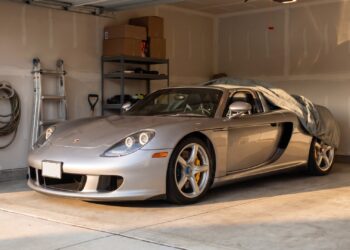
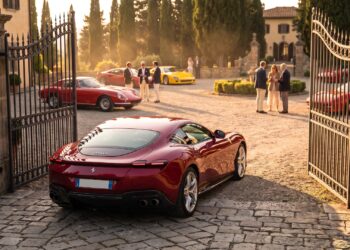
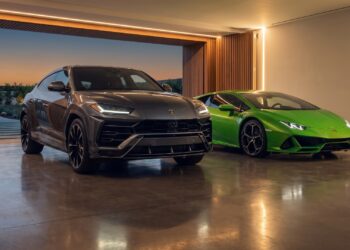
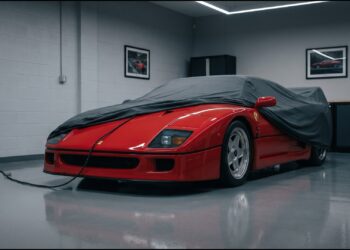
Editor’s note on imagery: Exotic Car News does not publish AI-generated depictions of real vehicles. The images in this article are illustrations of the auction and collecting process — a bid board, a saleroom, a provenance file, private storage and an empty room after a sale. None depicts a specific car, lot or auction house.