
McLaren McL 6GT: The Short Version
The McLaren McL 6GT is a carbon-fibre, rear-wheel-drive concept supercar revealed at Monterey Car Week on August 14, 2026. It pairs a mid-mounted V8 with a manual gearbox — the first manual McLaren since the F1 in 1992 — and previews a production car arriving in 2028. McLaren CEO Nick Collins says it will cost around $1.5 million and be limited to roughly 500 cars, launching a new, ultra-exclusive McLaren line above the existing range.
- Powertrain: Mid-mounted V8, rear-wheel drive
- Transmission: Manual gearbox with a clutch pedal
- Chassis: Full carbon-fibre monocoque and carbon bodywork
- Steering: Hydraulically assisted
- Inspiration: Bruce McLaren’s unfinished 1969 M6GT
- Concept revealed: August 14, 2026, Monterey Car Week
- Production version: 2028
- Price: “In the range of $1.5 million” — Nick Collins
- Production run: “About 500 of them, and that’s it” — Nick Collins
A Supercar That Argues With the Last Fifteen Years
Every so often a car company builds something that reads less like a product and more like a position paper. The McLaren McL 6GT, pulled out from under a sheet at Monterey Car Week on August 14, 2026, is one of those.
Here is what it does not have: a hybrid system. A dual-clutch gearbox. Launch control theatre. A torque-vectoring rear axle that quietly out-drives you. Here is what it does have: a V8 behind the seats, hydraulic power steering, rear-wheel drive, and a gear lever that you move yourself, with a clutch pedal on the floor to make it work.
It is the first manual road car McLaren has shown in 34 years — the last one being the McLaren F1, which entered production in 1992 and has spent the decades since becoming the most valuable modern car on earth. That is not a coincidence, and McLaren knows it.
“The McLaren McL 6GT imagines what our inspirational founder had wished to complete but with six additional decades of innovation and passion woven through every element, creating a modern icon of driver connection,” said Nick Collins, Chief Executive of McLaren Automotive.
Marketing language, sure. But strip it back and the sentence contains a genuine product thesis: McLaren has decided that at the very top of the market, the thing worth selling is no longer speed. It is involvement. Collins was blunter in conversation at the reveal: “We’ve had customers for a long time say, ‘Please do another manual.’ There hasn’t been a manual McLaren since the F1, which is a long time.”
The Numbers That Matter: $1.5 Million, About 500 Cars
McLaren’s press release withheld pricing and volume. Collins did not. Speaking at Monterey, he put the production car “in the range of $1.5 million” and the run at “about 500 of them, and that’s it.”
He also explained the thinking behind that ceiling in terms that tell you a lot about where the company’s head is: “We wanted to be a pull model rather than a push model. Other competitors right now are in a push model, and once you start damaging residual values, it’s very hard to reverse.”
That is a Ferrari sentence — deliberate scarcity as the engine of value — from a company that has spent recent years being criticised for the opposite. Asked directly whether the manual was a shot at Maranello, Collins said no, then added: “But it’s definitely authentic.”
There is also a genuinely charming origin story. According to Collins, McLaren Special Operations found the original M6GT body moulds in a storage warehouse about a year ago. “They blew the dust off them, and we said, ‘Wow, we think we could recreate an M6GT.'”
McLaren McL 6GT Specs: What’s Confirmed So Far
| Specification | McLaren McL 6GT (concept) |
|---|---|
| Engine | Mid-mounted V8 (McLaren has confirmed only “V8”; twin-turbocharging widely reported but not official) |
| Transmission | Manual with clutch pedal — six-speed per multiple reports |
| Drivetrain | Rear-wheel drive |
| Chassis | Full carbon-fibre monocoque |
| Bodywork | Carbon fibre |
| Steering | Hydraulic assistance |
| Aerodynamics | Low-drag body, Kammback tail |
| Power / torque | Not disclosed |
| Weight | Not disclosed |
| Production volume | About 500 (Nick Collins) |
| Concept debut | August 14, 2026 — Monterey Car Week |
| Production model | 2028 |
| Price | “In the range of $1.5 million” (Nick Collins) |
The omissions are as interesting as the inclusions. McLaren, a company that has historically led with numbers — 0–60, Nürburgring times, power-to-weight — released this car without a single performance figure, and without even confirming whether the V8 is turbocharged. When the pitch is feel rather than physics, the spec sheet becomes a secondary document.

The Car Bruce McLaren Never Got to Finish
To understand why this car exists, you have to go back to 1969.
Bruce McLaren was, by then, dominating Can-Am racing so completely that the series was nicknamed “The Bruce and Denny Show.” His M6A had won the 1967 championship outright. And Bruce — a New Zealander who, at 14, had rebuilt a dismantled 1929 Austin 7 Ulster with his father and gone racing in it — wanted to put a roof on his Can-Am car and sell it to the public.
The plan was the M6GT: a closed-cockpit version of the M6 chassis, built in partnership with Trojan, with an ambition of around 250 cars a year. A 5.7-litre, Bartz-tuned small-block Chevrolet V8 making roughly 400 bhp sat behind the cabin. It was good for about 165 mph and 0–100 mph in eight seconds — at a time when plenty of sports cars couldn’t reach 60 in that long. Bruce’s stated goal was the fastest-accelerating road car in the world, and he was almost certainly going to get it.
Then the FIA moved the goalposts, raising the number of road cars required for Group 4 homologation from 25 to 50. The racing rationale evaporated, and the programme lost its anchor.
Bruce built one for himself anyway. He registered it OBH 500H and used it on the road — a car with racing suspension and essentially no sound insulation — because that is the kind of person he was. It has covered just 2,094 miles in its entire life, most of them his, as Top Gear found when they drove it.
On June 2, 1970, Bruce McLaren was killed testing an M8D Can-Am car at Goodwood. He was 32. The M6GT road-car programme died with him, having produced only a handful of prototypes. McLaren would not build another road car until the F1 arrived 23 years later.
The McL 6GT is McLaren finishing the sentence. Which is a sentimental way to put it — but sentiment, it turns out, is exactly what the modern top end of the market is buying.
The Details Are the Story
Concept cars are usually an exercise in surfaces. The McL 6GT is an exercise in references, and they are dense enough that spotting them is half the fun.
- The silhouette is a direct nod to the M6A Can-Am racer — low, wide, with a long extended roofline that terminates in a chopped Kammback tail. It’s a shape from before the era of active aero and full-width wings, and it looks it, in the best way.
- The “Racing Loop” tail-light motif is pulled from the original M6GT.
- Bruce’s registration — OBH 500H — appears on the body as a tone-on-tone graphic. Blink and you’ll miss it.
- The “Speedy Kiwi”, McLaren’s earliest emblem and a nod to Bruce’s New Zealand roots, appears on the fuel filler cap and is rendered in three dimensions inside the gearknob itself.
- Bruce McLaren’s signature is engraved in the engine bay, alongside deliberately exposed screwheads — the kind of detail modern supercars usually spend fortunes hiding.
- Inside, a reinterpreted “boxed quilt” leather pattern meets gloss twill carbon, knurled milled-aluminium toggles and rotaries, and a digital instrument display that McLaren says retains the visual clarity and simplicity of the original’s gauges.
- The lozenge shapes in the rear diffuser echo the original car’s detailing.
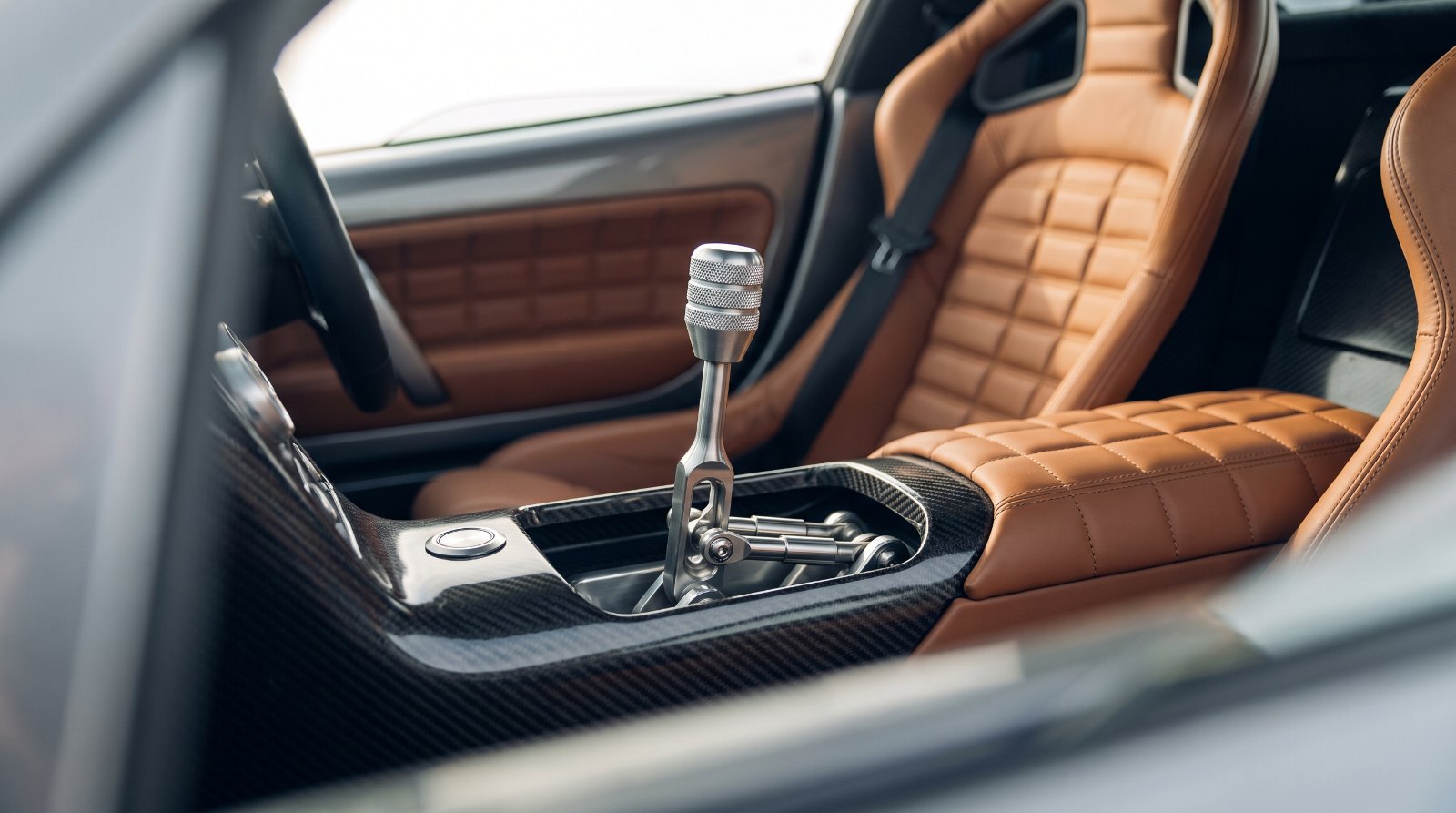
The single most important detail, though, is the gearshift. McLaren says the mechanism was engineered specifically for “maximum feel and throw” — which is a very deliberate way of saying the company treated the shifter as a performance component rather than a nostalgia prop.
Why Now? The Analog Supercar Is the Hottest Segment in the Business
The McL 6GT did not appear in a vacuum. It arrived at the precise moment when three separate industry trends converged — the same forces we traced in The Analog Comeback.
1. Manual take rates are embarrassing the people who killed the manual
The received wisdom of the 2010s was that the manual gearbox was a rounding error — slower, less efficient, and commercially irrelevant. The 2020s have comprehensively disproved that at the top of the market.
Pagani found that roughly 75% of Utopia customers chose the gated manual over the automatic — on a car starting around $2.5 million, limited to 99 units. Pagani’s own team has noted that customers had been asking for the manual to return since the Huayra era.
Porsche reports that around 80% of 911 GT3 Touring buyers specify three pedals. That number is why, in August 2026, Porsche put a manual back in the 911 Carrera S. “We have customer demand for it,” Porsche Cars North America chief Timo Resch explained, calling it “a good business decision.”
Aston Martin has run the same play twice, with the manual V12 Valour and the 38-unit Valiant — both instantly spoken for. Even Hennessey’s $2.65 million Venom F5-M now ships with three pedals.
When 75–80% of the wealthiest, most cross-shopped buyers in the world pick the harder option, that is no longer nostalgia. That is a market segment.
2. The EV supercar thesis has quietly collapsed
In February 2026, Lamborghini scrapped its all-electric Lanzador, replacing it with a plug-in hybrid. CEO Stephan Winkelmann said the acceptance curve for EVs among Lamborghini’s buyers was flattening and “close to zero,” and warned that continued EV development risked becoming “an expensive hobby.” Lamborghini now intends to build combustion engines for as long as it is permitted to.
That reversal mirrors a broader retreat — Ford, GM, Volkswagen, Mercedes-Benz, Volvo and Honda have all scaled back electrification timelines. For the supercar world specifically, the conclusion has been blunt: at seven figures, buyers are paying for sensation, and silence does not sell.
McLaren, for its part, has hedged intelligently. Its W1 hypercar — 399 units at roughly $2.1 million, sold out before the public reveal — is a hybrid — we put it head to head with Maranello’s answer in McLaren W1 vs Ferrari F80, and it appears in our 2026 hypercar delivery tracker. The McL 6GT is not. The company is running both arguments at once, which is probably the correct read of a genuinely split market.
3. Analog cars have become the best-performing asset class in the garage
Then there is the money. In April 2026, a Gordon Murray Automotive T.50 — the manual, V12, fan-assisted spiritual successor to the McLaren F1 — sold at Broad Arrow Auctions for $8.035 million. It had fewer than 30 miles on it and an original sticker just over $3 million. Four months earlier, another T.50 had made $5.63 million.
Gordon Murray’s T.33, limited to 100 units, sold out before deliveries began — part of a wider run on the last naturally aspirated V12s. The McLaren F1 itself has spent two decades setting records. The pattern collectors have extracted from this is simple and, so far, reliable: the last mechanical cars appreciate hardest.
A manual, naturally-steered, non-hybrid McLaren built in deliberately small numbers is, in that light, less a design exercise than a financial instrument with a clutch pedal. McLaren was not alone in reaching that conclusion: the Gordon Murray S1 and the Hennessey Blackbird landed the same afternoon.
What the McL 6GT Means for McLaren’s Business
Context matters here. McLaren Automotive was acquired by Abu Dhabi’s CYVN Holdings in 2025 and merged with the British start-up Forseven, with reporting pointing to an investment plan in the region of $2 billion. Nick Collins runs the combined business, and the group has openly signalled expansion into “new product categories.”
McLaren’s official framing is that the McL 6GT establishes the foundation for “a newly positioned and highly exclusive type of McLaren supercar beyond the core and expanded portfolio.” Read that carefully. This is not a replacement for the Artura or the 750S, and it isn’t the Ultimate Series either. It is a separate strand — a standing, low-volume, mechanically-focused line running alongside everything else McLaren builds.
Strategically, it is a smart use of new capital. Five hundred cars at roughly $1.5 million is on the order of three-quarters of a billion dollars of revenue from a single nameplate, at margins no volume model can approach. Low-volume halo cars are also the fastest way to rebuild brand desirability. Ferrari has monetised exactly this logic for decades — which is what makes Collins’s “pull model rather than push model” line the most telling thing he said all week. McLaren, after several difficult financial years, is now positioned to run the same playbook, and reporting on the turnaround has made no secret of Ferrari being the benchmark.
What We Still Don’t Know
Plenty. McLaren has not published power output, torque, kerb weight or dimensions, and has not officially confirmed whether the V8 is turbocharged or which unit it is based on — the 4.0-litre twin-turbo from the 750S and 765LT is the obvious candidate, and most outlets are assuming it, but McLaren hasn’t said so. The gear count is reported as six speeds rather than confirmed. Pricing and the ~500-car run come from Collins in interviews, not from an official release.
Nor has McLaren said whether the gearbox is bespoke or adapted, or which markets the production car will be homologated for — a genuinely non-trivial question for a manual, non-hybrid V8 facing 2028-era emissions and safety regulation.
What is confirmed is the direction: concept now, production car in 2028, and a new McLaren line that starts here. In the meantime, the McL 6GT joins a very short list — see every manual supercar you can actually still buy new in 2026.
Our Take
There is an easy cynical reading of the McL 6GT — that it is heritage cosplay, a badge-and-shifter exercise aimed at collectors who will never uncork it. And there will absolutely be cars that go straight into climate-controlled storage.
But the more interesting reading is that McLaren has correctly identified where value has moved. When every supercar is fast enough to be unusable, and every gearbox shifts faster than a human can think, the remaining differentiator is how much of the driving the car leaves for you to do. Bruce McLaren understood that in 1969, when he built a Can-Am car with a licence plate and then actually drove it.
Fifty-seven years later, his company is making the same argument. It just costs a lot more now.
McLaren McL 6GT: Frequently Asked Questions
What is the McLaren McL 6GT?
The McLaren McL 6GT is a concept supercar revealed at Monterey Car Week on August 14, 2026. It features a mid-mounted V8, a manual gearbox with a clutch pedal, rear-wheel drive, hydraulic steering, and a full carbon-fibre monocoque. It previews a production car due in 2028 that will launch a new, ultra-exclusive McLaren model line.
Does the McLaren McL 6GT have a manual transmission?
Yes. The McL 6GT uses a manual gearbox with a clutch pedal — reported as a six-speed — making it the first manual McLaren road car since the McLaren F1 entered production in 1992, a gap of 34 years.
When will the McLaren McL 6GT go on sale?
McLaren has confirmed the production version will arrive in 2028. The car shown at Monterey Car Week in August 2026 is a concept previewing that model.
How much will the McLaren McL 6GT cost?
McLaren Automotive CEO Nick Collins said at the reveal that the production car will be priced “in the range of $1.5 million.” McLaren has not yet issued an official price list.
How many McLaren McL 6GTs will be built?
Roughly 500. Nick Collins said at the reveal: “We’re probably going to do about 500 of them, and that’s it.” That figure has not yet appeared in an official McLaren release.
What engine does the McLaren McL 6GT use?
A mid-mounted V8 driving the rear wheels. McLaren has confirmed only that it is a V8 — it has not officially stated whether the engine is turbocharged, nor released power, torque or performance figures. Most reporting expects a twin-turbocharged unit related to McLaren’s existing 4.0-litre V8.
What was the original McLaren M6GT?
The M6GT was Bruce McLaren’s 1969 road-car project — a closed-cockpit version of the M6 Can-Am racer powered by a 5.7-litre, Bartz-tuned Chevrolet V8 making around 400 bhp. McLaren and Trojan hoped to build about 250 cars a year, but the FIA raised the Group 4 homologation requirement from 25 road cars to 50, and only a handful of prototypes were completed. Bruce McLaren was killed testing at Goodwood on June 2, 1970. His personal car wore the registration OBH 500H and has covered just 2,094 miles.
Why is McLaren building a manual supercar in 2026?
Demand. Manual take rates at the top of the market are extraordinarily high — roughly 75% on the Pagani Utopia and about 80% on the Porsche 911 GT3 Touring. At the same time, EV supercar demand has softened, and manual, non-hybrid cars such as the Gordon Murray T.50 have appreciated dramatically on the secondary market.
Is the McL 6GT a hybrid or electric?
Neither. The McL 6GT is powered solely by an internal-combustion V8, with no hybrid system. McLaren’s hybrid flagship remains the W1.
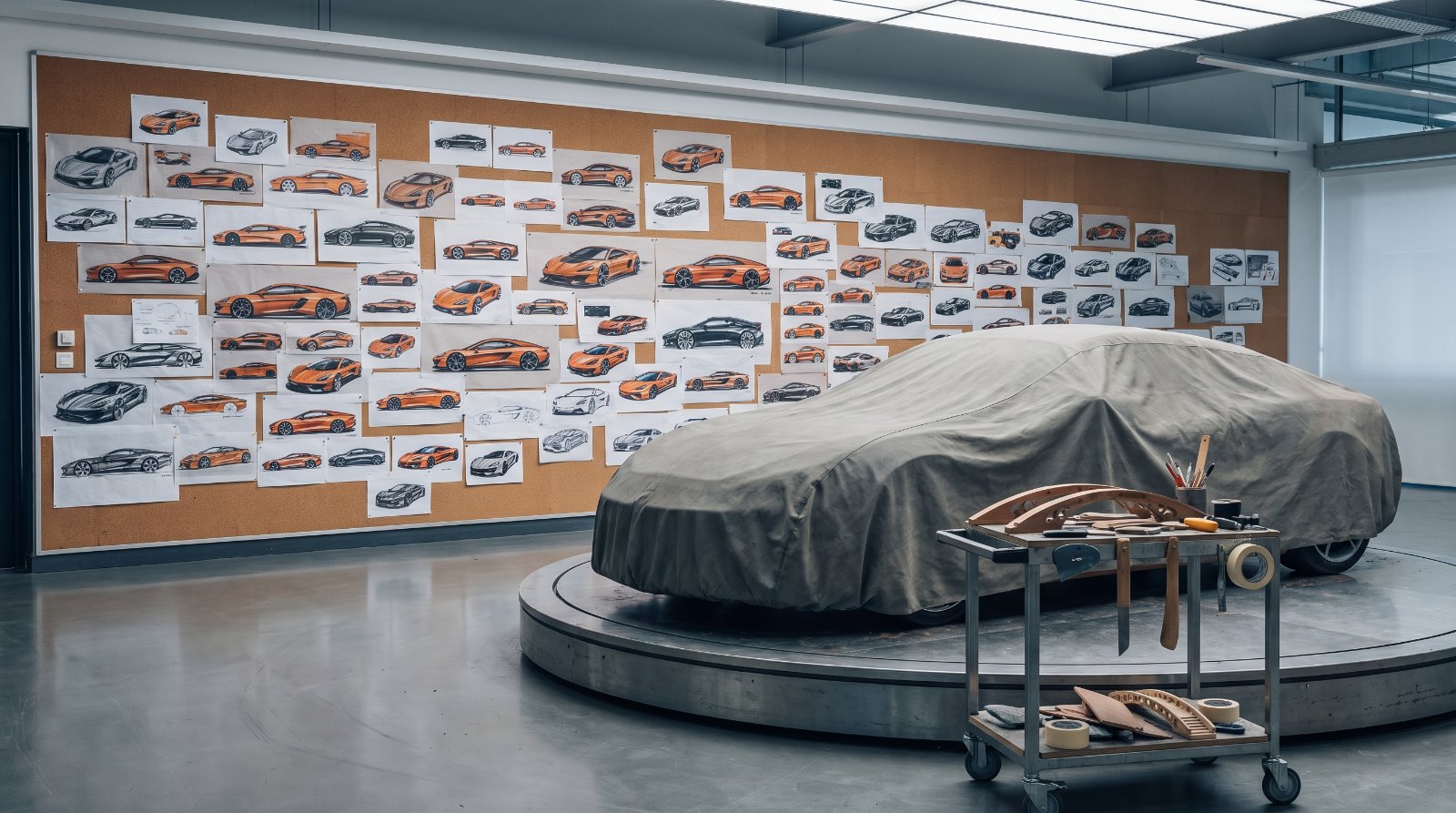
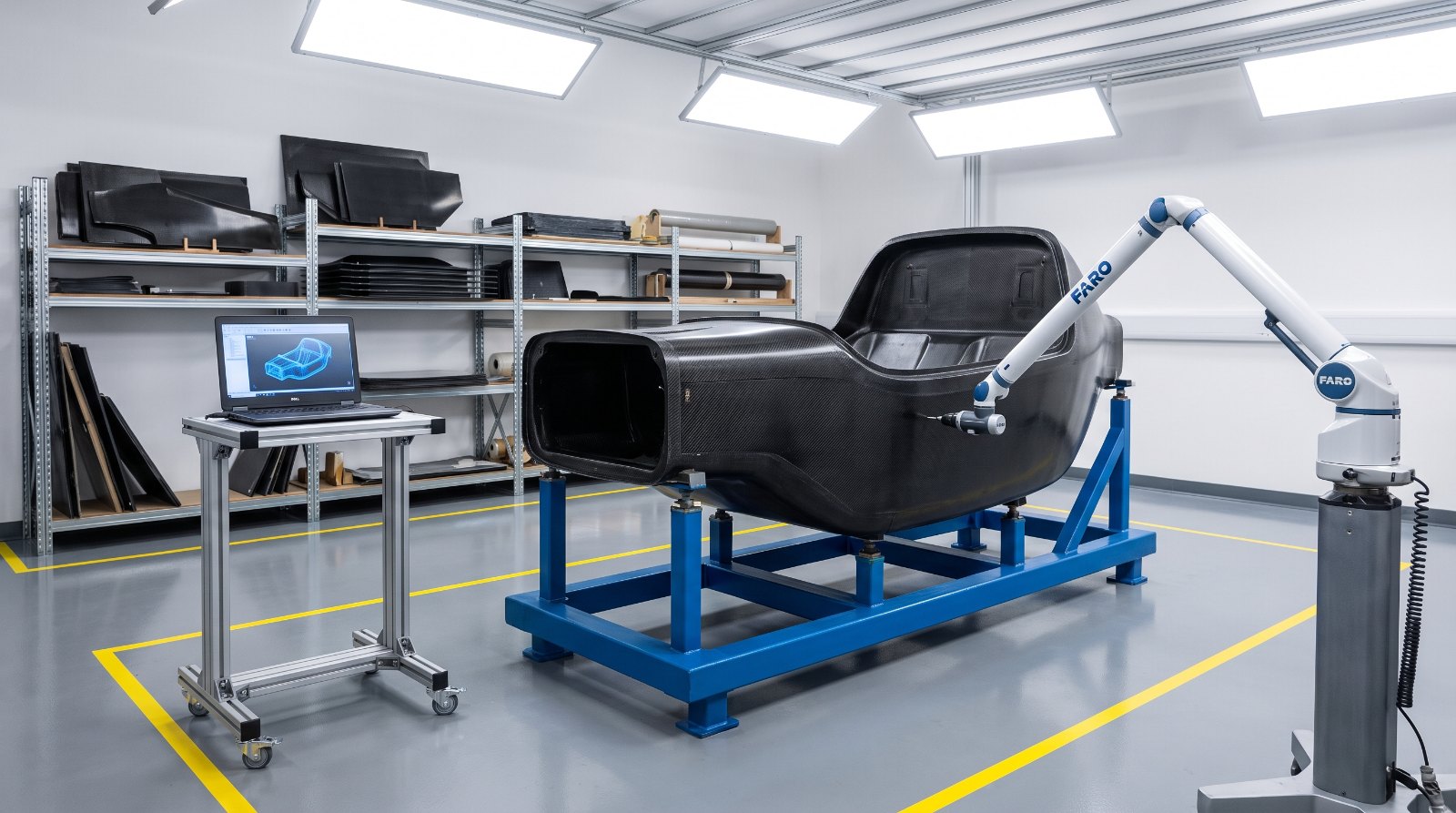
Editor’s note on imagery: Exotic Car News does not publish AI-generated depictions of real vehicles. The images in this article are illustrations of the themes discussed — a design studio, a period racing paddock, a manual gear lever, a carbon monocoque in development and an empty road. None is a photograph of the McLaren McL 6GT or of Bruce McLaren’s original M6GT, and none is intended to represent how either car looks. For official imagery, see McLaren Automotive’s press materials.