

A Moment Maranello Can’t Afford to Get Wrong
The Ferrari EV 2026 represents the most consequential shift in the brand’s modern history — a car built on sound, theater, and combustion now reimagined as a fully electric flagship. For a company that has spent sixty years defining the emotional ceiling of the automotive world, this is not just another model launch. It’s a redefinition of what Ferrari is allowed to become.
Every major manufacturer is launching something noteworthy this year. Lamborghini is expanding the Temerario range. Aston Martin is redefining Vanquish. Bentley is quietly reshaping its Mulliner strategy. But none of those carry the weight of the Ferrari EV 2026. This is the car that forces the exotic world to confront what electrification actually means at the top of the market — and whether the most storied name in performance can translate its DNA into a silent drivetrain.
Why the Ferrari EV 2026 Is Bigger Than a New Model
A new Ferrari is always an event. The Ferrari EV 2026 is something else entirely. It isn’t just another addition to the range — it’s a referendum on what Ferrari stands for in a post-combustion era.
For six decades, Ferrari has owned a specific emotional territory. The scream of a naturally aspirated V12. The snap of a flat-plane crank V8. The drama of a start-up sequence that feels more like an invocation than an ignition. Strip those away, and Ferrari has to prove that its identity lives in something deeper than exhaust notes — in design, engineering philosophy, driving feel, exclusivity, and the intangible sense of occasion that only Maranello has mastered.
If the brand succeeds, it rewrites what a luxury EV can aspire to be. If it stumbles, it hands rivals an opening they haven’t had in decades.
The Competitive Pressure Has Never Been Higher
Rimac has already proven that electric hypercars can redefine performance benchmarks. Lotus delivered the Evija. Pininfarina launched the Battista. Porsche is pushing harder into electrified flagships, and rumors continue to swirl around the Mission X program. Even Lamborghini — long resistant to pure EVs — has confirmed its first all-electric model is coming.
Ferrari isn’t entering an empty room. It’s entering a room where the standards have already been set by companies that don’t carry the same historical baggage. Rimac didn’t have to convince anyone its EV hypercar was authentic. Ferrari does.
That’s why the Ferrari EV 2026 debut is so critical. It arrives at a moment when the exotic EV segment has matured just enough to be judged seriously — and no longer gives early entrants the benefit of the doubt.
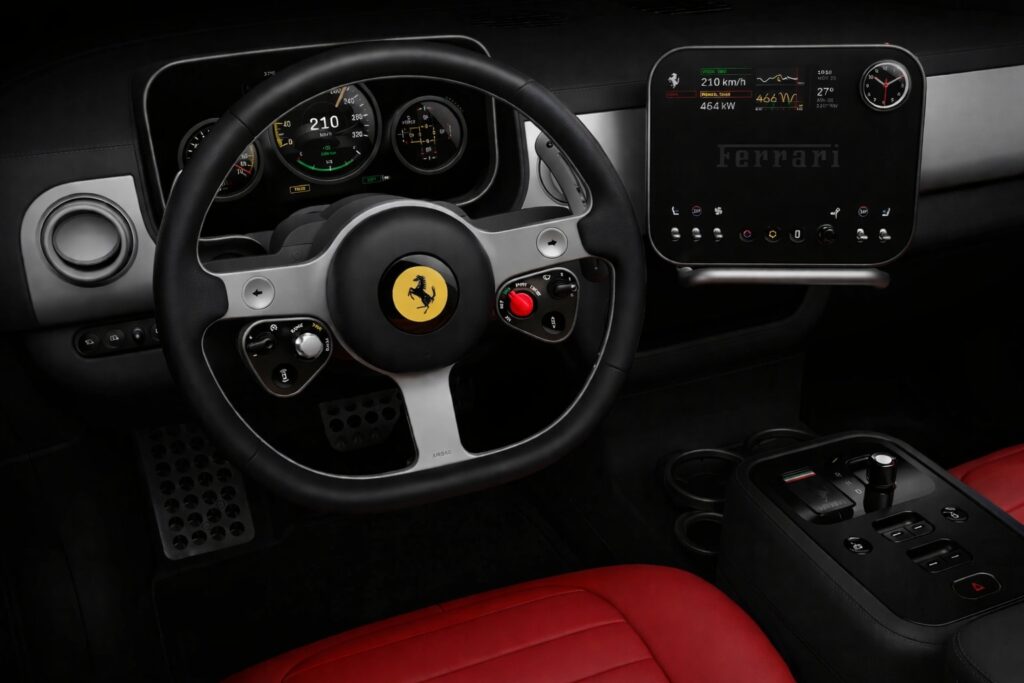
What Ferrari Has Confirmed So Far
Ferrari has been characteristically disciplined about details. The company has publicly committed to the Ferrari EV 2026 reveal, confirmed the car will be produced at a dedicated new facility in Maranello, and emphasized that the vehicle will reflect Ferrari engineering principles rather than mimic existing EV architectures.
Chairman John Elkann and CEO Benedetto Vigna have both framed the project around preserving driver engagement and emotional character — two words Ferrari rarely uses casually. Beyond that, specifications, pricing, body style, and naming remain closely guarded.
That restraint is strategic. Ferrari understands that the story around this car will shape its reception more than any single data point.
Why Collectors Are Paying Close Attention
In the collector market, first-of-its-kind Ferraris tend to occupy a unique position. The first mid-engine road car. The first turbocharged flagship. The first hybrid halo. Each became a reference point — and each developed a market identity that transcended its original sales performance.
The Ferrari EV 2026 slots directly into that lineage. Whether the market ultimately values it the way it values the 288 GTO or the LaFerrari will depend on execution, allocation strategy, and production numbers. But collectors are already tracking this car the way they track a limited-series hypercar, not a regular production model.
That alone tells you how significant the launch is perceived to be inside the enthusiast world.
The Real Question: Can an EV Feel Like a Ferrari?
This is the question every Ferrari EV 2026 conversation eventually returns to. And it’s the one Maranello has to answer not in marketing language, but in the driver’s seat.
Ferrari has hinted at proprietary solutions for sound, feedback, and driver connection — areas where most EVs still feel clinical. The brand’s racing heritage gives it credibility here that few rivals can match. But credibility only carries a launch so far. The car will ultimately be judged on whether it delivers the visceral, unmistakable sensation that makes a Ferrari a Ferrari.
If it does, the industry has a new benchmark. If it doesn’t, the myth takes its first real hit in a generation.
Why 2026 Marks a Turning Point for Exotic Electric Vehicles
The exotic segment has been cautious about full electrification, and for understandable reasons. Buyers at this level pay for emotion, not efficiency. Range anxiety matters less than presence. Weight — always the enemy of a great driver’s car — remains the most stubborn engineering challenge in any high-performance EV.
Ferrari entering the segment changes the conversation because it removes the last major holdout from the “EVs will never work at this level” argument. Once Maranello commits, the rest of the industry has to take the category seriously — and buyers who have been waiting for a definitive answer finally get one.
That’s why the Ferrari EV 2026 matters more than any other launch on this year’s calendar. It isn’t just another exotic debut. It’s the moment the exotic world decides what the next era looks like.
The Bottom Line
The Ferrari EV 2026 isn’t simply a new product. It’s a test of whether the most emotionally charged brand in the automotive world can carry its identity into an era it once seemed designed to resist. Every other major launch in 2026 will be measured, reviewed, and filed away. This one will be remembered.
Whether it’s remembered as a triumph or a turning point depends on what rolls out of Maranello later this year — and the exotic car world will be watching more closely than it has in a very long time.